
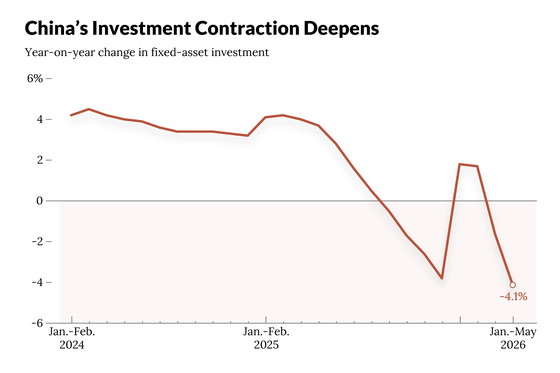
1. [para. 1] According to the National Bureau of Statistics, China’s fixed-asset investment contracted by 4.1% year-on-year in the first five months of the year, a worse-than-expected result driven primarily by a deepening crisis in the property sector and an unusual contraction in manufacturing spending. This decline signals persistent economic challenges, as the downturn intensified compared with earlier months.
2. [para. 2] The 4.1% decline widened from the 1.7% drop recorded in the first four months and fell short of the average forecast of a 1.7% decline in a Caixin survey of economists. Excluding real estate, investment still dropped by 1.2%, which was the lowest level since the data series began in 2024, underscoring that the weakness extends well beyond the troubled housing market.
3. [para. 3] The prolonged real estate slump remained the most substantial drag on overall investment, with property development spending plunging by 16.2% during the January-to-May period. This continued severe downturn in the housing market, marked by developer financial distress and weak demand, has been a major headwind for the Chinese economy.
4. [para. 4] Manufacturing investment also contracted, shrinking by 0.4% over the same period, marking its first decline this year. The downturn was attributed to weak capacity utilization across many sectors and ongoing government efforts to curb excessive competition and reduce overcapacity as part of industrial policy. However, the report noted that high-tech manufacturing remained a bright spot, continuing to attract investment despite the broader slowdown and reflecting policy priorities.
5. [para. 5] Infrastructure spending nearly stalled, edging up by only 0.6%. This very modest increase indicates that local governments are prioritizing the management of debt risks over engaging in large-scale economic stimulus, a cautious fiscal stance that contrasts with previous years when infrastructure was used more aggressively to counter economic slowdowns.
6. [para. 6] The investment weakness was broad-based across ownership categories. Private-sector fixed-asset investment fell sharply by 7.1%, signaling a lack of confidence among private enterprises, while state-owned enterprise spending also contracted, albeit at a milder rate of 0.4%. The data suggests a general lack of investment appetite affecting both the private and public sectors, with the private sector bearing the brunt of the downturn.
AI generated, for reference only













Leave a comment