
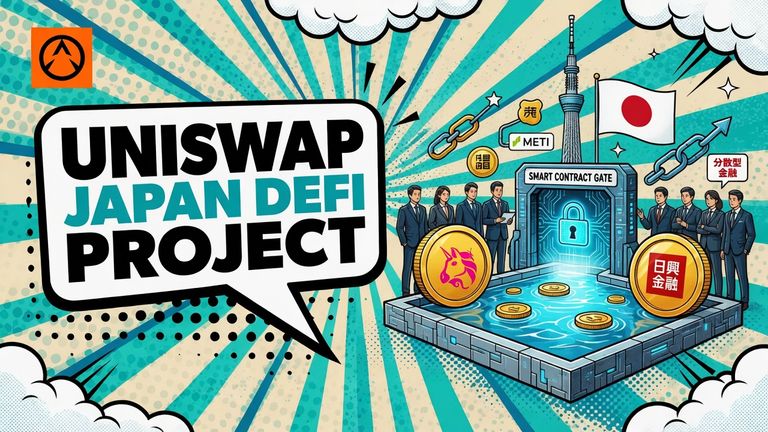
SMBC Nikko Securities and Nethermind are working with Uniswap Labs, Base and Nyx Foundation on institutional DeFi infrastructure for Japan, including a pool framework based on Uniswap v4 hooks.
For an asset holder, the practical effect would depend on what those hooks enforce. A hook can restrict who adds or removes liquidity. It could also apply anti-money-laundering and counter-terrorism-financing controls inside a pool. But the available material does not say whether ordinary trading would be restricted, which checks users must pass or who would be allowed to use the system.
What the Japan Project Would Build
The group has announced a memorandum of understanding for institutional-grade DeFi infrastructure in Japan. A standfirst published by The Defiant describes the target as a Japan-focused DeFi gateway, with completion sought by mid-2027. It does not clarify whether that date applies only to the gateway or also to the proposed pool framework.
WuBlockchain reported that the project plans to use Uniswap v4 hooks to build a compliant liquidity-pool framework. The plans include AML and counter-terrorism-financing mechanisms and investor-protection rules within pools.
The project will also explore AI-driven vaults, stablecoins and strategies for liquidity in real-world assets. Those components remain broad concepts in the available material. Their scope, and how they would connect to the proposed pools, has not been set out.
This is still development work, not a live DeFi product. No source reviewed identifies the chain on which the pools would run. Base is a named partner, but that does not confirm deployment on Base rather than Ethereum or another network.
Why a Uniswap Hook Matters
A Uniswap v4 hook is an external smart contract attached to an individual pool. One hook contract can serve multiple pools and intercept or change the execution flow at specified points.
Hooks can also affect who manages a pool. Uniswap’s documentation lists “gating who can add or remove liquidity” as a hook use case. That makes the mechanism relevant to allowlist-based pools, where approved users would manage liquidity while others could not.
That control is fixed when the pool is created. The hook cannot later be added, removed or replaced. Changing it would require creating a new pool.
The setup also has a technical constraint. A hook’s permissions are encoded in the low bits of its contract address, so it cannot be deployed to an arbitrary address. If its address lacks the permission flag for a particular function, the Uniswap PoolManager will not call that function. The relevant logic would silently do nothing.
Who Controls the Rules Is Unclear
The largest unresolved issue is governance. No source reviewed explains who can write the hook code or who may update, disable or override its controls after launch.
That matters because a hook contract sits inside the execution path of a pool. A gate that permits certain users or blocks certain actions is not an added label applied to the frontend. The contract determines whether the action can proceed.
The sources also do not name who will build the compliance hooks. SMBC Nikko, Nethermind and Uniswap Labs are involved, but their individual roles are not defined. Nyx Foundation is named as a signatory, with no further role explained.
The partners have previously worked together on secure DeFi access. In March 2026, SMBC Nikko and Nethermind announced research into a compliant gateway using “agentic AI,” or autonomous software agents operating within set risk limits. Their work included smart contracts and zero-knowledge proofs, and they later showed a conceptual demonstration at Yield Summit 2026.
SMBC Nikko said the work was intended to operate within Japan’s existing regulatory framework. But the current announcement leaves the enforceable rules for these pools unspecified.
A Fixed Pool Control, Not a Frontend Setting
Deploying a hook does not guarantee that Uniswap’s frontend will route users or liquidity to it. Uniswap’s documentation warns that creating a hook does not automatically attract liquidity.
The proposed system may give institutions a way to manage compliance inside pool operations. It could also make access and liquidity more selective, depending on the rules encoded in the hook.
Neither outcome is settled yet. The developers have not publicly defined the restrictions, governance rights, deployment chain or upgrade process. Without those details, the project is a plan for controlled Uniswap pools, not evidence that compliant pools are ready for holders to use.
The information discussed by Altcoin Buzz is not financial advice. This is for educational, entertainment, and informational purposes only. Any information or strategies are thoughts and opinions relevant to the accepted levels of risk tolerance of the writer/reviewers and their risk tolerance may be different than yours. We are not responsible for any losses that you may incur as a result of any investments directly or indirectly related to the information provided. Bitcoin and other cryptocurrencies are high-risk investments so please do your due diligence.
Copyright Altcoin Buzz Pte Ltd.













Leave a comment