
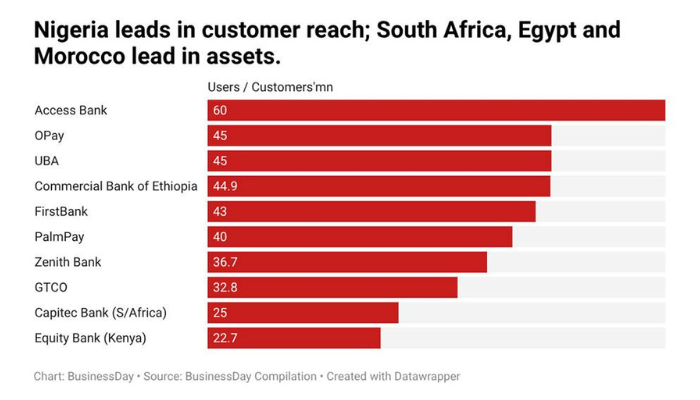
Nigeria has built Africa’s largest banking customer base, but it is yet to produce the continent’s biggest banks by assets, exposing a structural gap between financial inclusion and financial depth.
For years, Africa’s banking hierarchy appeared settled. South Africa dominated by balance-sheet size, Egypt benefited from enormous domestic liquidity, while Moroccan lenders expanded aggressively across Francophone Africa. Nigerian banks, despite their continental ambitions, remained influential regional players.
Access Bank reports about 60 million customers, the highest among lenders reviewed for this analysis. UBA and OPay each report about 45 million users, followed by FirstBank with 43 million, PalmPay with 40 million, Zenith Bank with 36.7 million and GTCO with 32.8 million.
Yet the balance-sheet ranking tells a different story.
According to the 2025 African Business Top 100 African Banks ranking, based on the latest available financial statements, the continent’s largest banking groups remain concentrated in South Africa, Egypt, Morocco and Algeria. Standard Bank Group, FirstRand, National Bank of Egypt, Absa and Nedbank dominate the top of the ranking by total assets, while no Nigerian bank features among the top 10.
Access Bank, despite serving the largest customer base, remains well behind the continent’s biggest lenders in terms of assets. UBA, Zenith Bank and FirstBank also rank outside Africa’s top tier by balance-sheet size. The contrast underscores a wider reality: Nigeria has excelled at distributing financial services, while other African markets have accumulated deeper pools of capital.
Customer race is different from the capital race
The distinction is significant because banking is fundamentally a balance-sheet business. Customers create distribution channels, deposits provide funding, capital absorbs losses, while assets determine how much banks can finance infrastructure, manufacturing, energy, trade and other productive sectors.
Standard Bank illustrates the difference. Although it serves roughly 20 million customers, it controls a balance sheet worth more than $200 billion. Access Bank, by comparison, serves around 60 million customers but operates with a much smaller asset base. The Nigerian lender has broader reach, but the South African bank possesses significantly greater financial capacity.
The disparity reflects the structure of the economies in which these institutions operate. South Africa benefits from one of Africa’s deepest institutional savings pools, supported by pension funds, insurance companies and sophisticated capital markets. Egypt enjoys a vast domestic economy and sizeable deposit base, while Moroccan banks have spent years diversifying earnings across several African markets.
Nigeria’s banks have pursued a different growth strategy. They have successfully expanded customer acquisition, digital payments and financial inclusion in Africa’s most populous country. However, the country’s financial system remains relatively shallow compared with its economic size and demographic potential.
The World Bank’s Nigeria Country Private Sector Diagnostic highlights this challenge. Domestic credit to the private sector stood at just 12.9 percent of GDP in 2024, compared with 20.1 percent across Sub-Saharan Africa and 34 percent for lower-middle-income countries globally. The report also noted that Nigerian banks struggle to provide long-term financing because their deposits are predominantly short-term.
Millions of accounts, limited long-term savings
The result is a paradox. Nigeria has succeeded in placing bank accounts and digital wallets in the hands of tens of millions of people without creating a comparable stock of long-term savings. Financial inclusion does not automatically translate into financial depth.
Customers primarily use their accounts to receive salaries, transfer funds or pay bills, contributing to transaction volumes, but not necessarily to the stable deposits required to finance factories, mortgages or large infrastructure projects. While millions of Nigerians are connected to the financial system, far fewer possess the financial assets needed to deepen the banking sector.
The rapid growth of fintech companies further illustrates this divide. PalmPay says it now serves about 40 million users, highlighting how digital platforms can quickly build mass-market financial franchises. Earlier industry reports placed the company’s user base at about 35 million, underscoring the pace of growth.
However, building users is not the same as building a strong balance sheet. Deposits must remain stable, capital must satisfy regulatory requirements, credit risk must be managed, and loan portfolios must withstand economic cycles, currency volatility, and liquidity pressures.
Consequently, customer rankings should be interpreted carefully. A reported “user” is not always equivalent to an active bank customer, depositor or borrower. In addition, the figures combine commercial banks with fintech platforms whose reporting standards and business models differ. Even so, the broader trend remains clear: Nigeria has become exceptionally successful at reaching customers. Its next challenge is converting that reach into lasting financial depth.
Exchange rate remains a major factor
Nigeria’s largest lenders already mobilise substantial deposits. Access Holdings reported customer deposits of N22.52 trillion in 2024, while Zenith Bank posted N21.96 trillion. Although these figures appear substantial in naira terms, exchange-rate movements have significantly altered continental comparisons.
Repeated depreciation of the naira has reduced the dollar value of Nigerian banks’ balance sheets, even as their assets and deposits continue to expand in local currency. Consequently, banks can grow significantly within Nigeria while appearing relatively smaller in international rankings.
Currency weakness, however, tells only part of the story.
The more fundamental challenge is Nigeria’s inability to convert its massive customer base into an equally deep pool of long-term capital. While banks have established millions of customer relationships, many remain transactional rather than wealth-building.
Ayodele Akinwunmi, chief economist at United Capital Plc, said customer numbers and asset size measure fundamentally different aspects of banking performance.
“Nigeria has the largest population in Africa, with over 240 million people, giving its banks access to a vast retail market. As a result, Nigerian banks have millions of customers across Nigeria and other African countries. However, having many customers does not necessarily translate into having the largest balance sheets,” he said.
According to him, relatively low deposits per customer remain a major constraint because average income and household wealth in Nigeria are significantly lower than in countries such as South Africa, limiting overall deposit growth.
He also identified exchange-rate depreciation as a major factor, noting that although bank assets are reported in local currency, the weakening naira substantially reduces their size when converted to U.S. dollars for international comparisons.
Akinwunmi further attributed the gap to South Africa’s higher GDP per capita, stronger institutional savings culture and more developed financial markets, where corporations, pension funds and insurance firms maintain much larger pools of financial assets. He added that South African banks also benefit from serving large multinational companies, mining firms and institutional investors, resulting in substantially larger loan books and investment portfolios.
Looking ahead, Akinwunmi expressed optimism that Nigeria’s banking recapitalisation programme, expanding financial inclusion, rapid digital banking adoption and sustained economic growth could significantly increase deposits and balance-sheet size over time.
“If per-customer wealth rises alongside customer numbers, Nigerian banks are likely to climb the rankings not only by customer base but also by asset size,” he said.
“In short, Nigerian banks are ‘population giants,’ while many South African banks remain ‘balance-sheet giants.’ The former reflects the size of the market they serve, while the latter reflects the amount of wealth and financial assets managed within that market, Akinwunmi added.














Leave a comment