
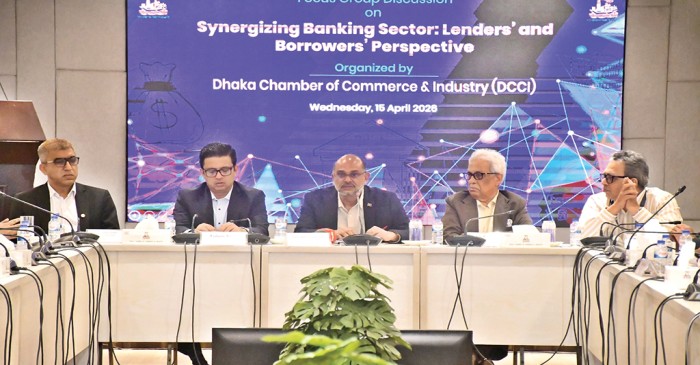

Domestic industries and private businesses in Bangladesh are struggling to access bank credit despite ample liquidity, as rising default risks and heavy government borrowing continue to squeeze lending to the productive sector, according to Dhaka Chamber of Commerce and Industry.
DCCI president Taskeen Ahmed on Wednesday said that the country’s industrial sector is passing through a difficult phase marked by declining production, rising non-performing loans and weakening credit flow to the private sector.
He made the remarks at a discussion titled ‘Synergizing Banking Sector: Lenders’ and Borrowers’ Perspective’ held at the chamber’s office in Dhaka on Wednesday.
Taskeen highlighted a clear imbalance in the banking system where liquidity indicators remain strong but lending activity has slowed sharply.
Private sector credit growth dropped to 6.03 per cent in March from 7.15 per cent a year earlier, while excess liquidity reached Tk 3.21 lakh crore within total liquid assets of Tk 6.26 lakh crore.
Speaking as chief guest, Rashed Al Mahmud Titumir, adviser to the prime minister, ministry of finance and planning, emphasised policy coordination rather than control over the central bank and said reforms to the Bank Company Act and financial laws are necessary to restore stability.
Acknowledging the current fragile state of the financial sector, the adviser assured that necessary policy formulations and structural reforms are being undertaken to ensure recovery.
He also underscored the need to develop a strong bond and capital market to reduce excessive reliance on banks for financing.
DCCI president Taskeen said that banks have become risk-averse due to a sharp rise in defaulted loans, particularly in the industrial sector as the non-performing loan ratio has climbed to 31.2 per cent.
Many genuine businesses and small entrepreneurs are suffering because of a handful of wilful defaulters, he said.
He also pointed to aggressive government borrowing, which rose by 673 per cent year-on-year to Tk 73,035 crore during July–January, pushing banks further towards risk-free lending and creating a crowding-out effect on private borrowers.
Taskeen stressed the need for structural reforms in the banking sector, improved governance and stronger coordination between lenders and borrowers.
He urged policymakers to prioritise financing for domestic industries alongside export-oriented sectors.
Bangladesh Association of Banks (BAB) chairman Abdul Hai Sarkar said simplifying SME financing remains essential and called for better coordination between policymakers and stakeholders.
Md Abdul Wahab, director (research) of Bangladesh Bank, put emphasis on alternative financing model apart from the traditional banking system.
He urged the private sector not to rely solely on banks for financing, but rather to increase dependency on alternative financing sources, such as the bond market and other related sectors.
M Shamsul Arefin, managing director of NCC Bank PLC, said that poor documentation and weak financial records among CMSME entrepreneurs often limit their access to bank loans, despite policy support.













Leave a comment