

A tidal wave of conversions has siphoned an unprecedented amount of capital out of mutual funds and into the ETF wrapper. Last year’s record 60 mutual-fund-to-ETF conversions in 2025 across 31 firms pushed total converted assets past $260 billion, and the past five years have now seen a grand total of 203 conversions. Of those, 29 have since been liquidated — leaving 174 ETFs that were once mutual funds, according to Morningstar Direct.
Dimensional kicked off the conversion train with the industry’s largest conversion wave in 2021, but the pipeline continues to widen. Hartford Funds recently secured board approval for multiple flagship fund conversions slated for late 2026. Among legacy giants, JPMorgan and Fidelity Investments have been the most aggressive. JPMorgan used conversions early on to rapidly scale its active ETF lineup, transforming multi-billion-dollar pools of core research and fixed-income capital into liquid wrappers. Fidelity broke new ground by orchestrating one of the industry’s first major passive index-to-ETF migrations, successfully reorganizing its Systematic U.S. Municipal Bond Index Fund into an ETF format (FMUN ) in early 2025.
The closing months of 2025 saw highly specialized, active equity managers join the migration:
- Goldman Sachs completed a coordinated conversion of four active mutual funds representing approximately $1.5 billion in assets under supervision. The transition effectively expanded its active equity ETF footprint while simultaneously compressing investor expense ratios.
- At the same time, Baron Capital marked its entry into the wrapper conversion space by transitioning two of its specialized growth vehicles — the Baron Technology and Baron FinTech mutual funds — into standalone active ETFs (BCTK) and (BCFN).
A Decade-Long Flow Divide
ETFs have steadily eroded mutual fund dominance — capturing market share via lower fees, tax efficiency, intraday liquidity and constant product innovation. By the end of 2025, ETFs commanded 36% of combined long-term fund assets — representing a 7% spike in three years — as total U.S. ETF assets surged 31% in 2025 alone to exceed $13 trillion.
Content continues below advertisement
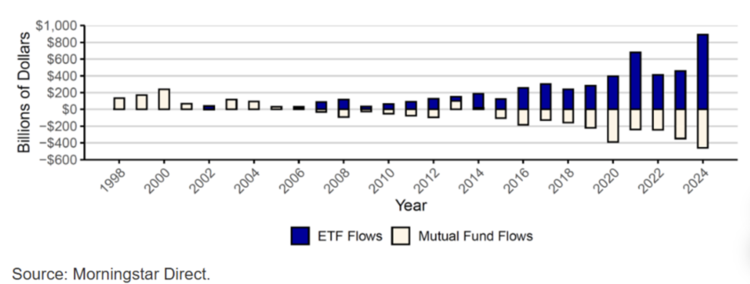
Meanwhile, long-term mutual funds saw assets grow just 5% over the same period, almost entirely from market appreciation. Strip out market returns, and mutual funds suffered net outflows in 2025, with active mutual funds alone bleeding over $600 billion.
Fixed income has emerged as a primary battleground here. During last year’s “Liberation Day” tariff-driven selloff, investors pulled roughly $60 billion from fixed income mutual funds in a single month, while bond ETFs absorbed about $10 billion in net inflows. Advisors increasingly prefer vehicles they can trade and reprice in real time rather than relying on end-of-day mutual fund NAV calculations.
The Dual Share Class Frontier
The next phase of the wrapper migration will rely on the regulatory unlocking of the dual share class structure. Vanguard held the exclusive rights to this framework — which allows an ETF share class to coexist alongside an existing mutual fund portfolio — until its patent expired in 2023. The regulatory bottleneck broke in December 2025, when the SEC opened the door to broader multi-class ETF exemptive relief.
Rather than fully converting legacy funds and risking operational disruption, firms are increasingly filing to add ETF share classes to existing portfolios. This framework transitions legacy assets into an exchange-traded format without triggering taxable events for existing shareholders, offering managers immediate scale. Dimensional has already rolled out the first-ever actively managed share class ETF, with the next wave of these products expected to hit the market in the second half of 2026.
A Fragmented Future
Flows reveal the underlying momentum perhaps even more clearly than AUM. The first quarter of 2026 set a record with more than $500 billion flowing into ETFs — a 17% increase over the prior year’s record first quarter — while mutual fund flows remained negative. From 2022 to early 2026, ETFs attracted approximately $5.5 trillion in cumulative net inflows, while long-term mutual funds posted a $1.3 trillion deficit — a combined swing approaching $7 trillion.
Despite the trend, mutual funds are far from obsolete. A durable segment of demand will remain among large institutional investors with bespoke requirements that ETFs cannot efficiently accommodate. Tax-exempt investors such as pension plans, endowments, foundations, and sovereign wealth funds derive little benefit from ETF tax efficiency. Many still require customized mandates, liability matching, specialized credit exposures, tailored liquidity structures, and operational flexibility that mutual funds and separate accounts can better provide.
Still, the direction of travel is getting tougher to ignore. Mutual funds may survive as specialized institutional tools, but the ETF wrapper is rapidly cementing its role as the central backbone of modern asset management.
For more news, information, and analysis, visit the Fixed Income Content Hub.












Leave a comment