


Author
Ahmed Barakat
Author

Share


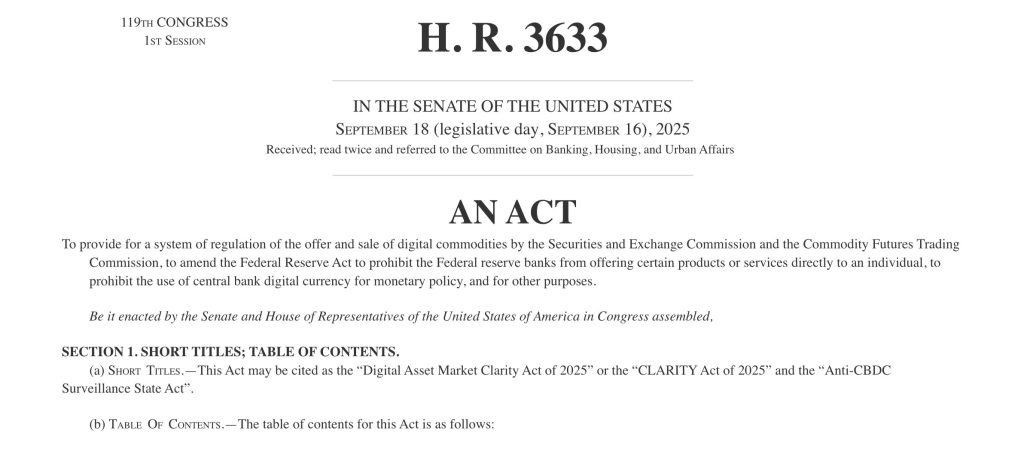
The CLARITY Act (Digital Asset Market Clarity Act) includes provisions addressing national security and foreign adversary risks in digital asset markets.
It advances a broader regulatory framework for cryptocurrencies, distinguishing between SEC oversight for certain investment contract assets and CFTC oversight for digital commodities via a certification/maturity pathway for sufficiently decentralized networks.
The bill preserves existing Bank Secrecy Act compliance, FinCEN authority, and Treasury tools, including sanctions authorities.
It also requires studies on foreign adversary activities related to digital asset intermediaries, such as potential data collection or intellectual property risks tied to jurisdictions like China, Russia, Iran, and North Korea.
Senator Elizabeth Warren has expressed concerns that the legislation could weaken global illicit finance standards.
“It’s already too easy for terrorists and criminals to launder huge sums of money and move it across borders”, claimed Warren.
If we water down global illicit finance standards, we’ll open the door to more cross-border sanctions evasion, money laundering, and terrorist financing, and give other countries cover to adopt similarly weak rules.”
Discover: The Best Crypto to Diversify Your Portfolio
Key Elements of the Clarity Act Bill
It establishes regulatory regimes for digital assets, including stablecoins. It includes a Certification of Decentralization (or maturity) pathway: issuers can seek a rebuttable presumption that a sufficiently decentralized asset qualifies as a digital commodity under CFTC oversight rather than SEC rules.
The decentralization pathway does not override existing national security, sanctions, or illicit finance requirements. U.S.-regulated entities must continue complying with sanctions screening and related obligations.
Market and Compliance Context
U.S. compliance teams already screen for sanctions and high-risk jurisdictional exposures as standard practice.
USDC and other U.S.-domiciled, transparent stablecoins maintain a structural compliance advantage due to their issuer frameworks and reserve transparency.
Institutional caution around assets with significant ties to higher-risk jurisdictions exists independently of this bill, driven by existing OFAC sanctions and AML rules.
Any potential liquidity or pricing effects remain subject to broader market dynamics, venue differences, and ongoing enforcement of current laws.
Claims of specific pre-passage pricing divergence tied directly to new “foreign adversary infrastructure” prohibitions in this bill are forward-looking and not yet broadly documented as measurable shifts.
The bill advanced out of the Senate Banking Committee on a 15-9 vote and is heading toward a Senate floor vote.
Discover: The Best Token Presales











Leave a comment