

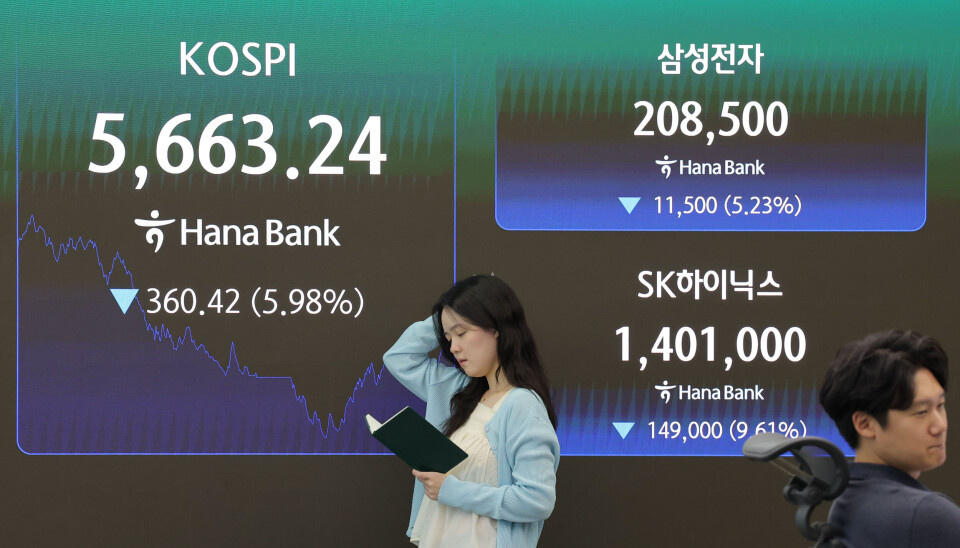
Foreign selling, shrinking retail cash and weaker institutional buying are deepening the Kospi’s slump as market turnover falls to its lowest level this year.
The Kospi has struggled to recover from its sharp July decline as a “triple liquidity squeeze” — sustained foreign selling, dwindling retail investor funds and weakening institutional buying power — weighs on the market.
The Kospi’s average daily trading value stood at 26.28 trillion won ($18.6 billion) so far this month, the lowest level this year, the Korea Exchange said Sunday. That is roughly half the 50.22 trillion won recorded in May and 50.35 trillion won in June.
The figure is also just 71.26 percent of the 36.88 trillion won recorded in July, when the Kospi suffered a sharp decline. The trading value came at 21.6 trillion won on Tuesday.
Earlier this year, the Kospi’s average daily trading value hovered around 30 trillion won, standing at 27.06 trillion won in January; 32.23 trillion won in February; 30.14 trillion won in March and 29.55 trillion won in April.
Trading volume has also plunged. The Kospi’s average daily trading volume this month stood at 301.67 million shares, also the lowest level of the year.
The simultaneous decline in trading value and volume is seen as a sign that retail investors have refrained from bargain hunting as the Kospi continues to struggle following its July plunge. The index has fallen another 5.1 percent this month.
Cash waiting on the sidelines is also rapidly declining as sentiment among individual investors cools.
Investor deposits stood at 100.71 trillion won as of Aug. 10, down by 4.86 trillion won from a month earlier, according to the Korea Financial Investment Association (Kofia).
Investor deposits refer to funds that investors keep in their brokerage accounts and tend to increase when expectations for a stock market rally grow.
Institutional investors’ buying capacity is also weakening.
The principal amount of domestic equity funds fell 14.8 percent, or 56.23 trillion won, in a month, from 378.85 trillion won at the end of June to 322.62 trillion won at the end of July, according to Kofia.
The decline indicates that the amount of principal invested in the funds has decreased, potentially constraining asset management firms’ capacity to purchase stocks.
Adding to the pressure is an increasingly challenging global liquidity environment.
Global liquidity growth slowed to 5.8 percent year-on-year in June, below its historical average of 6.5 percent. Growing concerns over global monetary tightening in the wake of the war in the Middle East could further restrict the amount of overseas capital available to flow into the Korean stock market.
Foreign investors, meanwhile, have shown little sign of easing their selling spree. They have sold a net 5.94 trillion won worth of Kospi-listed shares so far this month.
That follows net sales of 44.71 trillion won in May, 48.62 trillion won in June and 9.89 trillion won in July, marking a fourth consecutive month of net selling in the Korean stock market.
“Any interest rate hikes by major economies going forward will inevitably hurt global liquidity,” Kim Sung-no, a researcher at BNK Securities, said.
“With the buying capacity of domestic institutional investors also expected to remain limited, liquidity in the Korean market is likely to alternate between stagnation and contraction for the time being.”
BY JANG SEO-YUN [kim.jiye@joongang.co.kr]












Leave a comment