

The cryptocurrency industry has undergone a structural shift since the approval of spot Bitcoin exchange-traded funds in the United States in January 2024, with established traditional finance institutions, including Morgan Stanley and JPMorgan, moving from cautious observers to active participants, bringing compliance requirements, capital scale, and a demand for products built to their standards.
That shift has been accelerated by regulatory clarity arriving from multiple directions. The US GENIUS Act, signed into law in July 2025, established the first federal framework for stablecoins, while the Digital Asset Market Clarity Act drew a clearer line between Securities and Exchange Commission (SEC) and Commodity Futures Trading Commission (CFTC) jurisdiction over crypto assets.
The EU’s Markets in Crypto-Assets (MiCA) regulation sets enforceable standards across all 27 member states. Together, these frameworks reduced the legal ambiguity that kept institutional capital on the sidelines for years, producing two visible outcomes: a broader participant base and a fundamentally different product mix.
How Institutional Entry Reshapes Market Structure
Institutions brought to crypto a different relationship with risk, a different time horizon, and a higher burden of proof before deploying funds at scale, and that combination has altered the market in ways that go beyond price appreciation.
Safi Ghauri, a crypto lawyer at Esquare Legal and member of the European Commission’s Digital Assets Roundtable of Experts, frames the structural impact precisely.
“Institutional entry, apart from driving up token prices, is separating crypto’s volatility from its fragility,” she said. “Institutions have already done wonders for BTC and ETH by increasing the depth of order books, the quality of price discovery, and the resilience of markets during macro shocks.”
Institutional entry has measurably changed Bitcoin’s price behavior, with realized volatility declining to the point where Bitcoin is now less volatile than 33 of the 500 stocks in the S&P 500, a stabilization attributable to deeper liquidity and large investors who are structurally less prone to panic-selling.
Daniel H., CEO of Banana Gun, which has processed over $16 billion in on-chain trading volume, describes the execution-level effect.
“What we are seeing is a deepening of liquidity in major assets, with tighter spreads and more consistent order book depth, especially in BTC and ETH. At the same time, markets are becoming more interconnected with TradFi. Flows are now influenced not only by crypto catalysts, but by macro conditions, rates, and broader risk sentiment.”
The clearest sign of this macro tethering has been how Bitcoin and the broader market reacted during the US-Iran conflict earlier this year, which pushed Bitcoin down from a high of $97,000 as risk-off sentiment moved through both traditional and crypto markets at the same time.
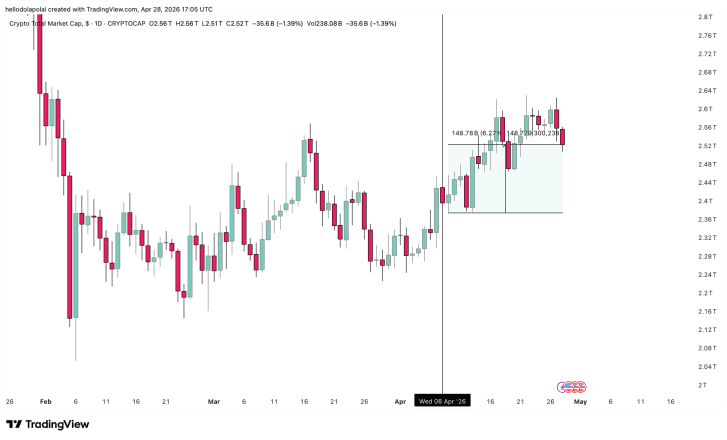
The recovery tells an equally important story; since the April 8 ceasefire, total crypto market capitalization has grown by approximately $148 billion, with capital returning in a pattern that tracks geopolitical resolution more than anything happening within the crypto ecosystem itself.
These gains are concentrated, with Ghauri noting that “institutional participation has also brought with it political participation and regulatory burdens on smaller projects,” and Daniel H. confirming that “liquidity is focused on a smaller set of assets and venues, primarily BTC, ETH, XRP, and other regulated tokens, creating a dynamic where the largest assets become more efficient and liquid while smaller assets remain more fragmented.”
The concentration effect is already visible within the US spot ETF market. According to SoSoValue, ETFs hold $102.54 billion in assets under management, Ethereum ETFs are closing in on $13.79 billion, XRP has reached $1.1 billion, and Solana sits at $883 million, a distribution that reflects institutional preference clustering around the most regulated and liquid assets.
Prashant Kher, Digital Assets Strategy and Transactions Leader at EY-Parthenon, draws on the firm’s annual Institutional Investor Digital Assets Survey to put this in structural terms.
“Institutional flows improve execution quality, governance, and operational discipline within preferred venues, but liquidity is increasingly concentrated into a narrower set of compliant products, assets, and third parties.”
Adding that the strong preference for regulated vehicles, with 81% of institutions preferring spot exposure through registered products, “points to liquidity centralization through ETPs and funds.”
Investor Takeaway
The entry of TradFi giants like Morgan Stanley and JPMorgan is transforming crypto into a more mature, macro-driven market with tighter spreads and deeper liquidity.
Regulation and the Expanding Product Mix
The institutions entering the market in 2026 are doing so through a more structured doorway than their predecessors, but what built that doorway, tighter regulation or better products, shapes how wide it can open and how many new instrument categories can pass through it.
Among institutions planning to increase allocations in 2026, Kher’s survey data shows 65% cite greater regulatory clarity and confidence in compliance frameworks as a key catalyst, with Kher framing regulation as “both the gate to participation and the accelerator of scale.”
Ghauri, speaking from her experience advising financial institutions and governments, offers a more skeptical reading.
“In all honesty, it is actually the products. Even today, the biggest exchanges, stablecoins, and staking platforms are functioning without proper licenses. Regulators are getting it wrong, as in the case of MiCA, which actually drove away projects and investments from the EU. Institutions like BlackRock and Fidelity did not enter the market because ETFs were launched. They had entered before that, when issues of scalability, security, and decentralization were sufficiently addressed.”
Daniel H. positions the two as sequential rather than competing forces, saying:
“Regulatory clarity is still the primary unlock. Without clear frameworks, large allocators simply will not participate at scale. But once that clarity starts to emerge, the next major factor is product maturity. Spot ETFs, improved custody solutions, and yield-generating instruments make it operationally feasible for institutions to deploy capital in ways that match their interests.”
What the current regulatory moment has most clearly delivered is the removal of ambiguity at the definitional level, with the GENIUS Act’s exclusion of compliant payment stablecoins from securities and commodity definitions giving regulated institutions a clear pathway to issue and hold stablecoins within a defined compliance perimeter.
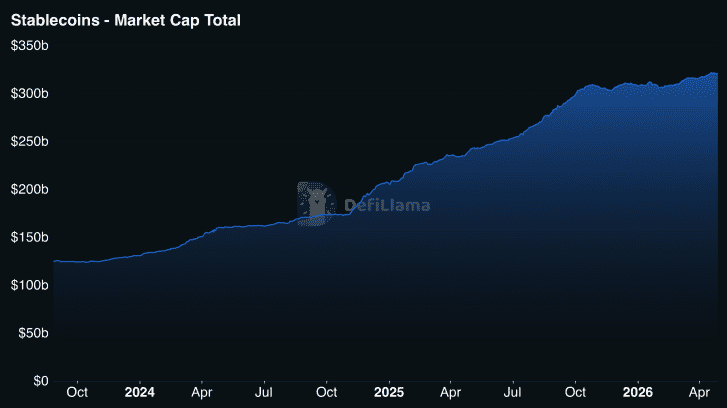
This has possibly played a key role in stablecoin market capitalization continuing to grow even as the broader crypto market drops, with total stablecoin market cap reaching an all-time high of $321billion on April 19, 2026, reflecting sustained demand for on-chain settlement infrastructure.
For pension funds and endowments operating under fiduciary mandates, that regulatory shift carries a different weight. The Biden-era had made crypto allocations a governance liability, guiding fiduciaries toward extreme caution and running an investigative program targeting plans that offered such investments. The current US legislative wave has changed that calculus, making the board justification considerably easier to make.
Ghauri’s point about MiCA’s mixed results remains a useful check on regulatory optimism, because poorly calibrated frameworks can shrink product diversity, and the design of regulation matters as much as its existence.
What distinguishes the current US framework is the specificity of its jurisdictional clarity, which creates the permission structure within which new product categories, including tokenized equities, on-chain derivatives, and regulated yield instruments, can be structured and distributed at an institutional scale.
The Product Mix Has Changed
Not until recently, the crypto market was built for crypto-native users through centralized exchanges for spot trading and DeFi protocols like Aave handling lending and borrowing, with no meaningful bridge to the compliance and custody standards that govern traditional capital. Three product categories now define the new mix.
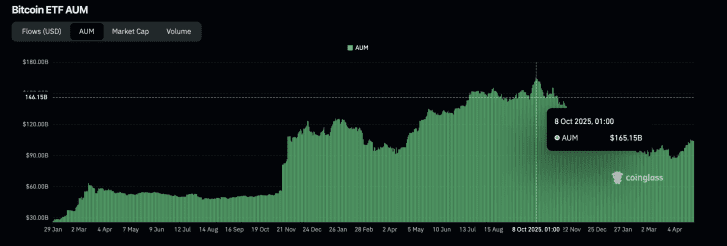
Exchange-traded products have become the dominant institutional on-ramp, with spot U.S. Bitcoin ETFs holding over $165 billion in AUM by late 2025 and BlackRock’s iShares Bitcoin Trust capturing more than $50 billion in under a year, the fastest ETF accumulation in history.
Kher’s survey shows 66% of institutions now access crypto through ETFs or ETPs, with these products restructuring price discovery by tying Bitcoin’s liquidity more directly to institutional trading behavior and traditional market hours.
Tokenized real-world assets have also moved from pilot to functioning market, with tokenized RWAs surpassing $3 billion in on-chain value by April 17, growing 41.75% year-to-date and 246% in the past year according to RWA.xyz data, with asset-backed credit at over $21.8 billion and tokenized US Treasury debt exceeding $15.3 billion.
Major institutions, including BlackRock, Franklin Templeton, Apollo Global Management, and Siemens, have moved into structured deployment, with 63% of institutional investors expressing interest in allocating to tokenized assets and 61% expecting tokenization to significantly impact trading, clearing, and settlement within three to five years, according to Kher’s survey.
Daniel H. identifies the core appeal in direct terms
“They offer familiar yield profiles in an on-chain format.”
Regulated stablecoins have become the connective tissue of the ecosystem, with stablecoin transaction volumes hitting $30 trillion in 2024 and December alone posting a record $5 trillion in transfers according to Coinbase and Glassnode data.
Kher’s survey shows 86% of institutions either use or are interested in using stablecoins, primarily for settlement and treasury management, while Ghauri identifies regulated stablecoins as one of three categories most likely to drive the next institutional wave.
“There is a race in every jurisdiction to make a stablecoin of the country’s currency, and its benefits clearly show why,” she said.
Investor Takeaway
Institutional expansion into crypto is being shaped by a sequencing effect, where regulatory clarity enables entry, but product sophistication determines scale and longevity.
Hybrid Product and Emerging Market
A fourth category is taking shape at the edges of the established three, one built on hybrid products that blur the line between both ecosystems in ways neither the ETF nor the tokenization narrative fully captures.
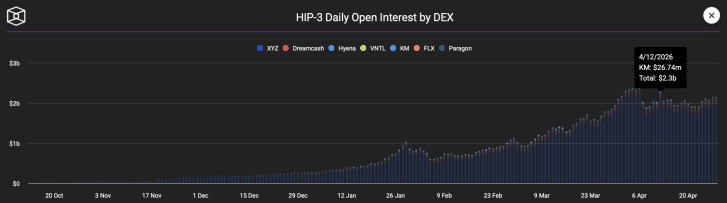
Hyperliquid’s HIP-3 is the clearest example of that spectrum, an on-chain perpetuals layer enabling around-the-clock access to traditional equity markets that generated $2.3 billion in open interest at its peak, with Grayscale’s 2026 outlook noting that the protocol consistently sees open interest and daily volumes rivaling the largest centralized derivatives venues.
Ghauri also flags prediction markets as an underappreciated candidate for the next institutional wave.
“Prediction markets are growing at over 100% year on year. It is not just about making money on opinions, but about gathering wisdom from the crowd, which has proven more accurate so far than even experts,” she said.
Prediction markets remain the earliest-stage category in this conversation, with on-chain prediction market TVL still sitting at $526 million according to DeFiLlama, a figure that looks modest against the scale of RWA or stablecoin markets.
The growth trajectory is harder to ignore, given that as recently as April 11, TVL across prediction market protocols stood at just $22.35 million, meaning the category has expanded more than 23 times in a matter of weeks.
Institutional attention is already forming around it, with Coinbase fighting in federal court to establish prediction markets under federal commodities law, while Citadel Securities president Jim Esposito has described the segment as one the firm is actively monitoring and where involvement is “certainly possible.”
What Happens to DeFi
Only 21% of institutions currently engage with DeFi use cases according to Kher’s survey, with security, regulatory uncertainty, and compliance risk cited as primary barriers by 85%, 84%, and 81% of respondents respectively, yet 43% plan to consider DeFi engagement over the next two years, a gap between stated intent and current behavior that reveals where the next phase of product development is headed.
The protocols most likely to close that gap are those bringing compliance to DeFi’s rails.
Aave’s Horizon product is the most visible example, a permissioned lending market built on the V4 architecture that ended 2025 with over $570 million in deposits and stands as the largest RWA-backed lending market in DeFi, sitting within a broader protocol that peaked at $75 billion in total deposits during 2025 and held 61.5% of active loan market share across the DeFi lending sector by year’s end.
Ghauri anticipates this trajectory continuing, noting that:
“Institutions love their reputation and prize their relationships with regulators, so they will not use anonymous, permissionless DeFi protocols. Instead, we will see branded protocols that use DeFi rails and bring CeFi branding with legal coverage.”
Daniel H. sees the same direction. “DeFi may become less permissionless, but in exchange you get more stability, better infrastructure, and deeper liquidity.”
Research from Sygnum Bank offers a counterpoint worth noting, finding that permissioned architecture alone has not yet resolved the legal enforceability questions that matter most to pensions, endowments, and sovereign wealth funds, where the infrastructure exists but legal certainty for the most conservative allocators does not yet fully follow.
Investor Takeaway
Hybrid crypto products are emerging as the next institutional frontier, blending traditional market access with DeFi infrastructure as compliance-focused innovation draws capital on-chain.
Conclusion
Hundreds of billions of dollars have flowed into tokenized RWAs, Bitcoin ETFs, and stablecoins over the past year, and while retail participation has always been the bedrock of crypto’s growth, institutional entrance has brought capital at scale, compliance infrastructure, and a demand signal that has permanently altered what gets built in this market.
Retail traders opened the door to crypto, but institutional capital is rebuilding the house, and the version of the market that emerges from this cycle will look less like the speculative frontier of 2021 and more like a parallel financial system with its own infrastructure, its own settlement rails, and an expanding roster of participants with a fundamentally different risk appetite and a much longer time horizon.













Leave a comment