
Operating profits at 12 companies fell 12.2% Unbilled construction revenue rose 12.2% Excluding Doosan Engineering & Construction, 11 companies’ operating cash flow shifted from a 104.8 billion won inflow to a 161.7 billion won outflow
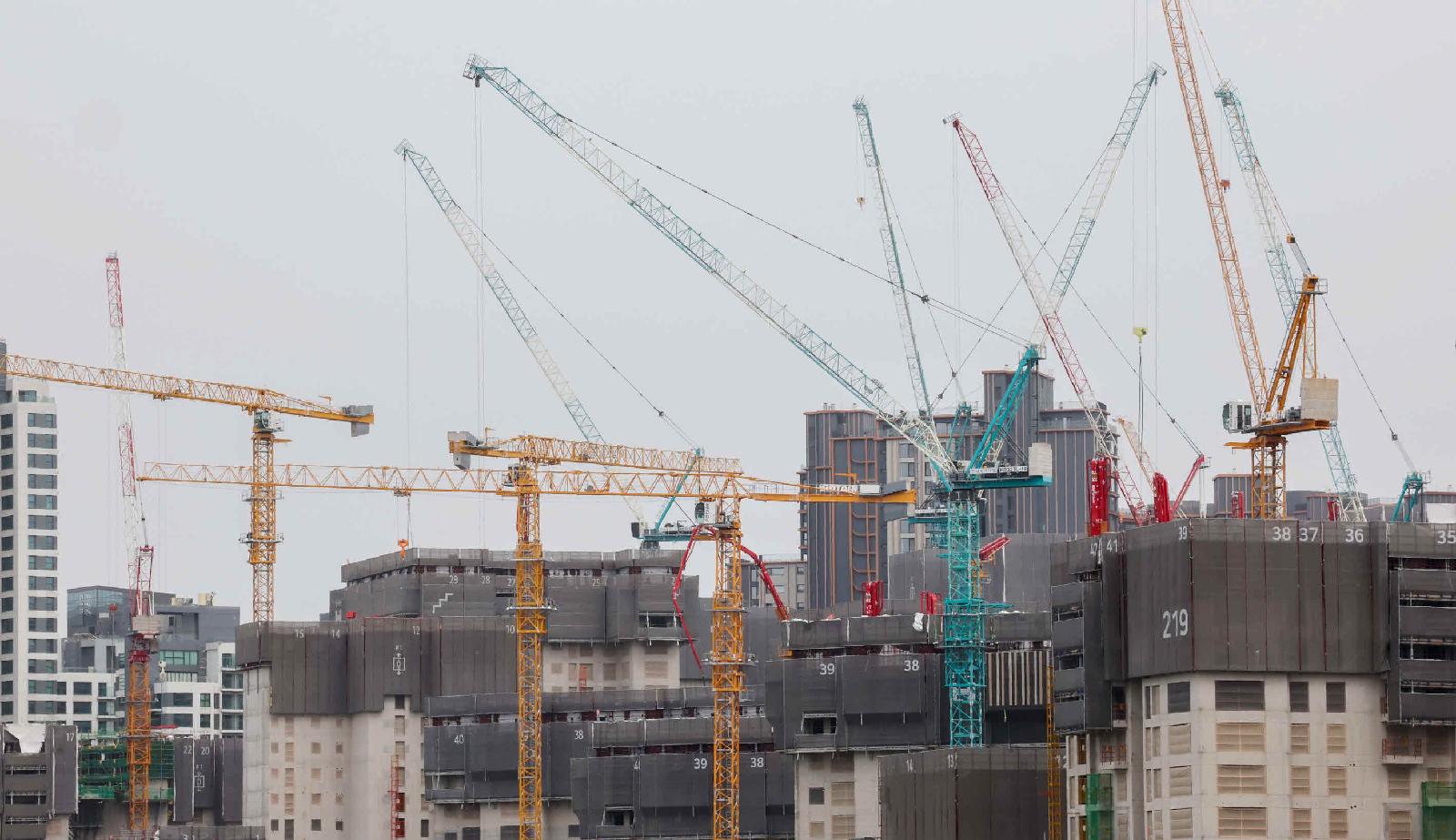
![A tower crane is installed at an apartment construction site in Seoul. [Photo by Han Ju-hyung]](https://wimg.mk.co.kr/news/cms/202609/09/news-p.v1.20260909.2f5dd86809c7403a85f866ac548c1944_P1.jpg)
Many mid-sized construction companies are struggling to secure cash despite reporting profits on their books.
Of the 12 companies surveyed in the first half of this year, 10 posted operating profits. However, seven of them recorded negative operating cash flow. Doosan Engineering & Construction significantly improved its cash flow, pushing the combined total into positive territory, while the other construction companies recorded notable cash outflows.
According to half-year reports disclosed on the Data Analysis, Retrieval and Transfer System (DART) on the 9th, the combined operating profit of 12 companies ranked between 30th and 100th in this year’s construction capability assessment, whose primary business is construction and whose financial indicators could be compared, totaled 232.8 billion won in the first half. This was down 12.2% from 265.2 billion won during the same period last year.
Combined operating cash flow turned positive, rising from negative 13.4 billion won in the first half of last year to 5 billion won this year. The main factor was Doosan Engineering & Construction’s sharp improvement, from negative 118.3 billion won last year to 166.7 billion won this year. Excluding Doosan Engineering & Construction, the other 11 companies shifted from a net inflow of 104.8 billion won last year to a net outflow of 161.7 billion won this year.
Cash holdings declined. The surveyed companies’ cash and cash equivalents fell 13.2%, from 1.2732 trillion won to 1.1057 trillion won. Cash and cash equivalents decreased at nine of the 12 companies.
By contrast, total short-term borrowings rose 4.4%, from 805.2 billion won to 840.3 billion won. They increased at eight of the 12 companies. Some construction companies experienced operating cash outflows, declining cash and cash equivalents, and increased short-term borrowing at the same time.
Unbilled construction revenue—amounts for work completed but not yet billed—also increased. Across the 12 companies, unbilled construction revenue rose 12.2%, from 701.3 billion won in the first half of last year to 787 billion won this year. By company, nine reported increases from the same period a year earlier.
Unbilled construction revenue refers to construction payments recognized as sales according to the progress of a project but not yet billed to the client. It does not itself indicate financial distress. However, if the time between billing and collecting payment grows longer, the point at which sales and profits recorded on the income statement are converted into actual cash is also delayed.
There were also cases in which cash outflows increased as accounts receivable and advances paid rose, or as accounts payable and advances received declined. Even when companies generate the same level of profit, their actual financial position can differ depending on when payments are collected and when subcontractors are paid.
Excluding Doosan Engineering & Construction, the combined operating cash flow of the other 11 companies shifted from a net inflow of 104.8 billion won in the first half of last year to a net outflow of 161.7 billion won this year. Their cash and cash equivalents also fell 22.0% over the same period, from 1.1276 trillion won to 879.4 billion won.
Credit rating agencies identified delays in collecting construction payments and the accumulation of borrowing burdens as the biggest risk factors, regardless of whether earnings improved. The combined net debt of major construction companies rated by credit agencies surged from 8.2 trillion won at the end of 2024, according to Korea Investors Service (KIS), to 11.6 trillion won at the end of March this year.
Analysts say the downturn in regional housing markets, combined with delays in the occupancy of non-residential projects, has disrupted the collection of construction payments and postponed debt repayments.
A KIS official said, “For mid-sized construction companies with a high proportion of regional projects, weak sales at a particular site or project financing (PF) liquidity risks can lower the creditworthiness of the entire company. In the second half of the year, it will be necessary to closely monitor each construction company’s supply volume, actual sales and occupancy results, and performance in collecting construction payments.”
This article has been translated by GripLabs Mingo AI.













Leave a comment