
Summary:
The competition logic of exchanges has changed.
Author: momo, ChainCatcher
In the past few years, an interesting phenomenon has been occurring. On one side, traditional financial institutions are beginning to embrace crypto assets, from Bitcoin ETFs to stablecoins, and then to tokenized securities, more and more financial institutions are entering the Crypto world.
On the other side, crypto exchanges are continuously extending into traditional financial markets. Products such as stocks, ETFs, prediction markets, and RWA are successively launched, and the once clearly defined two tracks are starting to come closer together.
Especially for crypto exchanges, the once crypto assets have turned into away games, while stocks have become the competitive home ground. Since last year, around the traditional financial business of “buying and selling stocks,” leading crypto exchanges represented by Binance and Gate have made multiple attempts.
But stock services have always been the domain of traditional brokers; why do crypto CEXs still have the opportunity to redo “buying and selling stocks”? As more platforms enter this track, what are the paths of differentiation?
1. Why can crypto CEXs redo “buying and selling stocks”?
In the past, the crypto industry attracted users from outside, often occurring during bull markets. The wealth effect brought by Bitcoin’s rise and altcoin seasons is the most important driving force for new users entering the market.
However, this bear market has seen two noteworthy new phenomena: first, the crypto industry is still attracting users from outside; second, after these new users enter Crypto, they often trade not the crypto assets themselves.
During the severe fluctuations in oil prices in March this year, @smartestxyz tracked a metric—”Non-Crypto-First Users,” meaning users whose first on-chain transaction was not cryptocurrency, but rather RWA Perp products like stock indices, gold, and oil, totaling nearly 50,000 people. In other words, many outside users are entering the crypto world not for Bitcoin, but for traditional financial assets.
Why does this phenomenon occur? One important reason is that there are indeed areas where traditional financial services do not reach.
Especially in regions with relatively weak financial infrastructure, such as Southeast Asia, Latin America, and Africa, these issues are often further amplified.
Another reason is the generational replacement of trading users. Many new generation young users have experienced trading crypto assets from the start, accustomed to the funding efficiency brought by 24/7 trading, stablecoin systems, and on-chain gameplay.
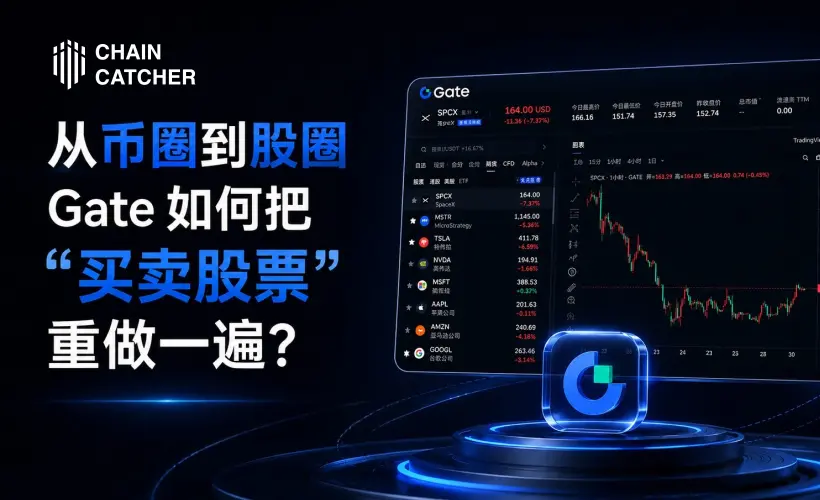
Specifically, we can compare the differences between traditional brokers and crypto CEXs in stock business. Currently, Gate, whether in business model or asset categories, is a platform with a relatively complete layout, so this article will use Gate as a reference for comparison.

First, let’s look at a question that users care about most: whether the underlying assets purchased are indeed stocks.
In the past, the stock business of crypto CEXs mainly focused on tokenized stocks, CFDs, and other products, where users gained more exposure to stock prices rather than owning the stocks themselves.
However, this situation has begun to change in the past year. Platforms represented by Gate and Binance have successively launched direct stock business models. For example, Gate connects with licensed broker Alpaca Securities to provide execution, clearing, and custody services for stocks, allowing users to hold stocks and enjoy dividends. Additionally, Gate’s functions for stock splits, consolidations, and stock transfers have also been launched.
This means that, from the perspective of asset supply, the gap between crypto CEXs and traditional brokers is rapidly narrowing.
Under this premise, the real differences between the two sides are increasingly reflected in user experience and account systems.
First is the access threshold and trading time. Compared to traditional brokers, which are limited by trading hours, account opening processes, and geographical restrictions, crypto CEXs rely on global accounts and stablecoin systems, making access thresholds more flexible; for example, in Gate’s direct stock business, some stocks have opened pre-market and after-hours trading, even 24×7 trading, and tokenized stocks provide longer trading hours, aligning more with crypto users’ trading habits. Meanwhile, Gate’s newly launched stock transfer function can also enhance the flexibility and convenience of managing stock assets for users.
It is worth mentioning that the stock transfer function launched by Gate directly addresses the pain points of users transferring assets across brokers and exchanges. As CEXs introduce stock business, many users still have their holdings with external brokers, and if they want to switch platforms, they often have to sell first and buy later, which is time-consuming and faces price fluctuation risks.
Gate’s transfer function supports the free transfer of US stocks and Hong Kong stocks between Gate and external brokers. Compared to the transfer fees generally required by brokers, Gate’s transfer in and out fees are completely waived, truly achieving flexible cross-platform allocation of stock assets.
Of course, this model also needs to comply with corresponding regulatory requirements and relies on licensed brokers to complete asset custody, and its market acceptance still needs further observation.
Next is the funding efficiency brought by a unified account system. Traditional brokers are closer to “one market corresponds to one set of accounts.” When users participate in different markets like US stocks and Hong Kong stocks, they usually need to open permissions separately, and fund transfers rely on bank accounts, currency exchange, and cross-border remittance systems.
In contrast, crypto CEXs are more like “one account managing global assets.” From the launch of US stocks on June 1, 2026, to the introduction of Hong Kong stocks on June 11, and then the launch of Korean stocks on June 22, Gate completed access to the three major core stock markets globally in less than a month, with these three popular stock markets sharing a unified stock account system, and funds settled uniformly through USDT. For users who already hold crypto assets, they can complete asset allocation between different markets within their existing accounts without going through currency exchange, cross-border remittance, and other processes.
More importantly, under a unified account system, stocks, stablecoins, and crypto assets can form the same funding pool and further connect lending, wealth management, derivatives, Polymarket prediction markets, and other trading scenarios, while covering mainstream derivatives such as spot, contracts, options, wealth management, and lending, as well as traditional trading methods like CFDs and direct stocks, achieving comprehensive coverage of assets and trading methods under one account system, making the flow and reuse efficiency of funds very high.
In addition, the product forms are also richer. Traditional brokers mainly provide real stocks and some securities derivatives, while crypto CEXs often offer various trading methods around the same underlying asset.
In addition to direct stocks, Gate has also laid out tokenized stocks, CFDs, and stock perpetual contracts. For users who are optimistic about the same company but have different risk preferences and trading cycles, they can choose different products based on their needs, rather than being limited to a single stock trading method.
2. How are the paths of crypto CEX’s stock business differentiated?
After understanding some of the differences between traditional brokers and crypto CEXs in stocks, let’s take a look at some internal path differentiations within crypto CEXs.
Currently, real stocks are no longer the capability of a few platforms. Both Binance and Gate have successively launched direct stock business and provided underlying securities execution and custody through licensed broker systems.

At the same time, each has retained tokenized stocks, perpetual contracts, and other crypto-native products, hoping to balance the investment attributes of real stocks with the 24/7, low-threshold trading experience of the crypto market.
In terms of fees, each has begun to align with the low-fee model of traditional internet brokers. For example, in the direct stock business, Gate has integrated a VIP tier system, with the lowest stock trading fee dropping to 0.023%, and no holding fees charged.
This means that the gap between crypto CEXs in terms of “whether there are stocks” and the ability to provide crypto experience advantages is narrowing. The real differentiation is no longer about whether there are stocks, but about which markets are covered, what products are offered, and whether these products can be integrated into the same trading system.
From the perspective of several leading platforms, their development paths are also different. Binance tends to rely on its large global user base to gradually fill in real stock capabilities while enriching trading scenarios with tokenized stocks; in contrast, Gate’s layout emphasizes “multi-market coverage + multiple product paths + account unification,” constructing a relatively complete global stock trading closed loop.
Currently, Gate has formed four product lines: real stocks, stock tokens, CFDs, and stock perpetual contracts, covering the three major securities markets of US stocks, Hong Kong stocks, and Korean stocks, and adding direct IPO (IPO Access) and Pre-IPO mechanisms, the former supports direct allocation for new stock subscriptions, while the latter anchors the valuation changes of unlisted companies in advance, forming a complete investment chain from Pre-IPO to the secondary market.
Specifically, in terms of US stocks, Gate supports over 10,000 US stocks and ETFs, covering mainstream trading markets in the US such as the NYSE and NASDAQ, allowing users to hold real stocks and simultaneously receive dividends and other basic shareholder rights.
In terms of Hong Kong stocks, Gate has become the first crypto trading platform in the industry to launch real Hong Kong stock spot trading, currently covering over 1,500 high liquidity stocks on the Hong Kong Stock Exchange’s main board and GEM, supporting fractional stock trading, and sharing the same stock account system with US stocks without needing to open an additional Hong Kong stock account.
Recently, with the Korean stock market gaining popularity, Gate has exclusively launched the Korean stock market, currently covering the top 1,000 listed companies by market capitalization on the Korea Exchange (KRX), including core targets like Samsung Electronics, SK Hynix, NAVER, and Hyundai Motor, also supporting fractional stock trading and included in unified stock account management.
Overall, Gate’s approach is not centered around a specific market or product but aims to integrate major global stock markets with different trading forms into the same account system.
3. From competing on products to competing on distribution, the logic of exchange competition has changed
Earlier, we discussed why crypto CEXs are starting to engage in stock business and how each is conducting this business.
Looking at the longer term, this competition is no longer just between CEXs but is a competition across the entire trading platform industry.
A clear trend is that traditional brokers and crypto exchanges are moving in the same direction. In the past year, Robinhood has successively launched crypto, prediction markets, and tokenized stocks in addition to stocks; Nasdaq and the NYSE are also promoting securities tokenization. On the other hand, crypto exchanges are continuously expanding into assets like stocks, ETFs, precious metals, and prediction markets.
Both sides are entering each other’s home ground, reflecting a change in the competitive logic of trading platforms. In the past, crypto exchanges competed on product supply; whoever launched popular assets first would more easily gain traffic. However, as the altcoin season recedes, the number of quality assets that platforms can continuously create is decreasing, and competition is shifting from “competing on products” to “competing on distribution.” Whoever can access global quality assets faster and reach users with lower thresholds and higher efficiency has a better chance of retaining users’ wallets.
Currently, the development directions of various platforms have begun to diverge. Some platforms focus more on US stock access, while others continue to strengthen the crypto-native experience, whereas Gate seems to have a clear vision, leaning towards effective distribution of global quality assets.
On one hand, it continuously expands the coverage of assets. It currently supports over 12,500 stock assets, covering the US, Hong Kong, and Korean markets, and has become the first crypto platform in the industry to launch real Hong Kong stock spot trading. On the other hand, it does not only provide one type of stock product but simultaneously lays out real stocks, stock tokens, CFDs, and stock perpetual contracts, allowing users with different risk preferences and trading scenarios to find corresponding trading methods.
In other words, compared to simply increasing a few stock access points, Gate is more focused on integrating as many quality assets and corresponding trading paths as possible into the same account system. If more real-world assets enter the chain in the future, this framework can continue to expand without needing to build a new product system from scratch.
Perhaps in a few years, people will no longer deliberately distinguish whether a platform is a “crypto exchange” or a “traditional broker.” What truly determines competitiveness will be who can continuously connect global quality assets and distribute these assets more efficiently to global users.













Leave a comment