
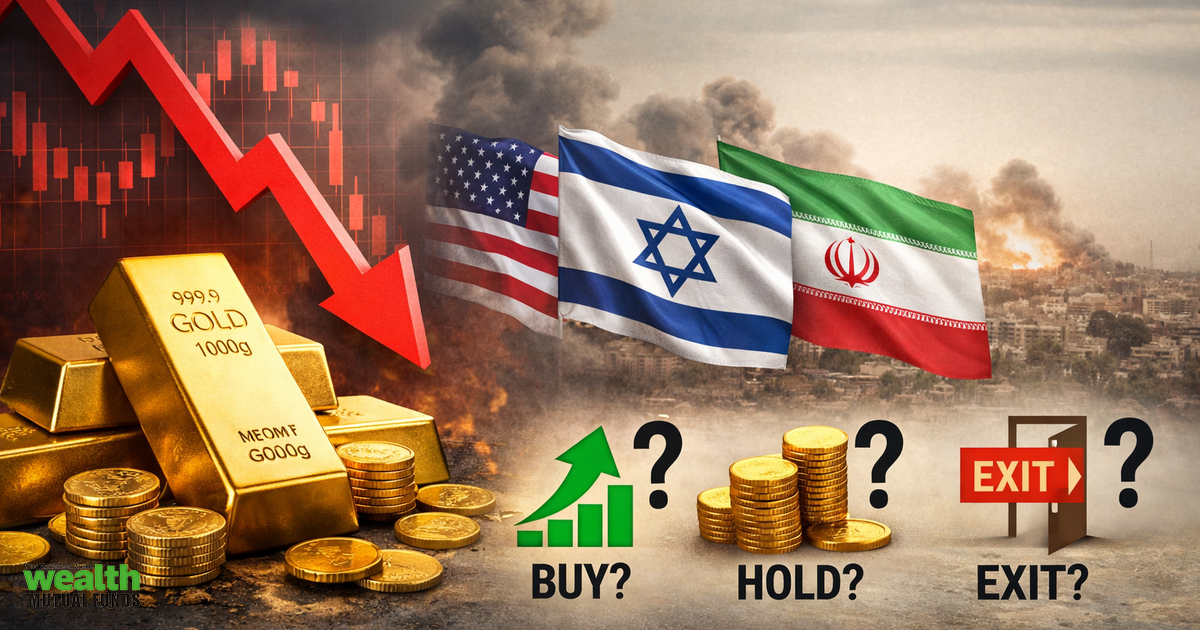
Experts suggest that investors should avoid making knee-jerk decisions based on short-term price movements, constantly changing geopolitical scenarios and should take the decision strictly as per their asset allocation. For those who entered at higher levels, exiting in panic may not be the best strategy. Instead, a staggered approach such as averaging could be considered, provided gold fits into their overall asset allocation.
Also Read | Retirement planning via mutual funds: How to achieve Rs 2 crore corpus
Pallav Agarwal, Certified Financial Planner, Bhava Services LLP shared with ETMutualFunds that investors should take all gold related investment decisions strictly as per their asset allocation, one need to understand that they are living in a volatile world where asset prices are moving sharply in either direction so to avoid losses, any kind of speculation in prices should be avoided and asset allocation needs to be followed with discipline.
Having a similar opinion that allocation should be in line with the long term goals and strategy rather than based on the market movements and constantly changing geopolitical scenario, Amitabh Lara, Executive Director, Anand Rathi Wealth Limited told ETMutualFunds that if one desire an allocation to gold, they can allocate up to 20% of their portfolio, as a substitute for the debt portion but not as a primary constituent as gold acts as a defence asset, while equity acts as a growth asset and hence will remain the primary long term wealth generator for investors.

Why gold ETFs decline and will ceasefire rally continue?
Since February 27, 2026 gold ETFs slipped over 6.14% with LIC MF Gold ETF declining the most of around 6.14% since the Mideast tensions started. This was followed by the UTI Gold ETF which declined 5.66% in the same period. The Wealth Company Gold ETF witnessed the lowest decline of 6.98% in the same period.
On Tuesday, U.S. President Donald Trump agreed to a two-week ceasefire with Iran, easing concerns over energy-driven inflation. Trump wrote on social media that “This will be a double sided CEASEFIRE!”. Earlier on Tuesday, he had warned that “a whole civilization will die tonight” if his demands were not met.
On Monday and Tuesday, gold ETFs remained flat but on Wednesday rallied upto 4% post this announcement by US President Donald Trump.
While sharing the reason for the decline and whether this rally will continue during the ceasefire period, Amitabh said that it was mainly due to the selling of gold by central banks as we saw nearly 60 tonnes sold from Turkey in a short span, which disrupted the strong institutional buying trend that had supported gold earlier.
Citing that the performance also depends on the current geopolitical scenario as oil prices rose above $115 per barrel, which has caused concerns about inflation and reduced expectations of rate cuts, Amitabh further said that due to the new of ceasefire, precious metal ETFs rallied upto 4% in a single session but the main factors of inflation and the interest rates have not changed significantly. Hence, investor sentiment may have improved but the broader outlook for gold remains dependent on how inflation and central bank policy evolve from here.
Agarwal said that the main reason for decline in gold prices was a stronger dollar led by higher US treasury yield due to the war, the market is also factoring in low or no chance of rate change by the US Fed.
He further said that the ceasefire announced will act as a short-term tailwind for the gold prices and because of that we are seeing a rally there. However, ceasefire is a double-edged sword as the safe haven demand of gold will go down if hostilities in the middle east taper down in the longer run, and gold prices might correct.
In the last one month, gold ETFs on an average fell 6.86% while extending the losses upto 7.22%. The list of worst performers remained the same. LIC MF Gold ETF declined the most, followed by UTI Gold ETF.
Also Read | Starting SIPs in new financial year? Experts suggest largecap, flexicap mix; prefer gold over silver
With easing geopolitical tensions following the ceasefire, Agarwal said that apart from the current geopolitical conflicts, the world is still facing tariff related issues and high oil prices. In this environment, gold prices are expected to remain very volatile in the near future and investors may take 10-15% exposure in Gold as a percent of their networth.
Amitabh said that gold’s performance will depend mainly on continued global uncertainty and a supportive low-interest-rate environment, if the ceasefire remains or interest rates stay higher for longer, gold may see a drop.
“Higher real interest rates pose another risk. Since gold does not generate income, sustained high rates, especially in the US, reduce its relative appeal and can put downward pressure on prices. For FY27, if investors wish to invest in gold, they can allocate up to 20% of their portfolio to the same,” Amitabh further said.
Are there better alternatives in the current environment?
Given the evolving macro landscape, some investors are also exploring alternatives to gold ETFs. Asset classes such as debt funds, especially short-duration or dynamic bond funds, are becoming attractive due to higher yields.
Amitabh said that it is important to understand the role of gold in one’s portfolio as it is a defense asset, similar to debt, and acts as a hedge so if investors wish to invest in gold, the best option is gold ETFs. SGBs initially were also a good option but their tax efficiency has been removed.
He further said that for long-term wealth creation, one should continue to invest in equity, which shows a much stronger probability of beating inflation and compounding wealth compared with gold, which has higher volatility and weaker risk-adjusted return potential.
Also Read | Silver & gold ETFs gain over 119% in FY26. Time to add, rebalance or book profits for FY27?
Agarwal said that rather than taking a direct call on Gold, one may look at Multi Asset allocation funds, in which asset allocation is managed by the fund managers in a more informed way.
One has to keep in mind so many factors which influence the gold prices, this can be managed in a better way by investing in multi asset funds, he added.
(Disclaimer: Recommendations, suggestions, views and opinions given by the experts are their own. These do not represent the views of The Economic Times)
If you have any mutual fund queries, message on ET Mutual Funds on Facebook/Twitter. We will get it answered by our panel of experts. Do share your questions on ETMFqueries@timesinternet.in alongwith your age, risk profile, and Twitter handle.
 as a Reliable and Trusted News Source










Leave a comment