
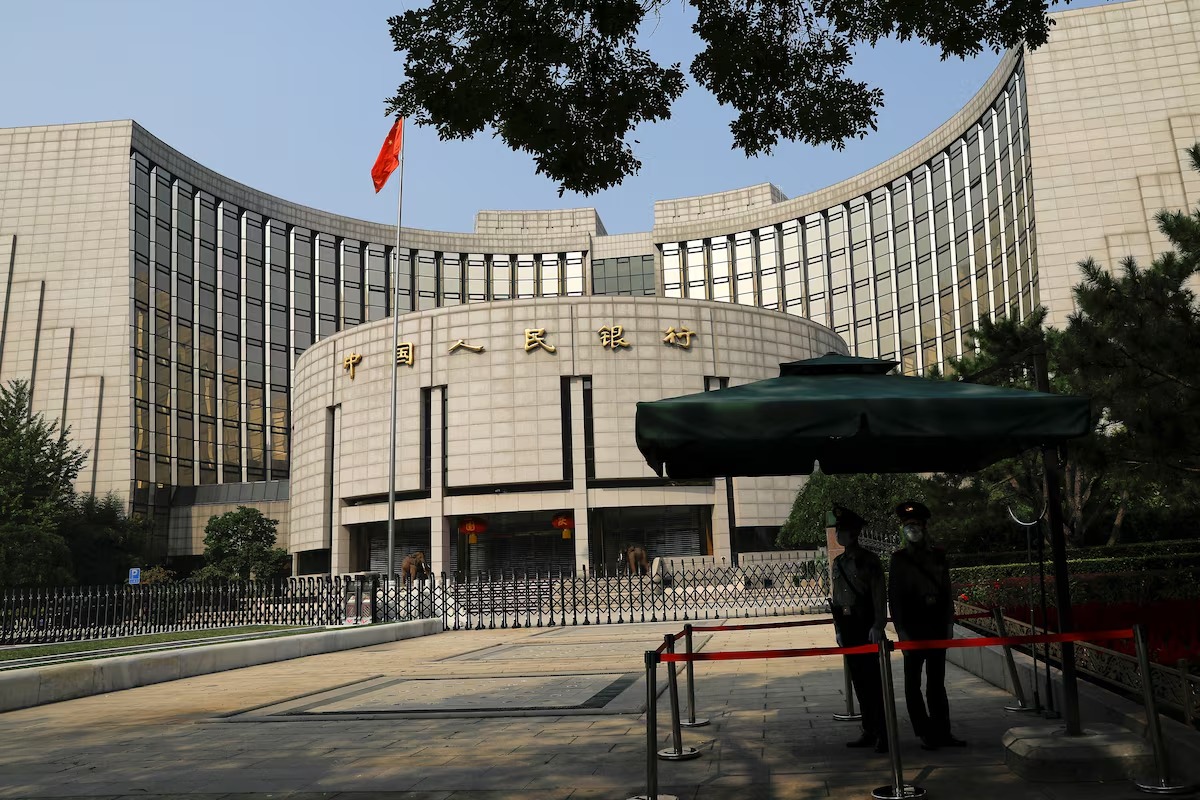
China’s central bank cut the size of its daily liquidity operations to zero for the first time in nearly two years on Wednesday, a move markets viewed as pushing more of the money idling in the banking system to the broader economy.
The People’s Bank of China (PBOC) said the volume of its seven-day reverse repurchase agreement operations was zero on the day, “in response to the needs of primary dealers in open market operations,” according to an online statement.
It was the first time since August 2024 that reverse repo volume turned zero, according to Reuters calculations.
“Today’s PBOC operation is surprising,” said Xiaojia Zhi, chief China economist at Credit Agricole.
It came at a time “China rates declined quite notably … The lack of bank credit growth and too rapid lowering of rates could have prompted the PBOC to send a rare warning signal to the markets.”
The volume-weighted average rate of the benchmark seven-day repo in the interbank market, a gauge that measures market conditions, traded at 1.33 percent on Wednesday and has been mostly staying below the reverse repo policy rate of 1.4 percent over the past month.
“Liquidity conditions remain quite ample at this point, perhaps prompting the PBOC to refrain from further injections,” said Lynn Song, chief economist for Greater China at ING.
“Unless we see an extended pause, it is likely only looking at the short-term liquidity environment rather than signalling a shift in the broader monetary policy direction.”
Bond markets were little changed after the PBOC’s action, with the 30-year treasury yields climbing 1 basis points to 2.2 percent.
Market participants and economists widely expect the PBOC to maintain an “appropriately loose” policy stance for the remainder of the year to support an economy under pressure from sluggish domestic demand and ripples effects of the Iran war.
The central bank had instructed banks to boost lending last month, sources told Reuters, following an unexpected fall in April.
“We think the PBOC would still maintain its monetary policy stance accommodative, and make more of a push to encourage bank lending and credit growth in near term,” Credit Agricole’s Zhi said.
That stance runs counter to a global tilt toward tighter policy to tame inflation fuelled by the Middle East energy shock. In the US, Federal Reserve officials signalled signalled rates may need to rise in the future if the Iran war keeps entrenched inflation elevated.
“Unlike many other Asian economies looking at rate hikes, China is yet to face this pressure as inflation is rising from deflation to low positive inflation,” ING’s Song said.
“A rate cut could become more palatable if we get a resolution to the Iran war, and confirmation that energy prices have peaked,” he added, penciling in a 10-basis-point rate cut in the fourth quarter of this year.
Reuters











Leave a comment