
You can enable subtitles (captions) in the video player
The key point is that this was the deal that put private equity on the map. And back then, in fact, it wasn’t actually called private equity. The key word is the leveraged buyout era of the 1980s.
And that’s where Gordon Gekko comes in, of course. Because LBOs were all about borrowing up to the hilt, tons and tons of debt, in order to gobble up a stodgy, inefficient company, and then beating it into shape or breaking it up and selling it off for parts, essentially. And obviously, it’s hugely relevant today because private equity now controls a swathe of the corporate world. It’s one of the biggest alternative asset classes out there in the world. And that means it’s still pertinent to ask just how much value this more cutthroat, buccaneering form of capitalism, born in the 1980s, actually adds.
This wasn’t the first-ever leveraged buyout to take place.
It’s not the first, but it’s certainly the most significant, in terms of the sheer amount of money that was made. And therefore, it became a touchstone, a way of almost proving… a proof of concept for the LBO as a form, because it showed that you could come away with an astronomic amount of money of profit. So I think that’s what makes it really, really significant. And in terms of just the sheer coverage that it generated. It was on the front of New York Magazine. The Times covered it. Everywhere was… everyone in every media outlet seemed to be talking about this at the time. So it really cut through.
OK. So you’ve created a lot of narrative suspense here. What was the deal? It’s 1982, and Wesray is about to do this iconic deal which made history, as you said. What was it?
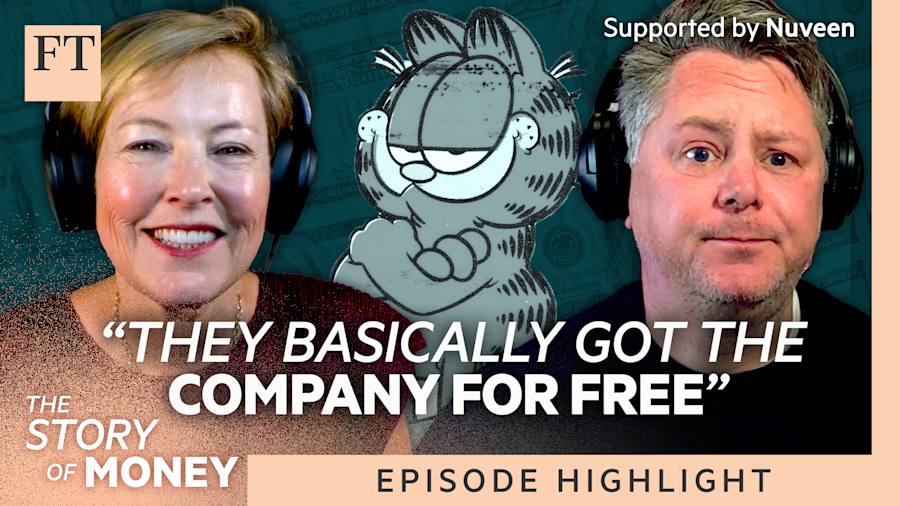
You wouldn’t think it would be iconic, given that it was for a greeting cards company, which doesn’t really seem to be one of the industries of the future when we think about capitalist ingenuity. But it was for a company called Gibson Greeting Cards, which was a greeting cards company based out of Cincinnati. It had been manufacturing greeting cards for many, many years. Crucially, it was sitting on some very valuable intellectual property, which was Garfield the cat. It owned the rights to Garfield the cat, a very popular cartoon feline, as we all know.
And it was also one of the textbook types of forms of value hidden within a conglomerate that Simon had been looking for, Simon and Chambers. Gibson was owned by Radio Corporation of America. And they had bought the company without necessarily realising the true value of the asset that they were sitting on. And now they were looking to unload it. And there was a sense in which it hadn’t been fully optimised, and there was value to be had here if you knew where to look.
So they weren’t just massive Garfield fans, essentially. That’s not why they went for Gibson.
No. I mean, they may have been, but yeah, I guess that’s not the main reason.
So tell us exactly what happened. How did this deal come together, with or without the cat?
So RCA sets the purchase price for about $80mn, and Wesray buys the company by investing just $1mn of equity. That is made up of… Chambers and Simon each put in, I think, around $330,000, and the rest comes from Wesray’s other partner and employees. And so they have basically bought the company using just a million dollars. How did they do this?
They borrowed $79mn and also sold off some of the company’s real-estate assets to finance the transaction. And I don’t think this has ever been done before that point, in terms of buying a company for that little, injecting so little of your own capital into a deal. And Simon does loads of fundraising. There is, as I mentioned, this piece in New York Magazine after the deal goes through that says the deal is wrought as if by the hand of Uncle Sam, because Simon relies heavily upon his contacts in the US government to open doors, but also from his time as Salomon Brothers.
So he’s really the kind of hustling fundraiser.
And Chambers is doing the accounting and the detail. And there is a moment when it looks like the deal is not going to go through when General Electric, which is one of the lenders for that $79mn, wants to pull out. And Simon says that if he were still working at Salomon Brothers he’d chuck you out of a window or something along… I’m paraphrasing, but it’s something like that. And Chambers manages to talk him down from his perch. And so the deal completes. And that’s what happens. And actually, during the time before they then take the company public, very little changes.
Why do they even try and structure it an LBO in the first place? Why didn’t they just go and buy it in the normal way?
There’s a lot of benefits for doing it this way. First of all, if it fails, then Gibson, not them, are responsible for paying off that $79 million of debt, so they will only lose $330,000 each. Also, there’s the fact that the interest payments on all of that debt reduce their taxable profits, which means that more money gets rerouted to them as kind of capitalist disruptors rather than the government taxman, making it more profitable for them as a deal.
And there’s also the fees that they can charge the company for the privilege of being owned by them. And Simon is quite open about this. He says, we charge the company fees and then some. Again, I’m paraphrasing. But it basically meant that they got the company for free by covering their initial $330,000 purchase equity that they had invested. They managed to recoup that by charging the company fees while they owned it.
So there are a number of reasons why this just looks like an incredible opportunity. And it really is hard to overstate just how revolutionary that was. This had not been done before at this scale.
Yeah. I mean, this is kind of… it’s not even just LBO. It’s like LBO maxxing, almost, to use the modern vernacular, where you’re borrowing basically almost all the money. And the tiny little sliver of equity you’re putting in actually is covered by the fees almost instantly that the company itself is paying you, which sounds incredible. So how did the deal play out? I’m guessing they made out like bandits, right?
Yeah. I think you could say that. I think that the thing that was really interesting to me while I was looking into this was, I was trying to understand, well, what had they done during this period of ownership? Because they take it public roughly 18 months after the deal first closes. And the typical private equity narrative is that you instil operational improvements. You basically turn a company around, and you create value in a way that it didn’t previously exist.
One of the things that I found striking about this deal was that actually very little changed in the company. The management structure still looked pretty much the same. There hadn’t been any dramatic kind of operational changes that had occurred during their period of ownership. And actually, Simon himself was pretty open about this. It was just lucky. They bought it when there was a downturn. The markets then recovered. They sold it 18 months later.
And they effectively had borrowed when interest rates were low, and they had seen a massive opportunity. And the timing had paid off. And so when the IPO happens 18 months afterwards, after the deal closes, its value has soared to something like $290mn, up from the purchase price of $80mn. So for each dollar they invest, they make something like a $200 return on that investment. I would have loved to have to be involved in this. It just sounds like so fabulously profitable. Probably wouldn’t be a journalist. So…
A 200 times return on 18 months sounds pretty incredible, right? Yeah.






Leave a comment