
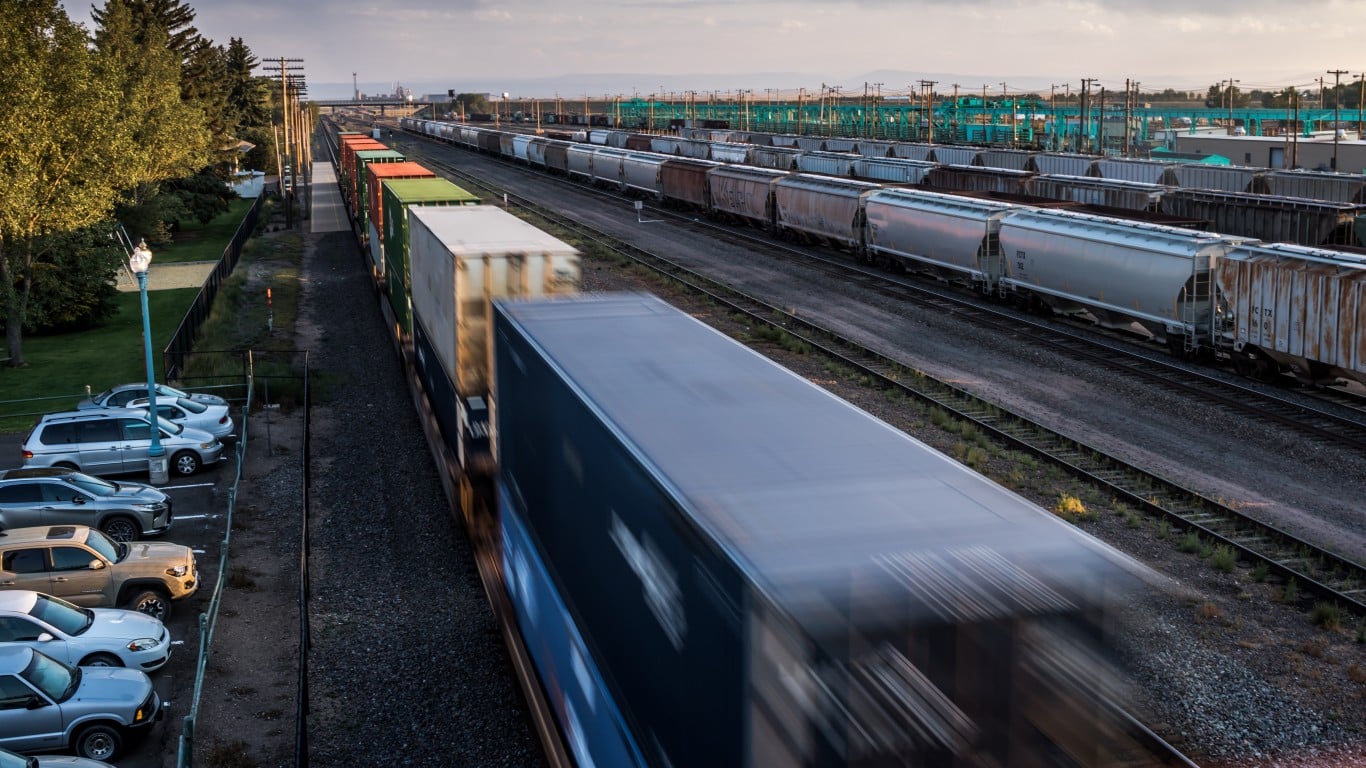
Freight railroads own infrastructure that cannot be replicated, but their dividends depend on variables most income investors overlook. Three major carriers just reported results that reveal exactly which payouts can survive the next downturn and which ones come with hidden…
This post may contain links from our sponsors and affiliates, and Flywheel Publishing may receive compensation for actions taken through them.
Railroads are income stocks with a moat you can see from an airplane. The three large US freight carriers here, Union Pacific (NYSE:UNP | UNP Price Prediction), CSX (NASDAQ:CSX) and Norfolk Southern (NYSE:NSC), own track networks that would be nearly impossible to rebuild today. That scarcity turns into cash, but the dividends ultimately ride on freight volume, pricing and a capital budget that never takes a year off. The second quarter showed what happens when the freight cycle turns in their favor: Union Pacific’s intermodal revenue climbed 26% to $1.386 billion as tight truck capacity pushed shippers onto rail. This is a durability story first. Here is how each payout holds up after the heavy spending these networks demand.
Union Pacific: Rising Payout Backed by a Western Franchise
Union Pacific hauls grain, coal, petrochemicals, metals, automobiles and a fast-growing domestic intermodal book across the western US. Its current capacity projects show where the growth is concentrated: the Houston complex, siding extensions in the Pacific Northwest and Iowa, and double-tracking the Sunset Route from Yuma to Tucson and ultimately to El Paso. Domestic intermodal just posted its fourth consecutive record quarter in volume and revenue.
Income profile: The quarterly dividend now stands at $1.42 per share, up from $1.38, for an annualized forward dividend of $5.68. Shares recently traded at $273.77, after a 11.44% pullback over the past month that lifts the entry yield for new buyers. Treat this as a dividend-growth holding first.
Dividend safety: Second-quarter operating cash flow reached $3.076 billion against capital spending of $873 million and dividends of $819 million. Last year the pattern held at scale: $9.29 billion of operating cash flow, $3.791 billion of capex and $3.236 billion in dividends. Management reported $1.8 billion of free cash flow generated after reinvesting in the network and paying the dividend, paid down $1.5 billion of long-term debt in the first half and holds adjusted debt to EBITDA at 2.5 times. The quarterly payout has climbed from $0.20 per share in the late 1990s and early 2000s, and company guidance explicitly cites “consistent annual dividend increases.”
Bull case: Pricing power is the engine. The CFO told analysts, “Our quarterly pricing dollars continue to exceed inflation dollars as we compete and win business at levels that reflect the value of our rail service.” The company raised its full-year reported EPS growth outlook to the high single-digit range, keeps a 20 plus percent capacity buffer and has roughly 200 industrial-development opportunities in the pipeline. More freight on existing track means more cash per dividend dollar.
Risk: The pending Norfolk Southern merger, which would create America’s first transcontinental railroad, brings regulatory and integration uncertainty. The Surface Transportation Board accepted the application on May 28, the statute gives regulators a year after acceptance, and management offered no definitive closing date. Merger costs already separate reported EPS of $3.36 from adjusted EPS of $3.41.
CSX: Eastern Network With a Fast-Growing Cash Engine
CSX runs an eastern network carrying chemicals, metals and equipment, forest products, coal and intermodal boxes. Export coal tonnage rose 12% last quarter, record US corn shipments through Chesapeake are expected to continue through year end, and the Howard Street Tunnel has expanded capacity for truck-to-rail conversions. Infrastructure and data-center construction support demand for domestic coal, frac sand, metals and heavy equipment.
Income profile: CSX pays $0.14 per quarter, an annualized forward dividend of $0.56, on a recent share price of $46.78. The stock has gained 40.27% over the past year, so much of the recent reward has come through price, with buybacks doing heavy lifting alongside the cash dividend.
Dividend safety: Second-quarter operating cash flow of $1.327 billion covered capex of $576 million and dividends of $260 million with room to spare. First-quarter free cash flow hit $793 million, up 47.95%, and management now guides to free cash flow growth of greater than 80% for the year with capex held at less than $2.4 billion. Last year’s $4.613 billion of operating cash flow funded $2.902 billion of capex and $972 million in dividends. The balance sheet shows $30.64 billion of total liabilities against $14.09 billion of equity. The quarterly rate stepped up every year in the record from $0.10 in 2022 to $0.14 today.
Bull case: Cost discipline is widening margins while volume grows. Operating margin expanded 240bps to 38.3% despite 160 basis points of fuel headwinds, and headcount ran 6% lower. First-half buybacks retired 12M shares for $506M, which shrinks the share count the dividend must cover. As management put it, “Returns on invested capital are a real focus for this team.”
Risk: Service fluidity lags the volume surge. Terminal dwell and trip plan performance remained below the company’s desired level because demand exceeded expectations and crew availability was tight in certain locations. Management summed it up: “We’re very productive and just not as fluid as we need it to be.” A planned headcount increase to fix service could slow the margin gains funding future raises.
Norfolk Southern: Steady Payout Waiting on a Merger
Norfolk Southern serves the East with a merchandise-heavy mix. Second-quarter merchandise revenue reached $2.133B (+8.2%), intermodal $908M (+22.2%) and coal $424M (+7.3%). Its network runs through terminals such as Chattanooga, Birmingham, Bellevue and Elkhart, and new industrial customers are landing in South Carolina, Alabama, Ohio and North Carolina.
Income profile: The quarterly dividend is $1.35, an annualized forward dividend of $5.40, with shares recently at $312.98 after an 11.25% slide over the past month.
Dividend safety: Second-quarter operating cash flow of $1.054 billion covered capex of $439 million and dividends of $303 million. The first quarter was tighter: operating cash flow of $344 million came in below capex of $382 million, yet the $303 million dividend was still paid. Last year’s $4.361 billion of operating cash flow comfortably handled $2.204 billion of capex and $1.215 billion of dividends, and this year’s capex guidance sits near $1.9 billion. Total liabilities of $28.87B compare with $16.25B of equity. The track record needs context: the payout has held at $1.35 since early 2023, up from $1.24 in 2022, so income here is steady with no recent growth.
Bull case: Freight demand is recovering. Revenue hit $3.465B, up 11.4% year over year, and adjusted EPS of $3.52 beat the $3.32 estimate. Management remains committed to at least $150 million of cost takeout this year and $650 million in cumulative three-year savings. Holders also have the pending Union Pacific combination as a potential catalyst, with the CEO saying the company is “even more confident about the unique opportunity to strengthen America’s supply chain.”
Risk: Eastern Ohio incident costs keep cash flow lumpy. First-quarter GAAP net income fell 27.07% as the prior year’s $185M net recoveries swung to $10M net expense, and operating cash flow dropped 63.79%. The incident added another $15 million in second-quarter costs, and litigation remains ongoing.
Which Railroad Dividend Fits Your Income Plan
All three railroads fund their dividends from free cash flow left after heavy network spending, and all three rode strong intermodal demand last quarter. Union Pacific suits investors who want the largest, most consistently rising payout backed by pricing power. CSX fits total-return investors who value surging free cash flow and aggressive buybacks alongside a smaller, steadily growing dividend. Norfolk Southern suits patient holders content with a flat, well-covered payout while the merger plays out. If the goal is collecting checks like these without ever tapping the shares underneath, we built a free guide on structuring a dividend ladder to do exactly that: Never Touch the Principal.
Contact [email protected] for any questions or corrections.











Leave a comment