
With aging, pension payments > Imported institutional investors prefer private equity loans that can be cashed in to meet payments. Pursue a 10% annual return through big three private equity loans such as Blackstone, KKR, and Carlile. Just as institutional investors in Korea also reduce their investment in M&A funds, which prefer private equity loans, it has a negative impact on the domestic M&A ecosystem

“About 3300 trillion won (US$2.362.2 trillion).”
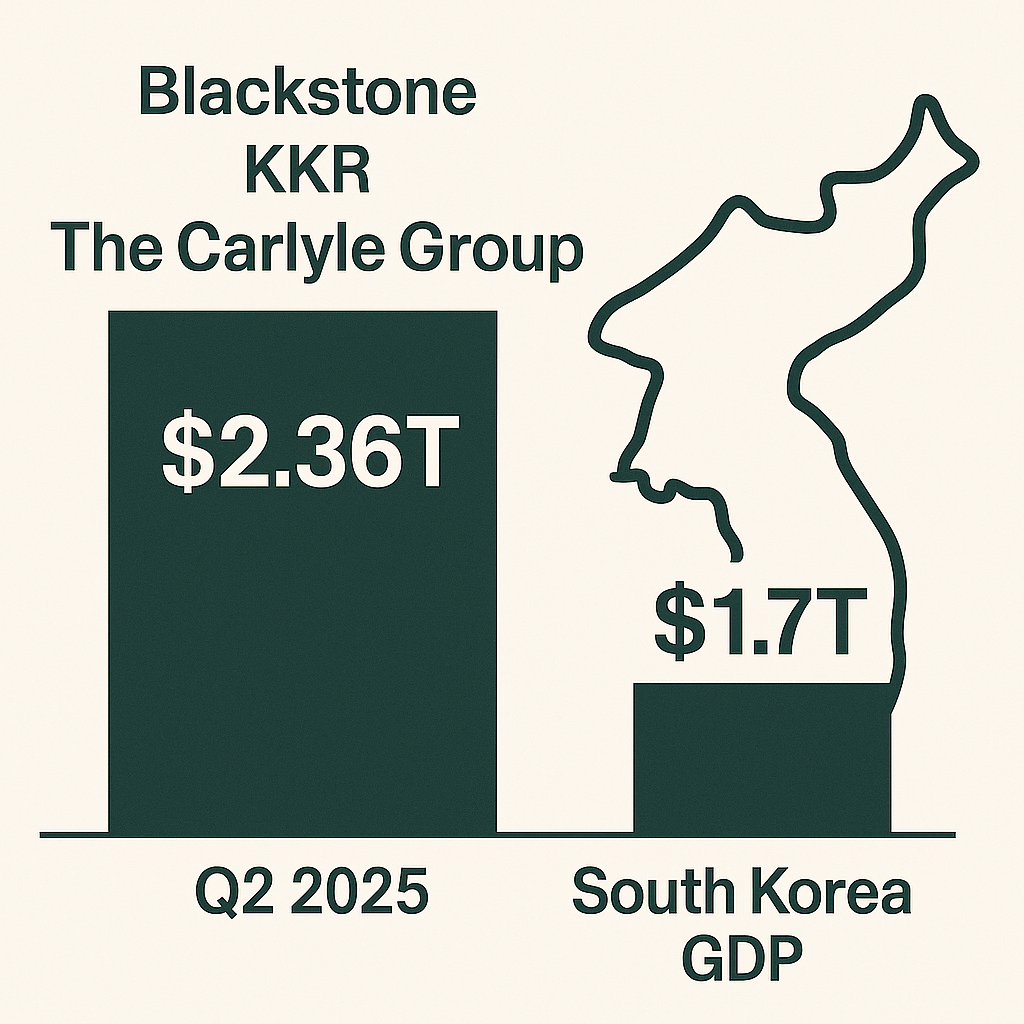
The combined operating assets of Blackstone, KKR and Carlisle, which are among the top three global private equity funds, as of the end of the second quarter of this year. This is more than Korea’s GDP ($1.7 trillion). This is how much assets the Big Three private equity funds, a symbol of U.S. financial capital, manage.
Blackstone’s operating profit for the first half of the year is approximately $2.8 billion. Considering that there were 4,895 Blackstone employees as of the end of last year, the operating profit per employee reached about 800 million won in Korean money as of the first half of this year. It’s 1.6 billion won a year. It’s a profit that can’t be compared to the domestic financial sector. This is because the operating profit per capita of domestic private equity funds and banking sectors is estimated to be between 300 million and 500 million won. “The yield of U.S. private equity funds is usually twice as high as that of domestic private equity funds,” said an official in the investment banking industry.
Then, how will the operating assets of the big three in the first half of this year be structured? We will track the ‘money flow’ through the Big 3 disclosures.
Aging, high interest rates, private equity fund management assets changed due to conservative private equity loan investment in aggressive corporate M&A
Before you analyze your performance, you should first look at your private equity’s asset portfolio.
It is broadly classified into four categories.
First, private equity shares. In other words, this includes Buy Out funds that buy and sell companies and Growth funds that enjoy growth fruits by investing in a minority stake in companies.
Second, real estate. On the real estate side, this is mainly office investment. It’s an investment for inflation hedging
Third, infrastructure. It invests in infrastructure such as various SoCs (social overhead capital) and distribution centers.
These three were traditional private equity investments. Private equity was the “identity” and “key” of private equity funds. It was thanks to private equity investment that KKR became famous as a corporate hunter. A high-ranking official in the IB industry said, “It is common for managers who M&A companies through buyout funds to be higher than those of infrastructure and real estate funds,” adding, “The core of private equity funds is buyout.”
What has come to mind lately is the fourth area, private equity.
Private equity loans refer to collecting funds from a small number of institutional investors to companies that have difficulty financing corporate bonds or stock markets. The usual target rate of return for private equity loans is known to be around 10%. That’s below the target return of 15%-20% for private equity (buyout funds that buy and sell companies and earn returns).

Nevertheless, private equity loans are attracting attention thanks to ‘cashing’.
Private equity in contrast to private equity, particularly buy-out funds that buy and sell businesses, can look for big gains, but there is a “disadvantage” of money being tied up for years. Private equity loans, on the other hand, can earn interest income on a regular basis through mortgage loans.
Due to the aging population, pension funds in developed countries are spending more than insurance income (payers pay). You need to give money to pensioners right away, but if all the money is tied to a buyout fund that isn’t cashing in right away, you can have a hard time paying cash. For this reason, institutional investors prefer private equity loans, even at the expense of profitability. In fact, CalSTRS, the third-largest pension fund in the U.S., decided last year to raise its fixed income target, including private equity loans, to 14% of its total assets in the medium to long term. Domestic institutional investors, including the National Pension Service, faculty and staff deduction association, and private school pensions, have also said they will increase the proportion of private equity loans in line with this.
High interest rates have also influenced this decision.
Buyout funds, which have an average annual return target of 15% to 20%, acquire companies through large borrowing and sell them years later in pursuit of excess returns. This was a model that worked well during the low interest rate period.
But in recent years, the shift to an era of high interest rates rather than low interest rates has led to large-scale borrowing leading to a decline in corporate value. A case in point is that Homeplus, which was bought by MBK Partners, a major private equity fund in Korea, has entered the corporate rehabilitation process with a total of 7 trillion won.

Global buyout fund recruitment reached $402.5 billion last year, down 15% from 2023 ($472.9 billion), according to global market research firm PitchBook. This means buyout fund recruitment returned to 2020 ($390.6 billion) during COVID.
Globally, private equity fund management assets are shifting to “safe mortgage loans” in line with the high-interest rate and aging era.
The No. 1 private equity portfolio of the Big 3 Private Equity Funds is ‘Private Loan’
With this background knowledge, let’s look at the changes in the operating assets of the global big three private equity funds.
In 2018 alone, Blackstone invested $472.2 billion in operating assets at the time, followed by real estate (28.8%), private equity (27.7%), private equity (27.0%), and others (16.5%).
What about now, seven years later? Blackstone is operating $1.2112 trillion as of the second quarter of this year, with private equity (33.6%), private equity (32.1%), real estate (26.8%), and others (7.4%).
Private equity loans, which were ranked third in 2018, rose to the top of the management asset portfolio in the second quarter of this year.
It was only last year that private equity loans at Blackstone Portfolio began to top the list. It’s a symbolic case where the world’s No. 1 asset manager became the “second lender.”

The same goes for Carlisle, who is in third place.
Carlisle’s operating assets for the second quarter of this year are $465 billion. Of this, private equity loans are $230 billion, accounting for 43% of the total assets. Carlisle also began to top its portfolio in the share of private equity loans in 2023.
On the other hand, KKR, which was famous as a “corporate hunter,” still maintains its identity as a private equity fund.
As of the second quarter of this year, 36% of KKR’s operating assets ($686 billion) are operated as a profit-seeking strategy through private equity, or M&A, to buy and sell companies.
But there are also glimpses of changes in KKR. This is because the private equity loan sector has risen to 20% of the total portfolio. Given that about 50% of KKR’s total assets were private equity and 10% were private equity at the end of 2022, the private equity sector has more than doubled its weight in three and a half years.
In particular, the big three private equity funds acquire insurers and reinsurers, and have significantly increased their operating assets (AUM) in the past five years through strategies to link “private loans” with the insurance industry. It is a model that attracts customers’ money through insurance companies, increases operating assets, earns mid-interest income through private equity loans, and achieves “insurance premium payment + excess profit.” Apollo (American private equity fund), which has already grown as much as the Big Three, became famous for this model.
If you look at the financial statements of the big three private equity funds, it’s clear.
It’s the process of a private equity fund that used to be a “corporate hunter” becoming a lender like a “bank.” Of course, this has a unique situation unique to the United States. The U.S. established regulations on banks after the 2008 global financial crisis, which boosted private equity lending. On the other hand, Korea is a financial holding system centered on banks, and banks still have a lot of lending capacity. As a result, public offering loans (banks) and other private equity loans (private equity funds) have developed in the United States, while private equity loans are not yet active in Korea.
Nevertheless, looking at the big three private equity portfolios gives us a glimpse of the times. In other words, ‘cashable safe profit generation’ in the age of aging and high-interest rates has become the greatest value.
This means the stagnation of global M&A (M&A).
The main agents of acquiring companies are large global conglomerates or private equity funds, because private equity funds focus more on lending a certain amount of money rather than acquiring companies. In fact, it varies by research institute, but in general, global M&A reached $5 trillion during the ultra-low interest rate period in 2021 and remains in the late $2 trillion range between 2022-2024.
The domestic M&A market, which prefers private equity loans due to fund depletion issues in Korea, continues to stagnate due to difficulties in raising funds
This trend is also occurring in Korea.
Most of the major institutional investors in Korea, including the National Pension Service, the Teachers’ Credit Union, and the private school pension, are increasing the proportion of private equity loans and increasing the investment. The National Pension Service’s 350 billion won investment in private equity loans (Samo Credit) last year was the first signal in Korea. The faculty and staff deduction association also invested 700 billion won in private equity funds this year, including private equity loans.
An institutional investor official said, “There is a growing interest in investor assets that can receive cash regularly, such as private equity loans and GP Stakes,” adding, “In particular, institutions with depletion issues have no choice but to prefer cash-inable asset groups because payments are increasing.”
In fact, according to the 3rd Long-Term Financial Outlook (2025-2065) recently released by the Ministry of Finance and Economy (formerly the Ministry of Strategy and Finance), civil servants pensions and military pensions have already turned into deficits, while private school pensions are expected to turn into deficits in 2026 and national pensions are expected to turn into deficits in 2048.
As these pension funds are expected to turn into deficits, it is difficult to pursue aggressive returns. This is because spending is higher than income, so it is more appropriate to invest in cashable assets and pursue medium returns rather than keep money in one place for a long time and pursue high returns.

Given this situation, domestic buyout funds are expected to have difficulty raising funds in the future.
This is because institutional investors are reducing their share of buyout funds. In fact, the National Pension Service, the biggest hand in Korea, invested around 1 trillion won in buyout funds in the first half of every year, but has yet to announce the recruitment of buyout blind funds this year.
“As institutional investors prefer private equity loans and reduce investment in buyout funds due to aging and high-interest-rate issues, domestic private equity fund managers (GP) are struggling,” a senior official in the IB industry said. “Only private equity funds with already investment history will be revived, and private equity funds that do not will not be invested will be poor and poor.” He added, “M&A is expected to be activated in the future even among private equity fund managers,” adding, “It will be an opportunity for the domestic investment landscape to change.”
Unlike the United States, in particular, domestic investment in buyout funds seeking aggressive returns could barely increase or even decrease in the future, as there is an issue of institutional investor fund depletion. This means that the domestic M&A market will not be as active as it is.
In fact, since the domestic M&A market recorded an annual transaction volume of 70 trillion won in 2021, the market size has been “half cut” to 30 trillion won per year. This trend is expected to continue in the future.













Leave a comment