
Key Takeaways
- Tangible common equity (TCE) measures a company’s physical capital, crucial for assessing its ability to handle losses.
- TCE is calculated by subtracting intangible assets and preferred equity from a company’s book value.
- The TCE ratio assesses a bank’s capital adequacy by comparing tangible equity to tangible assets.
- Financial firms with significant preferred stock holdings often use TCE to assess financial resilience.
- While not required by GAAP, TCE remains a valuable tool for analyzing bank stability and capital adequacy.
What Is Tangible Common Equity (TCE)?
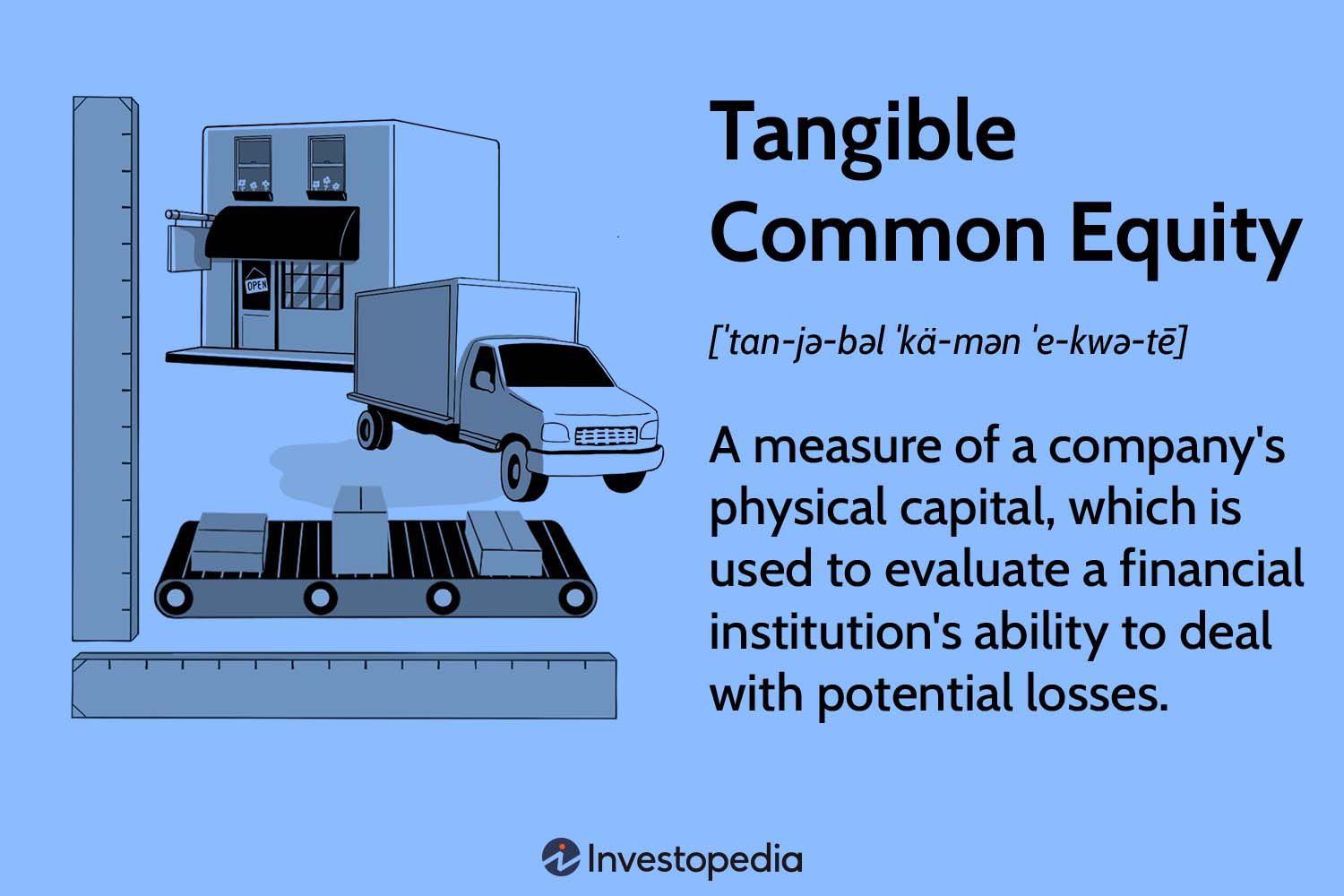
Tangible common equity (TCE) measures a company’s physical capital and assesses a financial institution’s ability to handle losses. It is frequently used to analyze financial firms with few tangible assets, like banks, to measure capital adequacy. TCE is also measured during financial stress testing to help determine an institution’s resiliency.
Tangible common equity is calculated by subtracting intangible assets (including goodwill) and preferred equity from the company’s book value.
Evaluating Financial Stability with Tangible Common Equity
Companies have both tangible and intangible assets—like a building versus a patent. Financial firms are often evaluated using TCE.
Measuring a company’s TCE is particularly useful for evaluating companies that have large amounts of preferred stock, such as U.S. banks that received federal bailout money in the 2008 financial crisis. In exchange for bailout funds, those banks issued large amounts of preferred stock to the federal government. A bank can boost TCE by converting preferred shares to common shares.
Using tangible common equity can also be used to calculate a capital adequacy ratio as one way of evaluating a bank’s solvency and is considered a conservative measure of its stability.
Important
TCE is not mandated by GAAP or bank regulations but is often used internally to gauge capital adequacy.
Key Factors in Analyzing Tangible Common Equity
The TCE ratio evaluates a bank’s capital adequacy by comparing tangible equity to tangible assets, estimating potential sustainable losses before equity is erased.
Depending on the firm, patents might be excluded from intangible assets if they hold a liquidation value.
Another way to evaluate a bank’s solvency is to look at its tier 1 capital, which consists of common shares, preferred shares, retained earnings, and deferred tax assets. Banks and regulators track tier 1 capital levels to assess the stability of a bank.
Lower-risk assets like U.S. Treasury notes are safer than low-grade securities. Regulators do not require regular submissions of tier 1 capital levels, but they come into play when the Federal Reserve conducts stress tests on banks.
How to Calculate Tangible Common Equity
Say that XYZ Bank had for the fiscal year 2021 a book value of $273.8 billion. Its goodwill was $69.01 billion, intangible assets $2.2 billion, and preferred stock $24 billion. Thus, XYZ Bank’s tangible common equity at the end of 2021 was $178.59 billion ($273.8 billion – $69.01 billion – $2.2 billion – $24 billion).
Tip
Many banks list tangible common equity in the supplementary sections of their financial statements.
What Does Tangible Common Equity Measure?
Tangible common equity is an estimation of the liquidation value of a firm, or what might be left over for distribution to shareholders if the firm were liquidated.
What Is the Tangible Common Equity Ratio Used for?
The tangible common equity ratio (TCE divided by tangible assets) can be used as a measure of leverage. High ratio values indicate less leverage and a larger amount of tangible equity compared to tangible assets.
When Is Tangible Common Equity Useful?
Tangible common equity is most often used when evaluating the position of financial companies like banks. It looks only at a firm’s physical capital to evaluate a financial institution’s ability to use them as collateral be able to cover potential losses.
The Bottom Line
Tangible Common Equity (TCE) is a crucial measure of a financial institution’s physical capital, used to evaluate its resilience in absorbing potential losses. It is calculated by subtracting intangible assets, like goodwill, and preferred equity from the company’s book value, thus providing an estimated liquidation value and insight into a firm’s tangible physical value.
The TCE ratio is crucial for assessing a bank’s capital adequacy, especially with high preferred stock levels or during stress tests.
Though not required by GAAP, TCE is a valuable tool for analysts assessing bank stability and leverage. TCE comparisons offer conservative insights into a bank’s solvency and risk management strategies, making it important as an internal performance indicator.












Leave a comment