
Key Takeaways
- Free Cash Flow to the Firm (FCFF) is an essential financial metric that indicates the cash generated from operations after all expenses, investments, and taxes, providing insight into a company’s financial health and ability to meet obligations.
- The FCFF calculation can be adjusted using several formulations, but its core purpose is to assess the cash available for distribution to investors, such as bondholders and stockholders, after business reinvestments.
- A positive FCFF suggests a company is generating excess cash post-expenses, potentially enabling dividend payments or debt reduction, while a negative FCFF could signal fiscal challenges or strategic reinvestment by growth-oriented firms.
- Investors should critically evaluate FCFF metrics, as firms might manipulate reported values through accounting techniques or temporary cash management strategies, like delaying payments or accelerating receivables.
- Understanding FCFF allows investors to better evaluate stock valuations, as it can reflect a company’s long-term cash-generating capabilities and serve as a benchmark for investment decisions.
What Is Free Cash Flow to the Firm (FCFF)?
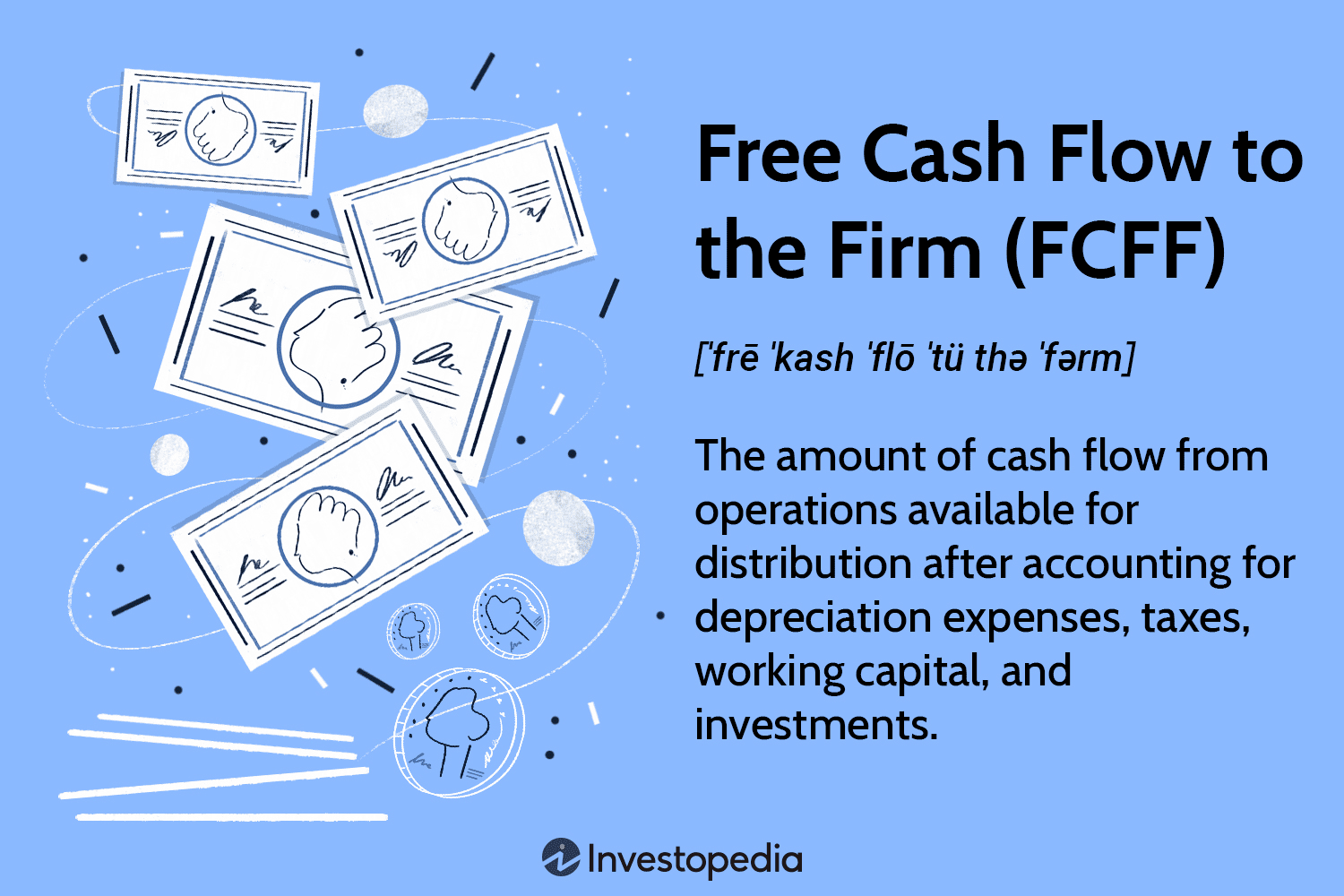
Free cash flow to the firm (FCFF) denotes the cash available for distribution after a company covers its depreciation expenses, taxes, working capital, and investments. As a crucial indicator of profitability, FCFF aids in measuring a company’s financial health after all expenses and reinvestments. FCFF highlights the cash a company can return to its investors via dividends, share repurchases, or debt repayments, making it an essential benchmark for financial analysis.
Investopedia / Michela Buttignol
How Free Cash Flow to the Firm (FCFF) Impacts Investment Decisions
FCFF is the cash available to investors after a company pays its costs and invests in assets like inventory and equipment. FCFF includes bondholders and stockholders as beneficiaries when considering the money left over for investors.
FCFF serves as an indicator of a company’s operations and performance. FCFF considers all cash inflows in the form of revenues, all cash outflows in the form of ordinary expenses, and all reinvested cash to grow the business. The money left over after conducting all these operations represents a company’s FCFF.
Free cash flow is arguably the most important financial indicator of a company’s stock value. The value of a stock is seen as the sum of the company’s expected future cash flows. However, stocks aren’t always priced accurately. Understanding a company’s FCFF allows investors to test whether a stock is fairly valued. FCFF shows a company’s ability to pay dividends, buy back shares, or repay debt. Any investor looking to invest in a company’s corporate bond or public equity should check its FCFF.
A positive FCFF means the firm has cash left after expenses. A negative FCFF means the firm hasn’t earned enough to cover costs and investments. In this case, investors should investigate why costs are higher than revenue. It might be due to a business strategy, as with fast-growing tech firms with external funding, or it could signal financial issues.
Methods for Calculating Free Cash Flow to the Firm (FCFF)
The calculation for FCFF can take several forms, and it’s important to understand each version. The most common equation is the following:
FCFF=NI+NC+(I×(1−TR))−LI−IWCwhere:NI=Net incomeNC=Non-cash chargesI=InterestTR=Tax RateLI=Long-term InvestmentsIWC=Investments in Working Capital
Free cash flow to the firm can also be calculated using other formulations. Other formulations of the above equation include:
FCFF=CFO+(IE×(1−TR))−CAPEXwhere:CFO=Cash flow from operationsIE=Interest ExpenseCAPEX=Capital expenditures
FCFF=(EBIT×(1−TR))+D−LI−IWCwhere:EBIT=Earnings before interest and taxesD=Depreciation
FCFF=(EBITDA×(1−TR))+(D×TR)−LIFCFF=−IWCwhere:EBITDA=Earnings before interest, taxes, depreciationand amortization
Real-World Calculation of Free Cash Flow to the Firm (FCFF)
If we look at Exxon’s statement of cash flows, we see that the company had $8.519 billion in operating cash flow (below, in blue) in 2018. The company also invested in new plant and equipment, purchasing $3.349 billion in assets (in blue). The purchase is a capital expenditure (CAPEX) cash outlay. During the same period, Exxon paid $300 million in interest, subject to a 30% tax rate.
Here’s how to calculate FCFF using this formula:
FCFF=CFO+(IE×(1−TR))−CAPEX
In the above example, FCFF would be calculated as follows:
FCFF=FCFF== $8,519 Million+($300 Million×(1−.30))− $3,349 Million $5.38 Billion
Distinguishing Between Cash Flow and Free Cash Flow to the Firm (FCFF)
Cash flow is the net cash and cash equivalents moving into and out of a company. Positive cash flow means a company’s liquid assets are rising, allowing it to pay debts, reinvest, return money to shareholders, and cover expenses.
Cash flow is reported on the cash flow statement, which contains three sections detailing activities. Those three sections are cash flow from operating activities, investing activities, and financing activities.
FCFF is the cash flows a company produces through its operations after subtracting any outlays of cash for investment in fixed assets like property, plant, and equipment, and after depreciation expenses, cash flow taxes, working capital, and interest are accounted for. In other words, FCFF is the leftover cash after a company covers operating expenses and capital expenditures.
Important Considerations When Evaluating Free Cash Flow to the Firm (FCFF)
While FCFF offers valuable insights to investors, it’s not infallible. Crafty companies still have leeway when it comes to accounting sleight of hand. Without regulatory standards, investors often disagree on which items should be capital expenditures.
Investors must thus keep an eye on companies with high levels of FCFF to see if these companies are under-reporting capital expenditures and research and development. Companies can temporarily boost FCFF by delaying payments, tightening collections, and depleting inventories. These activities diminish current liabilities and changes to working capital, but the impacts are likely to be temporary.











Leave a comment