
FTSE Russell has added Hoa Phat Group (HPG) to the Mid Cap segment of the FTSE All-World index, just as the company completes its largest fixed-asset investment cycle on record.

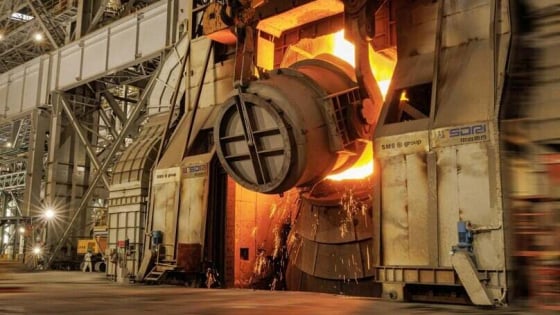
On August 5, 2025, Basic Oxygen Furnace (BOF) No. 2 and the RH-type vacuum refining furnace at the Hoa Phat Dung Quat 2 Iron and Steel Complex project officially commenced operations. Photo courtesy of the company.
The gross value of tangible fixed assets rose about 69% in 2025, driven by the completion of its Dung Quat 2 steel manufacturing project in Quang Ngai province, helping sharply increase production in the first half of 2026.
In its September 2026 semi-annual review, FTSE Russell added six Vietnamese stocks to the FTSE All-World index: VCB (Vietcombank), VIC (Vingroup), VHM (Vinhomes), BID (BIDV), VPB (VPBank), and HPG (Hoa Phat Group). VCB, VIC and VHM were classified as Large Caps, while BID, VPB and HPG were included in the Mid Cap segment.
Unlike the other five companies, HPG’s core business is tied to industrial manufacturing. Steel accounted for 93% of Hoa Phat’s revenue and 68% of its profit in the first half of 2026. The company says it is Southeast Asia’s largest steel producer, with annual capacity of about 16 million tons, focused mainly on hot-rolled coil (HRC) and high-quality steel products.

The list of companies added to the FTSE All-World index in this review. Photo courtesy of FTSE Russell
Dung Quat 2 takes Hoa Phat to a new scale
According to Hoa Phat’s consolidated Q2/2026 financial statements, the group recorded VND108.06 trillion ($4.14 billion) in net revenue in the first half, up 47% from a year earlier. Net profit reached VND15.48 trillion ($592.54 million), of which VND15.365 trillion was attributable to shareholders of the parent company, more than double the year-earlier figure.
Hoa Phat’s investment scale increased sharply in 2025 as the Dung Quat 2 project was completed and brought into operation. The gross value of the group’s tangible fixed assets rose from about VND108.147 trillion at the start of the year to VND182.309 trillion ($6.98 billion) at year-end, an increase of nearly 69%. The gross value of machinery and equipment rose by more than VND50 trillion ($1.91 billion), while buildings and structures increased by nearly VND23 trillion ($880.38 million).
In the first half of 2026, the pace of fixed-asset growth slowed markedly. By the end of June, the gross value of tangible fixed assets stood at about VND186.818 trillion ($7.15 billion), up just 2.6% from the start of the year. The trend suggests that after a period of heavy investment, Hoa Phat is gradually shifting its focus towards utilizing its new capacity.
The increase in assets during the completion and commissioning of Dung Quat 2 has had a positive impact on production.
Hoa Phat produced nearly 7 million tons of crude steel in the first half, up 36% from a year earlier, according to the company. Sales of HRC, construction steel, high-quality steel and billets reached 6.5 million tons, up 32%, while HRC sales alone rose 57% to nearly 3.4 million tons. Total second-quarter output was also about 9% higher than in the first quarter.
Mirae Asset Securities estimated that Hoa Phat’s crude steel capacity utilization reached about 94% in the second quarter of 2026. The HRC production line at Dung Quat 2 operated at about 88% of capacity, up from 55% in the first quarter, the brokerage said.
The new capacity has helped Hoa Phat increase its market share. Mirae Asset estimated that Hoa Phat’s domestic construction steel market share reached about 35.4% in the first six months of the year. Its average HRC market share was about 35.2%, rising to 40.5% in the second quarter. According to the brokerage, this was the first time Hoa Phat’s HRC market share exceeded the share of imported steel on the domestic market.
The expansion is not stopping with Dung Quat 2. In southern Vietnam, Hoa Phat is building the Long An steelmaking and rolling plant, with annual capacity of 700,000 tons and investment of about VND2.45 trillion ($93.78 million).
The project will establish a steelmaking and rolling facility close to the end market, using electric-arc furnace technology rather than the blast-furnace production chain used at Dung Quat. Compared with southern Vietnam’s construction steel consumption of about 3.55 million tons in 2025, the plant’s capacity would be equivalent to roughly 19% of the regional market.
At the same time, Hoa Phat is accelerating construction of a railway rail and special steel plant with annual capacity of 700,000 tons, which is about 60% complete, as well as a 500,000-ton high-quality steel plant expected to begin trial operations in September 2026. The company is also preparing its Phu Yen integrated steel complex, with planned annual capacity of 6 million tons, which remains at the legal and regulatory preparation stage.
Hoa Phat’s production scale has therefore changed significantly from before Dung Quat 2 came onstream. As the company begins to utilize the new capacity and continues to prepare further expansion projects, HPG has also been added by FTSE to the Mid Cap segment of the FTSE All-World index.
For investors, the next question is how much additional capital the inclusion in the index could bring to HPG shares.

Global HRC steel prices have cooled but remain as much as 43% higher than a year earlier. Photo courtesy of Trading Economics
How large could FTSE-related inflows be?
Inclusion in the FTSE All-World index makes HPG one of the stocks that passive funds tracking the FTSE index system may need to add to their portfolios. However, actual inflows will depend on the asset size of individual funds, HPG’s index weighting and the pace at which Vietnam is incorporated into the index.
In a July 29 report, Vietcap estimated HPG’s total market capitalization at about $6.68 billion and its free-float market capitalisation at $3.31 billion. Under Vietcap’s model, passive inflows into HPG could reach about $82.7 million once Vietnam is fully included in FTSE’s index series. During the initial stage, with a 10% inclusion factor, the corresponding inflow would be about $8.3 million.
A report from BSC dated August 19, just two days before FTSE announced its official list, also forecast HPG inflows of around $78.8 million. The report was issued ahead of FTSE’s official August 21 review.
The two brokerages therefore put potential passive inflows into HPG at around $80 million. However, both forecasts were made before FTSE finalized the index constituents, so the figures should be viewed as estimates rather than confirmed flows.
Under FTSE Russell’s roadmap, Vietnamese stocks will be incorporated into the Global Equity Index Series (GEIS) in four stages from September 2026 to September 2027, rather than being added in full during the first phase.
Vietcap estimated that under the full-inclusion scenario, purchases of HPG would be equivalent to about 4.6 trading days of the stock’s average monthly liquidity at the time of its report.
Index-related inflows could therefore provide an additional source of demand for HPG, but the stock’s longer-term outlook will still depend on the company’s ability to convert its larger asset base and new production capacity into profits.
Mirae Asset forecasts HPG will generate VND204.009 trillion ($7.81 billion) in revenue and VND26.129 trillion ($1 billion) in net profit attributable to parent-company shareholders in 2026. However, the brokerage expects steel industry conditions to become less favorable in the second half as HRC prices decline and the spread between selling prices and raw material costs narrows.
Despite raising its profit forecast following HPG’s strong first-half results, Mirae Asset cut its target price-to-book ratio for HPG to 1.56 times and lowered its target price to VND30,000 ($1.15) per share from VND31,800. The target remains significantly above the current market price.
HPG closed at VND21,700 per share on August 21, giving it a market capitalization of about VND183.2 trillion ($7.01 billion). Despite strong first-half earnings, the stock has traded mostly in the VND22,000-25,000 ($0.96) range for much of 2026 and has yet to establish a sustained rally. With more than 8.44 billion shares outstanding and a large free float, HPG would need significant demand to trigger a sharp price move.
Against this backdrop, HPG’s inclusion in the FTSE All-World index provides a potential additional source of demand from funds. For long-term investors, however, the key issue remains whether Hoa Phat can effectively utilize the capacity added by Dung Quat 2, absorb the additional output, expand its presence in southern Vietnam and maintain profit margins as steel industry conditions are expected to become less favourable than in the first half of the year.









Leave a comment