
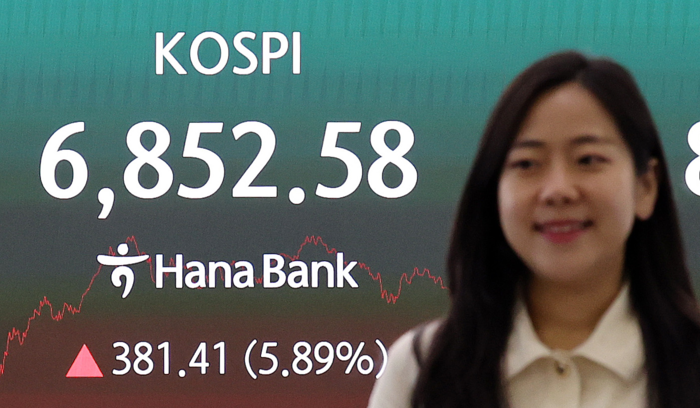

South Korea’s net international investment assets plunged nearly $700 billion in a single quarter in the April-June period, an unusual development attributed to a gap in investment returns.
According to data released by the Bank of Korea (BOK) on Thursday, the country’s net international investment position – international financial assets minus international financial liabilities – stood at $64 billion at the end of the second quarter, down $689.5 billion from $753.6 billion at the end of the previous quarter.
It was the largest quarterly decline since comparable data began in 1994. In terms of the outstanding balance, it was the lowest level since the third quarter of 2014, when it stood at $12.8 billion.
Korea’s net international investment position surpassed $1 trillion for the first time in the fourth quarter of 2024, reaching $1.1 trillion, but has since declined for three consecutive quarters, falling to $885.7 billion in the fourth quarter of last year.
Korea’s international financial assets stood at $3.08 trillion, up $201.7 billion from $2.88 trillion at the end of the previous quarter. The increase was the largest on record, while the balance exceeded $3 trillion for the first time.
International financial liabilities, meanwhile, surged by $891.2 billion to $3.02 trillion from $2.1 trillion over the same period, also marking the largest quarterly increase on record.
The sharp rise in foreign investors’ holdings of Korean stocks in value, driven by a surge in domestic stock prices, led to an unusually large increase in Korea’s international financial liabilities and, in turn, a steep decline in its net international investment position.
The BOK said residents’ overseas assets continued to grow, while higher domestic stock prices drove much of the increase in international financial liabilities, leaving room to cushion foreign exchange supply and demand through overseas asset sales in the event of an external shock.
The Ministry of Finance and Economy said Thursday that the country’s external payment capacity remained sound, citing a slight increase in net external claims and higher foreign exchange reserves.
By Kim Jeong-beom and Chang Iou-chung
[ⓒ Pulse by Maeil Business News Korea & mk.co.kr, All rights reserved]







Leave a comment