
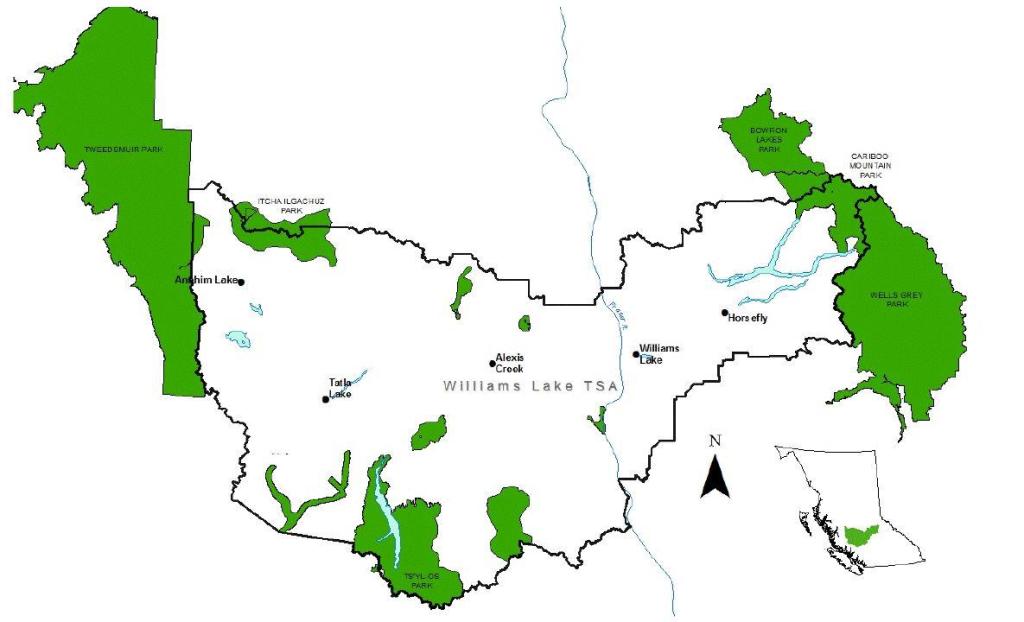
B.C. seeks public feedback on Williams Lake timber supply and future harvest levels
Published 9:42 am Thursday, August 13, 2026
The public is being invited to provide feedback on the timber supply review for the Williams Lake timber supply area before early October.
According to a B.C. government press release, residents can share their thoughts on the discussion paper by submitting their comments before Oct. 5.
The B.C. government said the discussion paper provides the results of a timber supply analysis and describes the current legal requirements, geography, natural resources and forest management practices of the Williams Lake supply area.
According to the provincial government, the information will help B.C.’s chief forester, Shane Berg, determine the allowable annual cut (AAC), or how much timber can be harvested in the timber supply area (TSA).
“Before setting the new AAC, the chief forester will consider input from First Nations, industry and community members,” the release reads.
“Public feedback is a part of every AAC decision and is an opportunity for communities to provide input, which will be considered during the AAC determination.”
The Province added that there are 10 First Nations communities within the area of the Williams Lake TSA, which are:
- Tl’etinqox (Anaham Band)
- Tsi Del Del (Alexis Creek First Nation)
- Yunesit’in (Stone Band)
- Xeni Gwet’in (Nemiah Valley Band)
- Tl’esqox (Toosey First Nation)
- Esk’etemc (Alkali Lake Band)
- Xat’sūll (Soda Creek Band)
- Williams Lake First Nation (T’exelc)
- Ulkatcho First Nation
- Stswecem’c Xget’tem First Nation (Canoe/Dog Creek Band)
Along with the 10 First Nation communities, 18 First Nations have asserted territories in the Williams Lake TSA. The provincial government added that all 28 First Nations have been invited to provide input on the timber supply review.
The Williams Lake TSA, which is administered by the Cariboo Natural Resource District, covers approximately five million hectares in the Cariboo region and its AAC is nearly three million cubic metres per year.
According to the release, when B.C.’s chief forester, who is a registered professional forester, makes a decision, it is an independent and professional judgement based on information from technical forestry reports, First Nations engagement, input from the public and government’s social and economic objectives.
Under the Forest Act, AACs must be reviewed at least once every 10 years for all 37 timber supply areas and 34 tree-farm licences in B.C.
Anyone who wishes to know more or send comments is asked to contact the Cariboo Chilcotin Natural Resource District via post or email.
Further information regarding the technical details of the timber supply analysis is available on request by contacting Forests.ForestAnalysisBranchOffice@gov.bc.ca.









Leave a comment