
Republican candidate for Wisconsin governor Tom Tiffany proposed splitting the Wisconsin Department of Natural Resources, claiming it would be better for sportsmen. However, the plan is opposed by conservation groups and other Wisconsin Republicans.
The Wisconsin Wildlife Federation, the state’s largest conservation organization representing sportsmen, cited stagnant license fees and rising costs as the source to the DNR’s funding challenges. The organization warned that “polarization only weakens conservation,” and called for unity and urged collaboration to protect Wisconsin’s natural resources.
But, Tiffany proposes breaking up the DNR, which is something that has been tried before and been met with strong public opposition. The DNR was created in 1967 through the merger of the The Conservation Department and The Department of Resource Development.
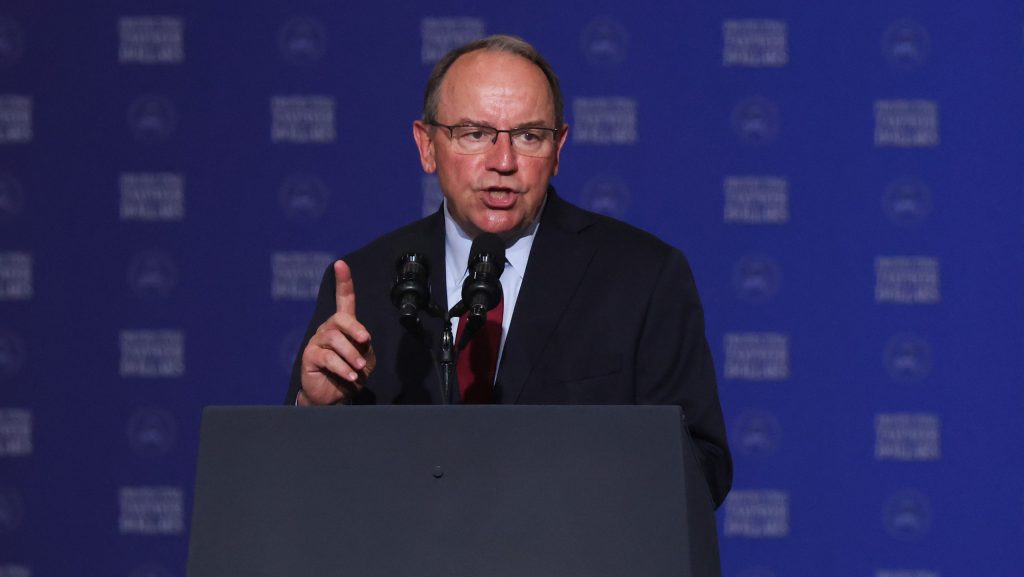
“So the question is in regards to controlling the Department of Natural Resources. So. And in all seriousness, I’m going to work with people like Luke Hildeman who have done so much work on this front to make sure that we have more opportunity for sportsmen, that we have better habitat for sportsmen, and that the Department of Natural Resources serves your interests, not you serving their interests,” Tiffany said at a Medford Tavern Talk on July 9. “We are going to revamp the Department of Natural Resources. I am open to splitting the agency. I am open to splitting the agency so you separate fish, wildlife, hunting, fishing, trapping from the environmental permitting part of it.
“We’re going to make sure that all of you with your sporting license fees, that it actually goes to having better habitat and more opportunity for sportsmen here in Wisconsin.”
The Wisconsin Legislative Audit Bureau found about 90% of state-funded fish and wildlife account spending benefited sportsmen either directly or alongside other outdoor users, according to the bureau’s fiscal year 2024-24 report.
“We determined that $46.3 million, or 49.8 percent of Fish and Wildlife Account expenditures supported by state revenue, was spent for activities that primarily benefited hunters and anglers,” the report states. “To determine the extent to which expenditures benefited hunters, anglers, or other users, we classified Fish and Wildlife Account expenditures supported by state revenue in FY 2023-24 by type of activity. We also determined that $36.7 million (39.5 percent) was spent for activities that benefited hunters, anglers, and other users. In addition, we determined that $0.3 million (0.3 percent) was spent for activities that did not directly benefit hunters and anglers.”
According to the Wisconsin Wildlife Federation, “The funding problem is structural, not managerial. … Most resident hunting, fish and trapping license fees have remained unchanged since 2005, even as costs have risen ~65%. At the same time, growing and diverse outdoor user groups are making greater use of our natural resources—a positive trend that should be celebrated, but one that also increases pressures requiring the agency to be equipped with additional resources.
“There is no single solution to Wisconsin’s conservation funding challenges. Rising costs, shifting outdoor use, and stagnant license sales demand collaboration across political lines and user groups. Polarization only weakens conservation; our natural resources and outdoor traditions require unity. While the current funding model has served the state well, it is time to chart a sustainable path that allows all who benefit from conservation to contribute financially.”
George Meyer, who served as a DNR secretary from 1993-2001, said there have been at least four proposals to split up the agency in the past. He said one occurred early on during his tenure at the DNR under former Republican Gov. Lee Dreyfus. “Each of those efforts have not been finally enacted by the Legislature, and there’s been pretty strong public opposition to them for several reasons,” Meyer told Wisconsin Public Radio in 2022.
Tim Michels, the Republican nominee for governor in 2022, also proposed splitting up the DNR despite Meyer’s objection. Michels’ proposal was similar to ideas put forward in the past, including one in 2016 by former Republican lawmaker Adam Jarchow of Balsam Lake. Former Republican Congressman Mark Green and former Republican Assembly Speaker John Gard also floated the idea, according to the Milwaukee Journal Sentinel.
Republicans have attempted to undo the merger several times. In 1999 and 2001, GOP lawmakers claimed that hunting and fishing license fees were being misspent but audits have concluded the money has properly gone to conservation wardens, land acquisition and wildlife-related purposes, according to the Wisconsin State Journal.
In 2017, the 300-member Wisconsin Association of Retired Conservationists urged former Gov. Scott Walker and the Legislature to reject a proposal to break up the DNR. “The association warns that dividing agency programs would be costly to taxpayers while reducing the value of natural resources and environmental protections,” the association wrote in a letter to Walker, according to the State Journal.
The conservationists said DNR effectiveness can be seen in the state’s top ranking for hunting and fishing, its popular parks and trails, and its revival of endangered species such as the osprey. They also pointed to cleanups of contaminated rivers and harbors in Milwaukee, Sheboygan, Racine and Marinette, and said the close cooperation of recreation and environmental programs in a single agency was responsible for making Wisconsin an attractive place.
“These high-quality natural resources that make Wisconsin a vacation, hunting and fishing destination, a healthy place to raise our children, and a quality of life attraction to businesses were the direct result of an integrated DNR,” the letter says. “Stepping backward from that successful and proven structure is a mistake.”
Another former DNR secretary, Scott Hassett, also warned Republicans in 2016. “If the DNR is split up, Republicans will ‘have one agency they can feed and one they can starve,” Hassett told the State Journal in 2016. “They like to feed fish and wildlife, and starve environmental protection.” Wisconsin merged its wildlife conservation and pollution control agencies into the DNR in 1967 as a way to make state government more efficient.
According to the State Journal, “Republicans have periodically tried to split DNR recreation programs away from its pollution-control functions, but they’ve fallen short, in part because two of the department’s main constituencies — outdoors clubs and environmental groups — have found a common cause in resisting.
“We all at some point have common interests in terms of the protection of the environment,” Meyer said in 2016. “Those who are not friends of conserving the environment want to split the department.”
The DNR fisheries program that stocks streams works best in close cooperation with the DNR offices that do research on aquatic life, protect shorelines, manage parks and recreation areas and regulate water pollution, Meyer said.
In addition to the environmental officials, Republicans faced opposition from lawmakers within their own party when the issue arose a decade ago.
In 1995, when Michigan split its DNR, administrative costs rose by millions, environmental funding fell and sportsmen lost influence over environmental decisions.
According to Ann Arbor News, “The cost of administration has increased 15 percent, the cost of executive division programs has skyrocketed 66 percent and environmental program funding has decreased 4 percent since the split.
The DNR and Tiffany’s campaign didn’t immediately respond to a request for comment.












Leave a comment