
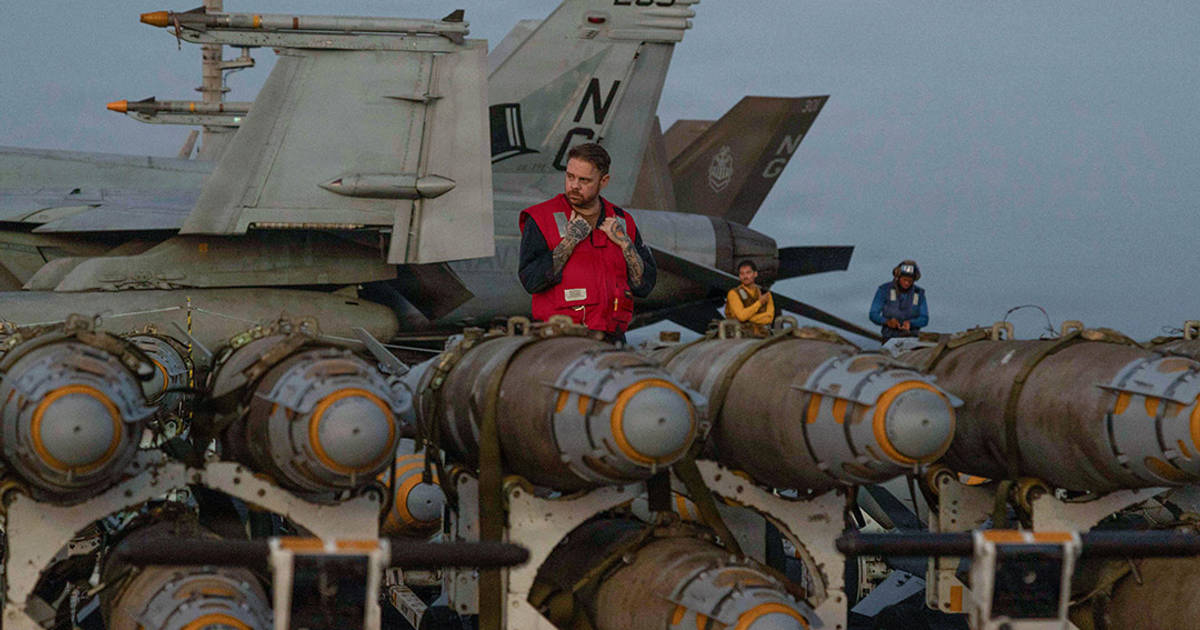
The true strategic risk, however, is not the total expenditure but the uneven rate of depletion. Inventories of some munitions remain deep and scalable, while others – particularly long-range interceptors and precision strike weapons – are nearing exhaustion.
This dynamic marks the convergence of several established strategic logics. Bertrand Badie’s ‘impotence of power’ captured the paradox of modern warfare, where American hyperpower of battlefield dominance fails to secure political outcomes. Barry Posen’s ‘Command of the Commons’ grounded US military primacy in its ability to project power across global sea, air and space. Yet, as Martin van Creveld warned back in 1991 that advanced militaries become uniquely fragile when their power depends on complex, low-density systems that are difficult to replace under stress.
This emerging imperative demands a new strategic framework: ‘Command of the Reload.’ In a salvo-based environment, where ‘missile math’ governs the intensity of warfighting, the decisive advantage shifts to the actor that can sustain its defensive economy and replenish its most critical assets. Operation Epic Fury is the first test of this new reality, and its initial results are a stark warning.
The Anatomy of Endurance: Critical Categories and the Second-Theatre Tax
The core lesson from the first 16 days is that ‘critical’ is becoming a material condition. A munition becomes critical when its replenishment is gated by thin suppliers, long qualification cycles, or constrained components like rocket motors and guidance electronics. Prior to the conflict, multiple reports had already warned of a ‘deteriorating US defence industrial base’ and its ‘empty bins in a wartime environment.’ The mass of the weapon is not the measure; a few kilograms of a constrained input, such as gallium, battery-chemicals or graphite, can stall the production of various weapons, while a warehouse full of steel is useless if a system is bottlenecked at the sub-tier.
This industrial fragility is exacerbated by both policy inertia and geopolitical realities. Even after the Trump Administration met with defence industry executives on 6 March, our discussions with defence firms indicate that no production surge has occurred because no funded orders have been placed. Industry leaders are reluctant to increase production without firm commitments, having been ‘burned’ in the past by promises of funding that did not materialize. Compounding this, the sole American factory for high explosives, Holston Army Ammunition Plant, has not received orders to increase production. Industrial base production is only made worse by the closure of the Strait of Hormuz, which threatens upstream supply chains for vital materials like sulphur.
As Table 2 shows, over a dozen munition types have been expended by the coalition at a rate that appears to be unsustainable. Already, Rheinmetall CEO Armin Papperger noted on 19 March that global stockpiles are ‘empty or nearly empty’ and that if the war continues another month ‘we nearly have no missiles available’.














Leave a comment