

This article from CYAUSE Audit Services Ltd is most popular:
- within Intellectual Property topic(s)
- in European Union
Kyriakos Tramountanellis’s articles from CYAUSE Audit Services Ltd are most popular:
- within Intellectual Property topic(s)
- in European Union
- in European Union
CYAUSE Audit Services Ltd are most popular:
- within Law Department Performance, Wealth Management and Immigration topic(s)
If you are a technology company or a franchisor the Cyprus IP
Box is for you!
1. What qualifies under the Cyprus IP Box
According to Cyprus Income Tax Law (Article 9(1)(k)):
A qualifying IP asset is:
- a patent,
- a computer program (copyrighted software), or
- other IP that is the result of R&D activity and not a
marketing-related intangible.
To benefit, the IP owner must also meet the nexus requirement
— i.e., the IP income must come from its own R&D
activities (or outsourced to unrelated parties) that created the
IP.
2. What does not qualify
- Trademarks
- Brand names
- Image rights
- Customer lists
- Marketing intangibles
- Franchise or license fees primarily for brand use or know-how
that is not R&D-based
For instance, marketing material and franchise agreements,
intangible assets such as trademarks, brands, image rights are not
considered qualifying intangible assets.
3. Franchise agreements — how they fit
- If the franchise agreement mainly covers brand, trademark, and
marketing support, → Not qualifying IP as it is marketing
focussed. - If the agreement licenses use of proprietary software systems,
internal platforms, or technology that were developed through
qualifying R&D, → Qualifying IP (subject to nexus
test).
In other words, franchise agreements could be subject to the
reduced Cyprus Corporation Tax rate of 2.5% if they do not relate
to marketing activities but rather to proprietary software
systems.
In practical terms, if your franchise model relies on the
franchisee using the franchisor’s proprietary software,
operating system, or tech tools that were developed in-house, the
portion of franchise income attributable to that IP could fall
under the Cyprus IP Box.
But you’ll need to:
- segregate the income streams contractually (software vs
brand), - demonstrate R&D activity in Cyprus or by the Cyprus entity,
and - document the nexus link (development costs → IP asset
→ income).
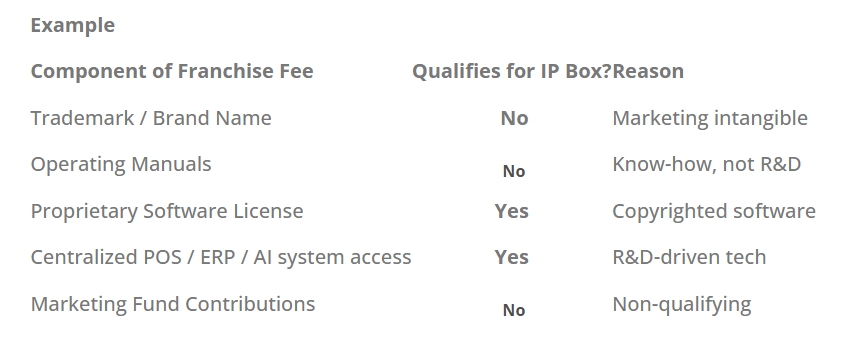
How should the franchise agreement be structured in order to
qualify for the Cyprus IP Box Regime.
1. Separate the income streams in the contract
Cyprus tax authorities and transfer pricing rules (as well as
OECD BEPS Action 5) expect you to segregate income clearly by
function.
So instead of one undifferentiated “franchise fee,”
break it down, for example, like this:
Example clause (simplified)
“The Franchisee shall pay to the Franchisor:
(a) a Software Licence Fee equal to 3% of Gross Revenue, for the
use of the Franchisor’s proprietary management software systems
and related support; and
(b) a Brand Royalty Fee equal to 2% of Gross Revenue, for the
use of the Franchisor’s trademarks, trade names, and brand
identity.”
This ensures:
- (a) can potentially qualify under the IP Box (if the software
is developed and owned by the Cyprus entity and meets nexus
requirements), - (b) remains outside the regime (as it’s
marketing-related).
2. Demonstrate that the software is “qualifying
IP”
The Cyprus entity must show:
- It developed or enhanced the software internally (or via
unrelated contractors), - It owns the economic rights to the software, and
- The software is protected under copyright law (registered or
inherently copyrighted).
This can be supported by:
- R&D cost breakdowns (Cyprus entity’s development costs,
payroll, etc.), - Technical documentation and version control logs,
- Copyright registration (optional but helpful),
- Functional descriptions showing the system’s innovation or
custom development.
3. Keep a nexus-tracking file (mandatory for IP Box)
Cyprus IP Box uses the Modified Nexus Fraction:
You must maintain:
- R&D costs incurred in Cyprus,
- costs for acquired IP or outsourced R&D (to
related/unrelated parties), and - calculations showing how these link to income from the
franchisees’ use of the software.
It is strongly advisable keeping this in an annual Excel
workbook or TP file.
4. Support with Transfer Pricing (TP) documentation
A Transfer Pricing study is a study performed by independent tax
experts at a fee where they express their opinion as to the
reasonableness of the rates used in commercial agreements using
3rd party evidence, benchmarking and industry data.
A Transfer Pricing Study should:
- identify the distinct IP assets (software vs brand),
- allocate fees based on comparable licensing benchmarks,
- and demonstrate that the 3% and 2% (or whatever ratio you use)
is arm’s length.
That allocation protects your structure if challenged by the
Cyprus Tax Department.
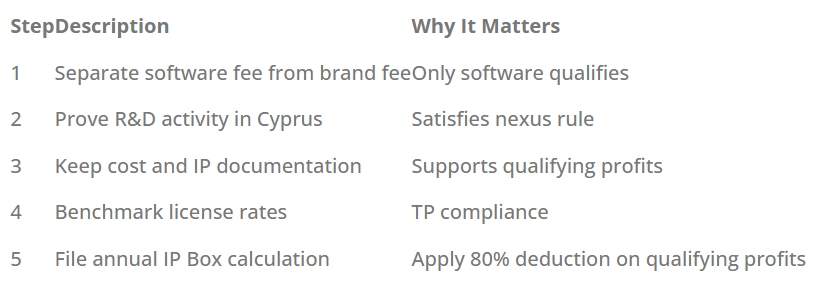
5. Summary — How to make it IP Box compliant
To view the full article please click
here.
The content of this article is intended to provide a general
guide to the subject matter. Specialist advice should be sought
about your specific circumstances.












Leave a comment