

Even though the market is soaring, you can still find many stocks trading at huge discounts to previous highs. This is where the buying opportunities are right now, not among the artificial intelligence (AI) winners that went up 500% over the last year.
Take Remitly Global (RELY -2.94%) and Adyen (ADYEY +0.21%). The two financial technology (fintech) stocks are down over 50% from the highs they set close to five years ago — a tremendously painful journey for any shareholder. And yet, they just might be among the best opportunities for growth investors on the stock market today.
Here’s why patient investors will do well buying both Remitly and Adyen as long-term fintech growth stocks.

Today’s Change
(0.21%) $0.02
Current Price
$9.32
Key Data Points
Market Cap
Day’s Range
$9.27 – $9.46
52wk Range
$8.93 – $18.42
Volume
1.3M
Avg Vol
2.3M
Gross Margin
83.44%
Remitly’s growth story
Remitly Global operates a digital remittance platform that allows individuals and small businesses to easily send money across borders. It’s mainly used as a replacement for legacy money transfer services (like Western Union) by people sending funds from the United States abroad.
The application has gained significant market share since Remitly’s initial public offering (IPO) in 2021, driven by its lower fees, easy-to-use mobile app, and a wide range of pickup options for receivers. Last quarter, total send volume grew 37% year over year to $16.2 billion, while total revenue had increased 572% since the IPO. Remitly is now highly profitable, generating net income of $49.1 million last quarter, for a net income margin of 11%.
Despite this growth and profit inflection, Remitly remains down 50% from its all-time highs set around the time of its IPO.

Image source: Getty Images.
Growth from a superior payments infrastructure
Another market-share gainer in a different corner of the payments market is Adyen. The company has built a global payments infrastructure that allows merchants and digital platforms to process payments seamlessly, both online and offline. You may never have heard of the brand, but it processes payments for hundreds of enterprises worldwide, including long-term partners Uber Technologies and Spotify Technology.
Regardless of the payment method a customer uses, Adyen takes a small cut of every transaction. Over the last 12 months, Adyen has processed $1.69 trillion in payment volume worldwide, up from $35 billion in 2015. The company is gaining market share because of its superior technology, which benefits the growing number of merchants that need a globalized payments infrastructure.
Revenue has grown at a 38% compound annual rate in U.S. dollars since 2015, with net revenue up 20% year over year in constant currency last quarter. At the same time, Adyen stock is down 72% from its 2021 highs.
The best part about Adyen is its cost discipline, which drives strong unit economics and shows up in its various margin figures. EBITDA (earnings before interest, taxes, depreciation, and amortization) margin is expected to return to 55% by 2028, accompanied by strong revenue growth.
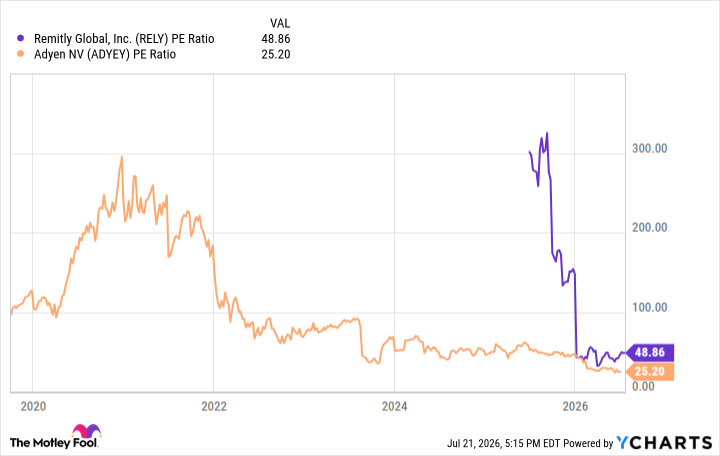
RELY PE Ratio data by YCharts.
Why Remitly and Adyen are great buys
What makes these two fintech growth darlings most attractive is their low valuations. This is what happens when you combine durable revenue growth and falling share prices.
Right now, Remitly Global trades at a price-to-earnings (P/E) ratio of 49. This may not seem cheap at first glance, but remember that the company is just seeing a profit-margin inflection at a greater scale. Full-year revenue in 2026 is expected to be just under $2 billion. An 11% profit margin on that figure is $220 million in net income, for a forward P/E of 23 based on the current market cap of $5 billion. There’s also plenty of room for revenue to keep growing and margins to keep expanding in the years ahead.
Adyen’s valuation is simpler. It trades at a current P/E ratio of 25 with a conservative balance sheet, healthy growth prospects, and expanding profit margins.
Taken together, these fallen angels look like great buys today for investors who plan to hold for the next five to 10 years.














Leave a comment