

The government is pushing to enact a “Basic Law on State Assets” to comprehensively manage state assets worth more than 1,400 trillion won. The plan expands the current State Property Act, which focuses on the preservation and sale of land and buildings, to cover intellectual property and financial assets, while also creating measures to share development profits from state real estate with citizens.
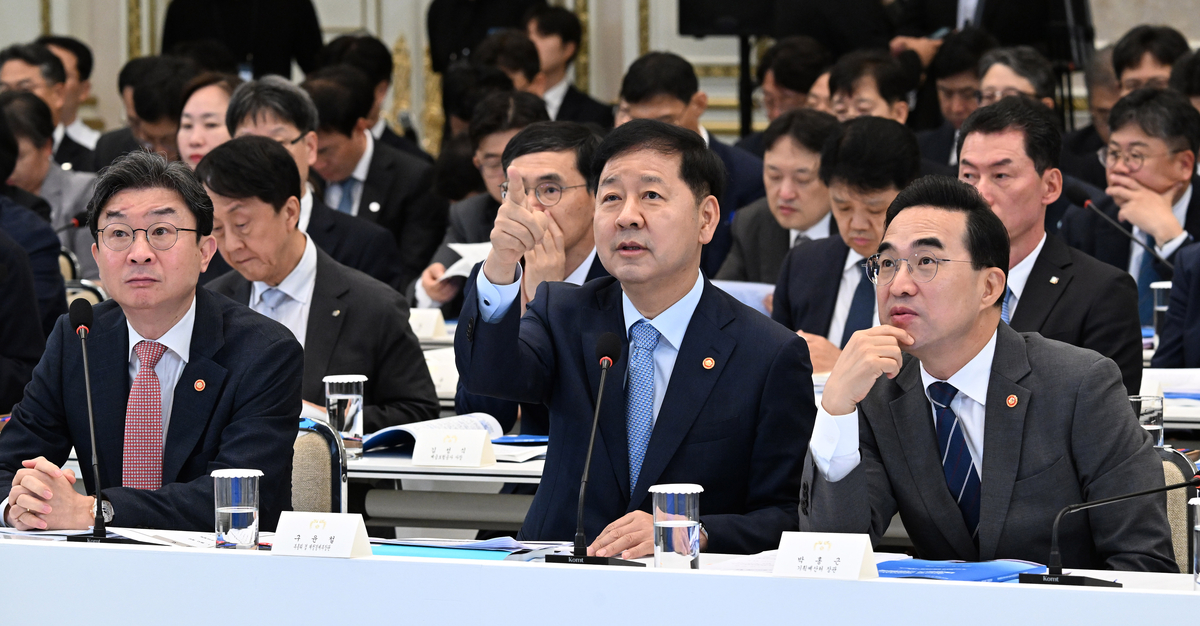
The Ministry of Economy and Finance announced the treasury and state property innovation plan at a policy briefing held at the Yeongbin-gwan guest house of the presidential compound on the 15th. The concept calls for shifting to a “K-Asset” framework that raises value by developing and operating state assets, rather than merely preserving or disposing of them.
The current State Property Act was enacted in 1950 and was designed on the premise of a real estate-centered asset structure. “The scale of state assets now exceeds 1,400 trillion won, and their types have diversified into intellectual property and financial assets,” a ministry official said, adding that the government would form a joint public-private task force to push for the enactment of the Basic Law on State Assets.
The new law is expected to include management principles for the full range of assets held by the state, including not only land and buildings but also government equity stakes, patents and copyrights. The task force will also review measures to include virtual assets, which are not substantially addressed under the current framework.
The government will also strengthen surveys to assess the state of state property management. It plans to conduct the comprehensive state property survey annually, currently done every five years, and to build an artificial intelligence (AI)-based database to systematically manage the utilization status and development potential of assets.
The government will actively use private capital and expertise in the development process. It will expand trust-based development and long-term leasing, and share operating profits generated from securitizing state real estate with citizens. It will also prepare an “Integrated Guideline for State Property Development Projects” by December this year, unifying standards that previously differed by development method and participating entity.
State-owned land will be used as a means to support national strategic projects. In the process of building industrial complexes and clusters for the three major mega-projects, the government will allow private contracts for state-owned land and reduce usage fees and lease fees. It will also expedite the preliminary feasibility studies for public institutions required for the Korea Electric Power Corporation’s power grid construction and the Korea Land and Housing Corporation’s (LH) industrial complex development.
On the other hand, the government will strengthen controls over undervalued sales and unauthorized occupation. It will push for legal amendments to require prior reporting to the National Assembly when selling state property worth 30 billion won or more, and to prohibit discounted sales in principle. For unauthorized occupation, it will raise the indemnity rate and expand restoration orders and administrative execution.
AI and blockchain will also be introduced into the management of treasury funds and government bonds. Starting in 2027, the government will build a system using dedicated treasury-fund AI to reduce shortfalls and surpluses arising during fund execution by each ministry, and to optimize the timing and scale of government bond issuance by analyzing market conditions.
A pilot project to execute treasury funds via deposit tokens will begin in the second half of this year. The goal is to first apply it to electric vehicle charging facility subsidies and government business promotion expenses, then execute a quarter of all treasury funds via deposit tokens by 2030. In 2027, the government will also push a pilot project for government bond tokenization.
Direct investment in retail-oriented government bonds through retirement pension accounts will also be permitted starting in September. However, specific institutional designs—such as the timing of the Basic Law on State Assets enactment, the scope of virtual assets, the method of securitizing state real estate, and restrictions on where deposit tokens can be used—will be finalized after future discussions among the public-private task force and relevant ministries.













Leave a comment