
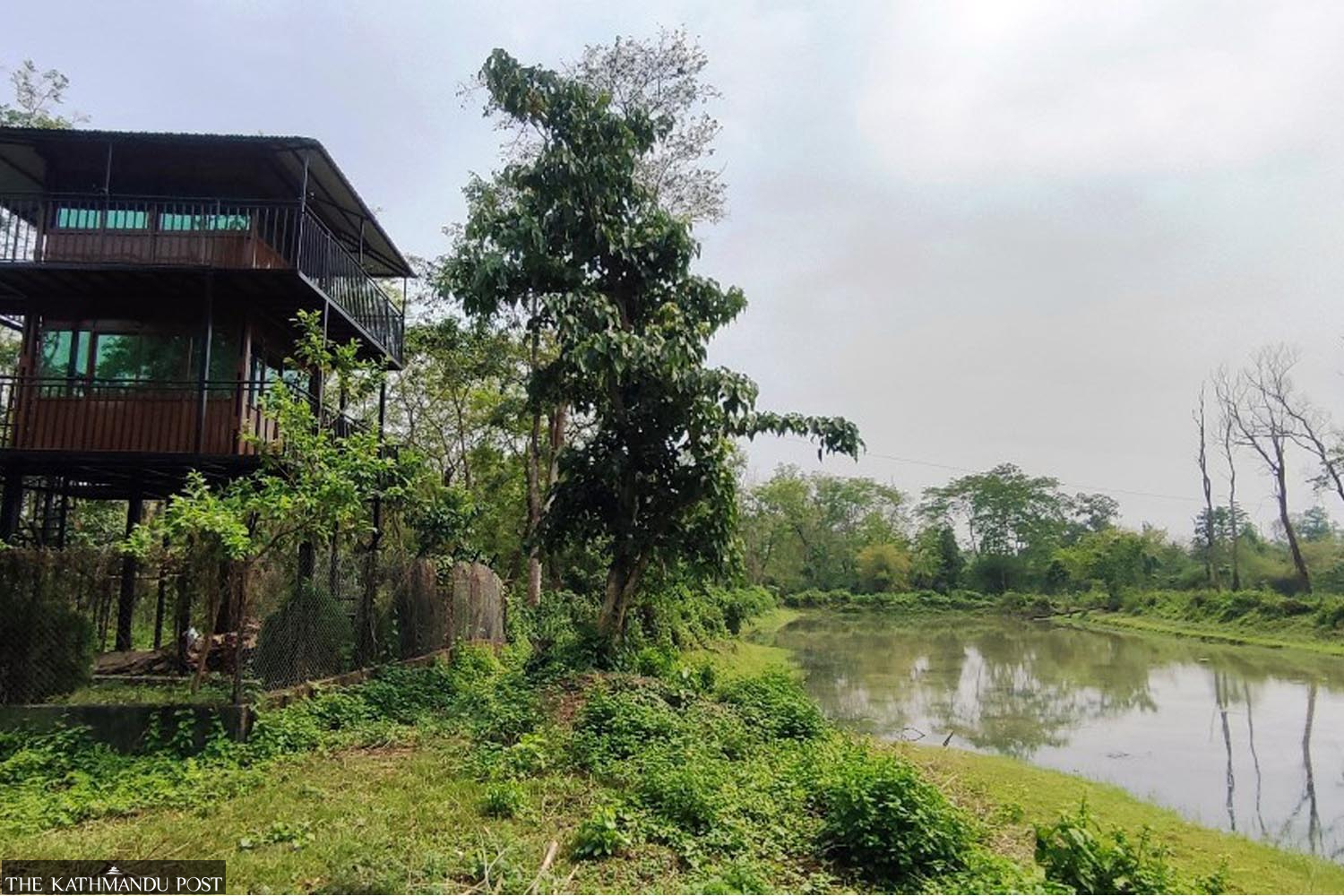
A proposal to introduce an evening jeep safari in the biologically sensitive Barandabhar forest corridor has drawn strong opposition from conservationists, who warn it could disrupt wildlife movement in one of Nepal’s most critical biological linkages.
Jeep safaris are a long-established tourism activity in Chitwan, allowing visitors to observe rare wildlife. At present, safaris operate only in the morning and afternoon, with vehicles required to exit forest areas before sunset.
The new plan, however, seeks to extend safari operations into the evening inside the Barandabhar corridor, which links the hills of the Mahabharat range with the lowland ecosystems connected to the Chitwan National Park.
Conservationists say the proposal raises serious concerns given the sensitivity of the corridor, which is considered a key wildlife passage.
The corridor forest, stretching across Bharatpur’s Gondrang in the west to Tikauli in Ratnanagar, is bisected by the East-West Highway. North of the highway, three community forests in Ratnanagar—Panchakanya, Chaturmukhi and Bhimwali—are preparing to launch the evening safari jointly.
“We have worked hard to protect the forest. Selling only timber is not enough. We are turning to eco-tourism due to its potential,” said Hari Kumar Gurung, chair of the Chaturmukhi Community Forest committee. He said daytime safaris had already begun in parts of the forest last year.
The proposal emerged soon after authorities suspended jeep safaris inside the Chitwan National Park during the monsoon season, citing damaged tracks and wildlife breeding cycles.
The suspension, issued on Tuesday, is expected to last around two to three months. On the same day, reports emerged that community forests in Barandabhar were preparing to begin evening safaris from mid-July.
The timing has fuelled debate among officials and conservation groups, prompting authorities to review whether proper preparations are in place before implementation.
Conservationists have voiced strong objections.
Surajan Shrestha, a wildlife rights activist based in Sauraha, urged the Division Forest Office, Chitwan, to halt the plan.
“A forest is wildlife’s home. Animals do not tolerate noise and disturbance in their home at night,” he said.
Shrestha recalled that a long wildlife overpass was proposed to ensure safe animal movement when the East-West Highway was widened through Barandabhar, underlining the corridor’s biological importance.
“Introducing evening-time jeep movement here is reckless. We should benefit from tourism while respecting wildlife. Operating this safari while disturbing animals at night is simply greed in the name of money,” Shrestha said.
Nature guide and conservationist Doma Paudel said evening is a sensitive time for wildlife behaviour.
She warned that vehicle movement could disrupt natural routines and increase stress in animals.
“If animals become agitated and aggressive, it will put at risk not only tourists but also locals who enter the forest to collect firewood or grass,” Paudel said. “Tourism should reduce human-wildlife conflict, not create new challenges.”
She added that such projects require detailed research before approval, stressing the need to prioritise coexistence over visitor numbers.
Chitwan-based bird and wildlife expert Basu Bidari also opposed the plan, calling Barandabhar a critical corridor.
“In winter, animals move to lower ground and in summer to higher elevations. They rely on this corridor day and night. An evening safari here would disrupt that movement, he said.”
However, not all conservation voices are opposed. Nature guide Manesh Limbu from western Chitwan said tourism and conservation could be balanced with strict regulation.
“If conservation is not tied to income, it stays only a slogan. Many countries run similar safaris. We can do the same with proper management,” he said.
Jeep safaris have long operated in Chitwan during the morning and afternoon, and the idea of an evening safari originally came from tourism entrepreneurs in Sauraha. Operators had planned to introduce evening jeep safaris in the buffer zone, including Kumroj and others east of Sauraha. Preparations had begun around seven years ago, ahead of the 2020 Visit Nepal Year campaign, but the plan never materialised.
The current plan has shifted to national forest areas outside the park and the buffer zone after the proposal failed to move forward in buffer zone forests near the national park.
Om Pandey, president of the Regional Hotel Association Nepal Sauraha, said an evening safari would offer tourists a new experience in Chitwan.
“If introduced, it will add a new tourism product in Chitwan,” Pandey said.
Pandey said the association would run the safari if the forest user groups’ plan is approved by the authorities. He also said the proposal has been labelled a night safari, but the plan is to run it only in the evening.
Bishnu Prasad Acharya, chief of the Division Forest Office, Chitwan, said the safari will not start immediately. “Two community forests are currently running daytime jeep safaris. Their approval runs until mid-July, and a new plan has not been prepared yet,” Acharya said.
HAN president Pandey said the safari would be launched on a trial basis initially, which would help with marketing, and could move into full operation around the Dashain festival if things go as planned. He said the safari work plan must be approved by the forest user groups’ general assembly and then cleared by the forest office, a process that could take until July-end.
“The work plan should clearly define morning and evening safaris. In summer, safaris can run until 8pm at most, and in winter until 7pm. These details must be set in the plan,” he said.
Pandey said that the safari route would cover around 15 kilometres through the Panchakanya, Chaturmukhi and Bhimwali community forests.
Panchakanya Community Forest chair Govinda Syangtan said the proposal had been received positively.
“The safety of both animals and visitors is our responsibility. We will operate the safari in a way that does not disturb wildlife. That is why approval should come through,” he said.
Wildlife expert Baburam Lamichhane said extensive preparation is needed before introducing evening safaris.
He said only electric vehicles should be used to minimise noise and warned that the route must be properly maintained.
“Timing must be strictly controlled. Safaris should not run late into the evening,” he said.
He said the number of vehicles should also be regulated to avoid additional stress on wildlife, noting that similar controlled safaris operate in Africa and India.
He urged the authorities to proceed only after properly assessing the sensitivity of the biological corridor.
The plan has been driven largely by tourism entrepreneurs in Sauraha, who initially attempted to introduce evening safaris in buffer zone community forests near Kumroj in 2020 ahead of the Visit Nepal Year campaign. The proposal was never implemented.
With restrictions near the national park, the current plan has shifted to national forest areas outside protected zones.
Om Pandey, president of the Regional Hotel Association Nepal Sauraha chapter, said the new activity could diversify tourism offerings.
“This is our initiative. We have also held meetings with forest user groups. If the government approves the process, it will add a new product to tourism in Chitwan,” he said.
He clarified that the proposal refers to evening safaris rather than full night operations.
Division Forest Office Chitwan chief Bishnu Prasad Acharya said the plan is not ready for immediate rollout.
“The current work plan for daytime safaris ends in Asar. A new plan has not yet been prepared,” he said.
He added that safaris would require formal approval from forest user assemblies and the forest authority, a process that could take until mid-August.
Acharya said monsoon conditions also make forest driving unsafe. He emphasised that any plan must clearly define operating hours.
“In summer, safaris should end by 8 pm at the latest and in winter by 7 pm,” he said.
The proposed route spans around 15 kilometres inside the Pangkanya, Chaturmukhi and Bhimbeli community forests.
Pangkanya Community Forest chair Govinda Syangtan said concerns over wildlife impact were being taken seriously.
“We do not want to harm wildlife. Their safety and visitors’ safety are both our responsibility. We will ensure minimal impact,” he said.
Wildlife expert Baburam Lamichhane said evening safaris require strict safeguards before approval.
He recommended electric vehicles to reduce noise pollution and stressed the need for smooth, obstacle-free roads along the route.
“If these conditions are met, only light disturbance remains from headlights. Timing must also be strictly controlled. Safaris should not extend late into the evening,” he said.
He also warned against allowing too many vehicles at once, saying safari volume must be regulated.
He cited examples from Africa and India where controlled night safaris operate under strict management systems.
Inside the Barandabhar corridor, natural wetlands, grasslands and viewing platforms already exist, including Khageri Machan, which allows wildlife observation along the route.
Conservationists say any final decision must account for the corridor’s ecological sensitivity, given its role as a major wildlife passage between protected areas and surrounding forests.













Leave a comment