
2.2.3 Other Types of Trademarks
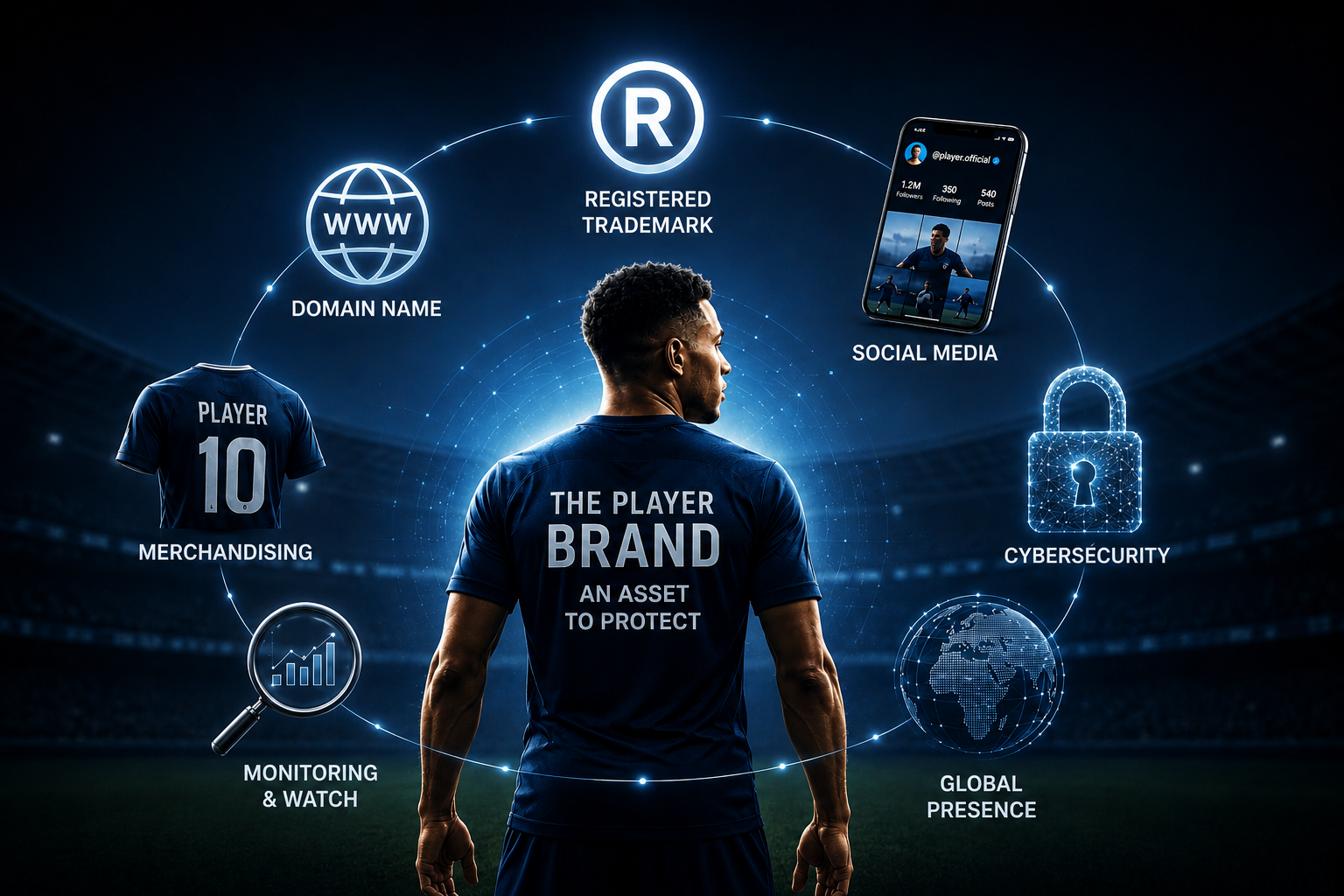
A player’s name and celebrations are not the only elements capable of benefiting from trademark protection. Depending on the circumstances, a player may also protect logos, monograms, handwritten signatures, nicknames, jersey numbers, slogans, silhouettes, graphic representations, three-dimensional shapes, and even certain sound marks associated with their identity or commercial activities.
Contemporary trademark law offers a wide range of protection mechanisms. Alongside traditional word marks, it also recognises figurative marks, three-dimensional marks, position marks, pattern marks, multimedia marks, hologram marks, and sound marks. In some cases, the same element of a player’s identity may even benefit from several complementary forms of trademark protection.
This diversity enables athletes to build comprehensive trademark portfolios covering all the signs that contribute to their commercial identity. The objective is not only to prevent unauthorised use, but also to establish valuable assets capable of supporting partnerships, licensing arrangements, merchandising, and other forms of commercial exploitation.
2.3 Building a Domain Name Portfolio
In the digital environment, trademarks and domain names maintain a unique relationship. These two assets perform distinct yet complementary legal functions. A trademark identifies the commercial origin of goods or services. A domain name is simply the natural extension of that trademark. It may serve as the access point to an official website, an online store, an academy, a foundation, a content platform, merchandising activities, or entrepreneurial ventures developed after a player’s sporting career.
Effective protection of these assets nevertheless requires the adoption of a genuine portfolio management strategy. As of 2026, the domain name ecosystem comprises more than 1,200 Top-Level Domains (TLDs), in addition to country code Top-Level Domains (ccTLDs) and emerging blockchain-based naming systems. This landscape is not static. The Internet Corporation for Assigned Names and Numbers (ICANN) has launched a new application round for the creation of additional generic Top-Level Domains, meaning that the number of available TLDs is expected to continue growing in the coming years. In such an environment, systematically registering every conceivable variation would be both unrealistic and economically inefficient.
2.3.1 Essential Domain Name Extensions
Given the growing number of available extensions, the strategy cannot consist of systematically registering every possible variation. Instead, it should be based on a carefully considered selection of the most relevant extensions, taking into account the player’s reputation, key markets, commercial projects, and the level of risk associated with each extension.
The .com extension generally remains the global benchmark. Securing it often forms the cornerstone of a domain name protection strategy. Other traditional generic extensions, such as .net and .org, may also be valuable, particularly for protecting the principal variations of the player’s name, as well as those of their foundation, academy, or institutional projects.
Extensions directly related to football and sport also deserve particular attention. TLDs such as .football, .soccer, .futbol, .sport, .sports, .club, and .team can strengthen the consistency of a player’s digital identity while reducing opportunities for opportunistic registrations by third parties. Their relevance, however, depends on the player’s actual activities, target audience, and the likelihood of confusion.
|
Category |
Relevant TLDs |
Value for a Football Player or Football Brand |
|
Global reference |
.com |
Priority extension. It remains the international standard for official websites and global commercial activities. |
|
Traditional generic extensions |
.net, .org |
Useful for securing the main variations of the player’s name, foundation, academy, or institutional projects. |
|
Football |
.football, .soccer, .futbol |
Extensions directly related to football. Relevant for official websites, academies, foundations, or promotional operations. |
|
Sport in general |
.sport, .sports |
Suitable for broader sporting activities and projects extending beyond football alone. |
|
Clubs and teams |
.club, .team |
Relevant for academies, youth teams, supporter communities, or certain entrepreneurial projects. |
|
Training and coaching |
.academy, .coach, .training |
Useful for academies, training camps, coaching programmes, and post-career activities. |
|
E-commerce |
.shop, .store |
Suitable for official stores, merchandise, merchandising, and commercial collaborations. |
|
Events |
.tickets, .events |
Useful for training camps, promotional events, tours, or meet-and-greet activities with supporters. |
|
Media and content |
.tv, .video, .media, .live |
Relevant for audiovisual content, official channels, documentaries, and live broadcasts. |
|
Communities and premium programmes |
.fans, .fan, .vip, .plus |
Suitable for community spaces, premium subscriptions, exclusive content, and marketing operations. |
|
Commercial activities |
.business, .partners |
Useful for partnerships, licensing, sponsorships, and B2B relationships. |
|
Geographic extensions (ccTLDs) |
.fr, .eu, .uk, .es, .it, .de, .br, .us, .au, .jp, .cn, etc. |
Relevant for the player’s key markets and the territories where the brand is commercially exploited. |
|
CityTLDs |
.paris, .london, .barcelona, .melbourne, .nyc, etc. |
Useful where a player has a strong connection with a particular city. |
|
Sensitive extensions to monitor |
.sucks, .wtf |
May be used for critical, parasitic, or fraudulent purposes; monitoring is recommended. |
|
Web3 and decentralised systems |
.eth, .crypto, .wallet, .nft |
Blockchain-based domain names that may justify defensive registrations for the most exposed players. |
|
dotBrand (future perspective) |
.playername |
A potential option for the strongest sports brands under ICANN’s New gTLD Program. |
Depending on the player’s projects, other specialised extensions may also be worth considering. Extensions such as .academy, .coach, and .training may be appropriate for training activities or post-career ventures; .shop and .store for e-commerce; .tickets and .events for promotional or event-related activities; .tv, .video, .media, and .live for audiovisual content; and .fans, .fan, .vip, and .plus for supporter communities or premium membership programmes.
Finally, geographic extensions and cityTLDs may be of particular value where a player has a strong connection with a specific city, country, or market, whether through their place of origin, residence, professional activities, or commercial operations. This may include country-code extensions such as .fr, .eu, .uk, .es, .it, .br, or .au, as well as cityTLDs such as .paris, .london, .barcelona, .melbourne, or .nyc.
The objective is therefore not to multiply registrations mechanically, but rather to identify the extensions that offer the best balance between visibility, commercial value, strategic coherence, and risk management.
For high-profile players, domain name management has become a strategic priority. IP Twins assists rights holders with the auditing, registration, renewal, and protection of their international domain name portfolios.
2.3.2 Domain Name Blocking Mechanisms
Even with a carefully targeted registration strategy, the number of potentially necessary domain name registrations remains considerable. This is why preventive blocking mechanisms now play an important role in brand protection strategies. Solutions such as GlobalBlock and GlobalBlock+ make it possible to prevent the registration of identical signs and, in some cases, confusingly similar variants across hundreds of participating TLDs, without requiring the individual registration of each domain name. These mechanisms have become one of the most effective tools for reducing exposure to risk while keeping protection costs under control.
2.3.3 Crypto Domains and Decentralised Naming Systems
Beyond traditional domain names, rights holders must now take into account the emergence of decentralised naming systems. Crypto domains, particularly within the .eth, .crypto, .nft, .wallet, and other blockchain-based naming systems, represent a new category of digital assets that may be registered by third parties.
Although their use remains more limited today than that of traditional domain names, the defensive registration of the most strategically important identical variants may prove worthwhile for players with significant international visibility. This precaution is all the more advisable given that, at present, no universal equivalent to the UDRP exists across most decentralised naming systems. Where a crypto domain has been registered by a third party, the available recovery mechanisms are often far more limited than those available under the traditional domain name system. At the very least, the defensive registration of a player’s name within the .eth namespace should now be considered as part of any serious digital asset protection strategy.
The objective remains the same: to reduce exposure to risk before any infringement occurs. As with any risk management strategy, the aim is not to eliminate every possibility of abuse, but to make the opportunistic exploitation of the player’s brand as difficult, costly, and unattractive as possible.
2.4 Monitoring the Digital Ecosystem
No protection strategy, however sophisticated, can eliminate all risks. Trademark registrations, defensive domain name registrations, blocking mechanisms such as GlobalBlock, and preventive registrations within Web3 naming systems are all essential measures. They do not, however, remove the need for continuous monitoring.
The internationalisation of the digital economy, the proliferation of online platforms, the continuous expansion of Top-Level Domains, the emergence of new digital services, and the speed at which content spreads make the implementation of continuous monitoring systems indispensable.
2.4.1 Monitoring Intellectual Property Assets
Monitoring has become one of the cornerstones of protecting athletes’ intellectual property assets. In today’s global digital environment, infringements are no longer limited to the reproduction of protected signs. Fraudsters also seek to divert audiences, exploit reputations, impersonate identities, collect personal data, disseminate misleading content, and market unauthorised products.
This evolution has considerably broadened the scope of monitoring. It is no longer confined to trademarks and domain names, but now extends to all digital spaces capable of contributing to a player’s identity. Online Brand Protection programmes may therefore encompass trademark registers, traditional domain names and crypto domains, social media platforms, e-commerce platforms, online marketplaces, mobile applications, search engines, content-sharing platforms, Web3 environments, NFTs, and even certain AI-generated content.
In practical terms, monitoring makes it possible to detect, among other things, the registration of new domain names incorporating the player’s name or trademarks, the appearance of fake social media accounts, the sale of counterfeit products on online marketplaces, and the unauthorised use of the player’s image and distinctive signs. It may also extend to more technical indicators, such as DNS changes, the issuance of TLS/SSL certificates, or the activation of new content that may reveal fraudulent activity.
The objective is not merely to identify existing infringements, but to detect them early enough to enable a rapid response. A fraudulent domain name identified within a few days of its registration generally poses only a limited risk. The same domain name, if left active for several months, may become the basis for phishing attacks, identity theft, the sale of counterfeit products, or other forms of fraud with far more serious consequences. Promptly detecting an infringement, assessing its level of risk, and implementing the appropriate corrective measures are therefore essential components of any modern online asset protection strategy.
IP Twins provides trademark, domain name, and digital asset monitoring services tailored to the needs of stakeholders in the sports industry. These solutions include the detection of high-risk domain names, fake social media accounts, counterfeit products, and online reputation threats, as well as the management, protection, and optimisation of domain name portfolios.
2.4.2 Heightened Vigilance During High-Risk Periods
This vigilance is particularly important in professional football. Transfer windows, major international tournaments, award ceremonies, changes of equipment sponsors, the launch of new merchandise, and the announcement of commercial partnerships regularly give rise to spikes in opportunistic activity. Fraudsters seek to exploit the heightened media attention surrounding players in order to maximise the visibility and credibility of their schemes. These periods of increased media exposure therefore justify the temporary reinforcement of monitoring measures to ensure that infringements are detected and addressed as quickly as possible.
2.5 Removing Infringements of Intellectual Property Assets
Even the most sophisticated protection strategies cannot prevent every infringement of intellectual property rights. Trademark registrations, defensive domain name registrations, blocking mechanisms, and monitoring systems significantly reduce the risks, but they can never eliminate them entirely.
Once an infringement has been detected, the question is no longer simply whether action should be taken, but also which mechanism is most likely to achieve the desired outcome as effectively as possible. The choice of response depends in particular on the nature and scale of the infringement, the urgency of the situation, the territory concerned, the available evidence, and the objectives pursued by the rights holder.
2.5.1 Take-Down Procedures
In many situations, the fastest solution is to request the removal of the infringing content directly from the relevant technical intermediary.
The major digital platforms have progressively developed mechanisms for addressing infringements of intellectual property rights. Social media platforms generally provide procedures for reporting impersonation, fake accounts, or the unauthorised use of trademarks. E-commerce platforms and online marketplaces likewise operate programmes that enable rights holders to obtain the removal of listings offering counterfeit products or unlawfully using protected signs.
Comparable procedures also exist on content-sharing platforms, mobile application stores, online advertising platforms, and certain hosting service providers.
These mechanisms offer several advantages. They are generally fast, relatively inexpensive, and often make it possible to secure the removal of infringing content within a matter of hours or days. They are therefore particularly well suited to urgent situations, especially where a fraud is ongoing or where the content has attracted significant public attention.
Need to remove unlawful content quickly? IP Twins manages take-down procedures before social media platforms, online marketplaces, advertising platforms, hosting providers, and app stores to protect its clients’ trademarks, domain names, and digital assets on a global scale.
2.5.2 Alternative Dispute Resolution Procedures for Domain Names
Where the infringement concerns a domain name, alternative dispute resolution procedures are often the fastest and most effective mechanism. The Uniform Domain Name Dispute Resolution Policy (UDRP), adopted by ICANN in 1999, enables a rights holder to seek the transfer or cancellation of a domain name where three cumulative conditions are satisfied: the domain name must be identical or confusingly similar to a trademark in which the complainant has rights; the registrant must have no rights or legitimate interests in the domain name; and the domain name must have been registered and used in bad faith. Administered in particular by the WIPO Arbitration and Mediation Center, the UDRP has become the leading international mechanism for combating cybersquatting in generic Top-Level Domains. Decisions involving Francesco Totti, Ronaldinho, Michael Owen, Wayne Rooney, Kew Jaliens, and Kylian Mbappé demonstrate its importance in protecting players’ digital identities.
The influence of the UDRP, however, extends well beyond generic Top-Level Domains (.com, .net, .org, .football, .futbol, .sport, etc.). Many country-code domain name registries have developed their own alternative dispute resolution mechanisms, often inspired by the UDRP while adapting it to the specific features of their respective extensions. This is notably the case with Nominet’s Dispute Resolution Service (DRS) for .uk, as well as the mechanisms applicable to certain European extensions and numerous national procedures governing ccTLDs. These systems provide rights holders with a remedy that is generally faster, more specialised, and often less expensive than traditional court proceedings. For professional football players, they are particularly valuable where their name has been registered by a third party under a country-code extension corresponding to a key commercial market, their country of origin, or a jurisdiction in which their reputation is commercially exploited.
These procedures are not, however, intended to resolve every type of domain name dispute. Their effectiveness lies precisely in their limited scope. The case of Marcet Trade S.L., Marcet Knowledge S.L. et Fundación Marcet c. Silvia Martín Martínez / Pablo Marcet Bonel(OMPI, D2022-1790) provides a particularly instructive example. The dispute concerned the domain name
IP Twins assists rights holders in recovering domain names through UDRP proceedings and the national dispute resolution procedures applicable to country-code Top-Level Domains (ccTLDs).
2.5.3 Court Proceedings
Where an infringement is particularly serious, forms part of a complex fraudulent scheme, or causes significant harm, court proceedings may become necessary.
State courts have a far broader range of remedies at their disposal than administrative or alternative dispute resolution procedures. They may, among other things, grant injunctions, order seizure measures, impose interim relief, compel the disclosure of information relating to distribution networks, order the shutdown of websites, require the identification of those responsible, and award damages.
In practice, judicial proceedings are often brought where infringements are widespread, repeated, or organised on an international scale. They also play a crucial role where several categories of infringement overlap, for example where an operation combines trademark infringement, identity theft, fraud, unfair competition, and the misuse of domain names.
The prior preparation of a robust evidential file is therefore of paramount importance. The monitoring programmes discussed above are specifically designed to gather the necessary evidence, document infringements, and identify the parties involved before legal proceedings are commenced.
Today, responding to infringements no longer relies on a single enforcement mechanism. Instead, it forms part of a graduated strategy combining monitoring, take-down procedures, alternative dispute resolution, administrative enforcement, and judicial proceedings. The objective is not merely to bring an existing infringement to an end, but to select the most appropriate mechanism to ensure the long-term protection and value of the player’s intellectual property assets.
Professional football has given rise to a new category of assets: players’ intellectual property assets. Names, trademarks, domain names, social media accounts, digital content, academies, foundations, and entrepreneurial ventures have all become essential components of their commercial value. This evolution creates significant business opportunities, but it is also accompanied by growing risks. Cybersquatting, counterfeiting, identity theft, phishing, fake social media accounts, fraudulent official websites, and other forms of unauthorised exploitation continue to proliferate as players’ visibility increases.
In this global digital environment, protecting intellectual property assets can no longer be limited to registering a few trademarks or securing an official website. It requires a comprehensive approach combining intellectual property protection, domain name portfolio management, digital platform monitoring, cybersecurity, and appropriate enforcement mechanisms. This is precisely the purpose of Online Brand Protection: to identify risks, detect infringements at the earliest possible stage, and preserve the long-term value of the digital assets built around the player.
For professional athletes and their representatives alike, the protection of intellectual property assets is therefore no longer merely a legal issue. It has become a matter of governance, reputation, and risk management, lying at the very heart of value creation in modern professional football.
IP Twins assists rights holders worldwide in protecting their trademarks, domain names, and digital assets. In the sports sector, the group works with clubs, federations, event organisers, and other stakeholders facing challenges related to cybersquatting, online counterfeiting, identity theft, and the protection of their digital reputation.
Its services include domain name portfolio management, Online Brand Protection, digital asset monitoring, UDRP proceedings and other domain name recovery mechanisms, as well as the development of protection strategies tailored to an ever-evolving digital environment.











Leave a comment