
Key Takeaways
- Financial leverage uses borrowed money to potentially increase investment or business returns.
- Leverage magnifies both gains and losses, making risk management essential.
- Businesses often use leverage to finance growth, acquisitions, and major projects.
- Investors may use leverage through margin accounts, options, and futures contracts.
- Financial leverage is commonly measured using ratios such as debt-to-equity, debt-to-assets, and debt-to-EBITDA.
Get personalized, AI-powered answers built on 27+ years of trusted expertise.
What Is Financial Leverage?
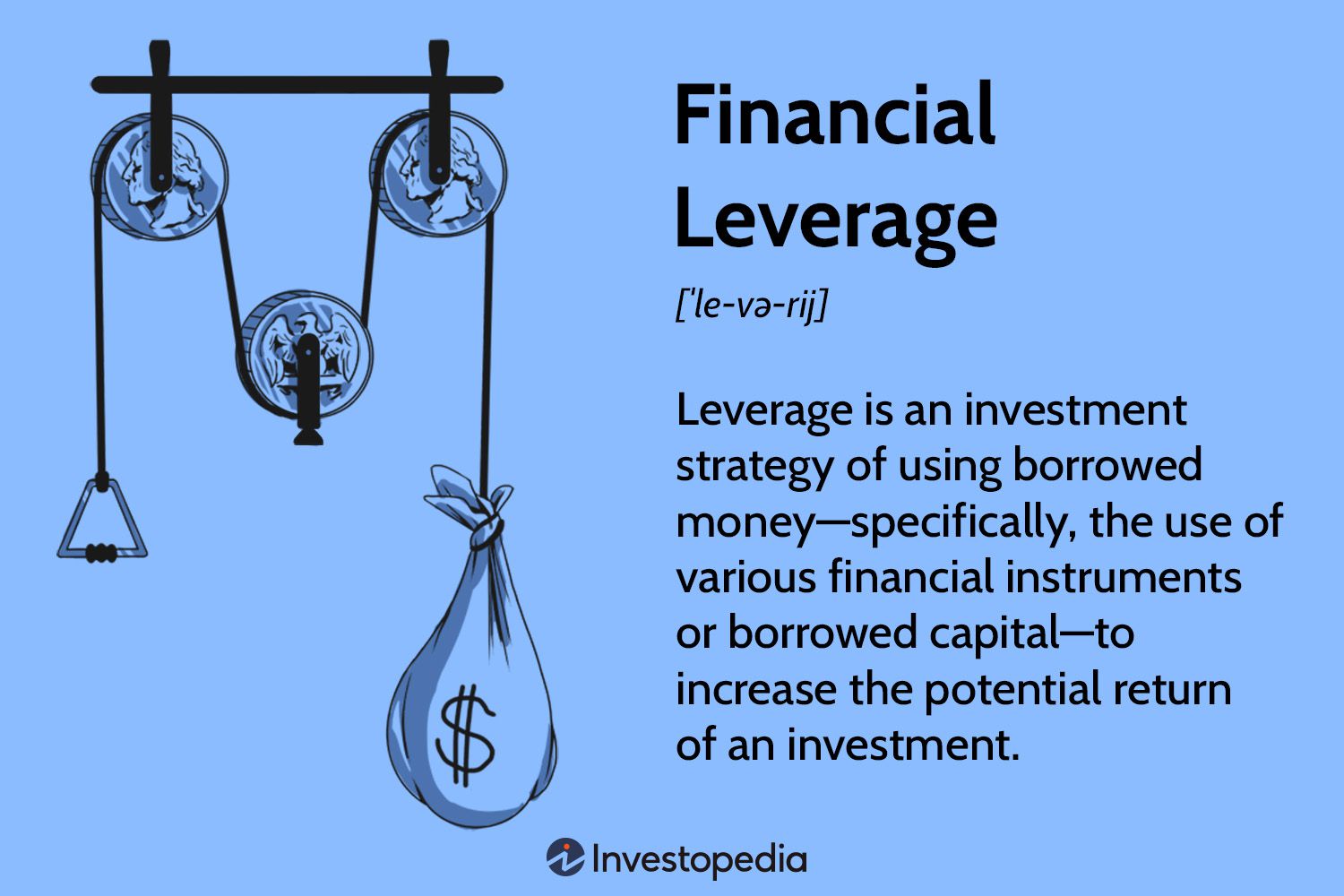
Financial leverage is the practice of borrowing money, investing the funds, and planning for future returns to be greater than debt servicing costs. In this way, a company can use debt to generate more revenue, though at a risk. Leverage is often used when businesses invest in themselves for expansions, acquisitions, or other growth methods. It’s also an investment strategy that uses various financial instruments or borrowed capital to increase the potential return on an investment.
Investopedia / Lara Antal
How Financial Leverage Works
Leverage involves using debt or borrowed capital to undertake an investment or project. It’s commonly used to boost an entity’s equity base. The concept of leverage is used by both investors and companies:
- Investors use leverage to significantly increase the returns that can be provided on an investment. They leverage their investments using various instruments, including options, futures, and margin accounts.
- Companies can use leverage to finance their assets. They can use debt financing to invest in business operations to influence growth instead of issuing stock to raise capital.
Investors who aren’t comfortable using leverage directly can access leverage indirectly in a variety of ways. They can invest in companies that use leverage in the ordinary course of their business to finance or expand operations without increasing their outlay.
The point and result of financial leverage is to multiply the potential returns from a project. Leverage will also multiply the potential downside risk in case the investment doesn’t pan out. It means that the item has more debt than equity when someone refers to a company, property, or investment as being “highly leveraged.”
How to Calculate Financial Leverage
An entire suite of leverage financial ratios is used to calculate how much debt a company is leveraging in an attempt to maximize profits.
Debt Ratio
You can analyze a company’s leverage by calculating its ratio of debt to assets. This ratio indicates how much debt it uses to generate its assets. A company has relied on leverage to finance its assets if the debt ratio is high. A ratio of 1.0 means that the company has $1 of debt for every $1 of assets. It has more assets than debt if it’s lower than 1.0, and it has more debt than assets if it’s higher than 1.0.
Debt Ratio = Total Debt ÷ Total Assets
You’re using all debt, including short- and long-term debt vehicles, when you calculate this ratio.
Debt-to-equity (D/E) Ratio
You can measure leverage by looking strictly at how assets have been financed instead of looking at what the company owns. The debt-to-equity (D/E) ratio is used to compare what the company has borrowed to what it has raised from private investors or shareholders.
Debt-to-Equity (D/E) Ratio = Total Debt ÷ Total Equity
A D/E ratio greater than 1.0 means that a company has more debt than equity, but this doesn’t necessarily mean that a company is highly leveraged. Each company and industry typically operates in a specific way that may warrant a higher or lower ratio.
Debt-to-EBITDA Ratio
You can also compare a company’s debt to how much income it generates in a given period using its Earnings Before Interest, Taxes, Depreciation, and Amortization (EBITDA). The debt-to-EBITDA ratio indicates how much income is available to pay down debt before these operating expenses are deducted from income.
A company with a high debt-to-EBITDA carries a great degree of debt compared to what the company earns. The higher the debt-to-EBITDA, the more leverage a company is carrying.
Debt-to-EBITDA Ratio=Debt÷Earnings Before Interest, Taxes, Depreciation, and Amortization
Important
An issue with using EBITDA is that it isn’t an accurate reflection of earnings. It doesn’t include expenses that must be accounted for. It’s a non-GAAP measure that some companies use to create the appearance of higher profitability.
Equity Multiplier
Debt isn’t directly considered in the equity multiplier, but it’s inherently included because total assets and total equity each have a direct relationship with total debt.
The equity multiplier attempts to understand the ownership weight of a company by analyzing how assets have been financed. A company with a low equity multiplier has financed a large portion of its assets with equity. It’s not highly leveraged.
Equity Multiplier = Total Assets ÷ Total Equity
DuPont analysis uses the equity multiplier to measure financial leverage. You can calculate the equity multiplier by dividing a firm’s total assets by its total equity. Then multiply the total financial leverage by the total asset turnover and the profit margin to produce the return on equity.
The equity multiplier is 2.0 or $500 million ÷ $250 million if a public company has total assets valued at $500 million and shareholder equity valued at $250 million. This shows that the company has financed half its total assets with equity.
Its equity multiplier would be 5.0, however, if it had $500 million in assets and equity of $100 million. Larger equity multipliers suggest that further investigation is needed because there might be more financial leverage used.
Degree of Financial Leverage (DFL)
Fundamental analysts can also use the degree of financial leverage (DFL) ratio. The DFL is calculated by dividing the percentage change of a company’s earnings per share (EPS) by the percentage change in its earnings before interest and taxes (EBIT) over a period.
Degree of Financial Leverage =% Change in Earnings Per Share÷ % Change in EBIT
The goal of DFL is to understand how sensitive a company’s EPS is to changes in operating income. A higher ratio indicates a higher degree of leverage, and a company with a high DFL will likely have more volatile earnings.
Consumer Leverage Ratio
These formulas are used to evaluate a company’s use of leverage for its operations, but households can also use leverage by taking out debt and using personal income to cover interest charges.
Consumer leverage is derived by dividing a household’s debt by its disposable income. Households with a higher calculated consumer leverage have high degrees of debt compared to what they make and are therefore highly leveraged.
Consumer Leverage = Total Household Debt ÷ Disposable Income
Consumers may eventually find it difficult to secure loans if their consumer leverage gets too high. Lenders often set debt-to-income limitations when households apply for mortgage loans.
Tip
Leverage ratios are most useful when compared against a company’s historical results, industry peers, and competitors rather than viewed in isolation.
Advantages and Disadvantages of Financial Leverage
Financial leverage comes with both pros and cons.
Advantages
Some investors and traders use leverage to amplify profits. Trades can become exponentially more rewarding when your initial investment is multiplied by additional upfront capital. Using leverage also allows you to access more expensive investment options that you wouldn’t otherwise have access to with a small amount of upfront capital.
Leverage is best used in short-term, low-risk situations where high degrees of capital are needed. A growth company may have a short-term need for capital, resulting in a strong mid-to-long-term growth opportunity during acquisitions or buyouts.
Disadvantages
If investment returns can be amplified using leverage, so too can losses. Using leverage can result in much higher downside risk, sometimes resulting in losses greater than your initial capital investment.
Brokers and contract traders also often charge fees, premiums, and margin rates. They require you to maintain a margin account with a specific balance. You’ll still be on the hook for extra charges if you lose on your trade.
Leverage also has the potential downside of being complex. Investors must be aware of their financial positions and the risks they inherit when they enter into a leveraged position. This may require additional attention to one’s portfolio, and contribution of additional capital should their trading account not have a sufficient amount of funding per their broker’s requirement.
Pros
-
Can amplify returns, creating potential for big profits
-
Reduces barriers to entry by allowing investors to access more expensive trading opportunities
-
A strategic way for companies to meet short-term financing needs for acquisitions or buyouts
Cons
-
Can amplify downside by creating potential for losses and increased debt
-
More expensive than other types of trading
-
Results in fees, margin rates, and contract premiums regardless of the success of the trade
-
More complex as trading may require additional capital and time based on portfolio needs
Financial Leverage vs. Margin
Margin is a special type of leverage that involves using existing cash or securities as collateral to increase one’s buying power in financial markets. Margin allows you to borrow money from a broker for a fixed interest rate to purchase securities, options, or futures contracts in anticipation of receiving substantially high returns.
You can use margin to create leverage, increasing your buying power by the total amount in your margin account. You would have a 1:10 margin or 10x leverage if you require $1,000 in collateral to purchase $10,000 worth of securities.
Example of Financial Leverage
Consider a company formed with a $5 million investment from investors. This equity is money the company can use to operate.
If the company borrows an additional $20 million, it now has $25 million to invest in business operations and growth opportunities. This increases the company’s potential returns but also increases risk, as it must repay the debt regardless of whether the investment succeeds.
Companies often use leverage by issuing bonds or taking on loans to finance expansion, acquisitions, equipment purchases, or new projects. This strategy works best when the return generated from the borrowed funds exceeds the cost of the debt.
Explain It Like I’m Five
Financial leverage means using borrowed money to invest so you can potentially earn a larger return than you could with your own money alone. It can increase profits, but it also increases the risk of bigger losses.
How Is Financial Leverage Calculated?
Financial leverage can be calculated in several ways. A suite of financial ratios referred to as leverage ratios analyzes the level of indebtedness a company experiences against various assets. The two most common financial leverage ratios are debt-to-equity (total debt/total equity) and debt-to-assets (total debt/total assets).
What Is a Good Financial Leverage Ratio?
A debt-to-equity ratio greater than one generally means that a company has decided to take out more debt rather than financing through shareholders. This isn’t inherently bad but the company might have greater risk due to inflexible debt obligations. The company must be compared to similar companies in the same industry or through its historical financials to determine if it has a good leverage ratio.
Why Is Financial Leverage Important?
Financial leverage is important because it creates opportunities for investors and businesses. That opportunity comes with high risk for investors because leverage amplifies losses in downturns. Leverage creates more debt that can be hard to pay if the following years present slowdowns for businesses.
The Bottom Line
Individuals and companies can boost their equity bases in several ways. Financial leverage is one of these methods. Financial leverage for businesses involves borrowing money to fuel growth. It allows investors to access certain instruments with fewer initial outlays.
Using leverage is risky, however. It’s important to compare the advantages and disadvantages and determine whether financial leverage truly makes sense for your financial circumstances and goals.














Leave a comment