
Decentralized finance resembles traditional capital management
The top three have 70% control of DeFi capital
Fund management and risk management capabilities determine the market
![Risk curators market share as of May 2026. The top three companies, Steakhouse, Centora and Gauntlet, control more than 70% of their total operating assets, forming an oligopoly system. [Source = Tiger Research]](https://wimg.mk.co.kr/news/cms/202605/20/news-p.v1.20260520.b0a6865cfb614f5cbff7c3c2b3d09c21_P1.png)
The power of the virtual asset decentralized finance (DeFi) loan market is rapidly moving from smart contracts (codes) to “risk curators” with professional judgment skills.
Analysts say this is why the global traditional asset management industry, which has $147 trillion (about 19 trillion won) in operating assets, is eyeing the on-chain loan market, which is only $7 billion.
Tiger Research, a research firm specializing in Web3, diagnosed on the 20th that the DeFi ecosystem has evolved similarly to the fund management method of traditional finance, opening a new window of opportunity for large institutions that have accumulated risk management know-how for a long time.
According to Tiger Research, the initial DeFi market was in the form of a single protocol managing the entire lending infrastructure and risk criteria, such as Aave and Compound.
With all the assets tied to one giant pool, there was a risk that the problem of certain rogue assets would be transmitted throughout the system.
However, the situation has completely changed with the emergence of multiple-volt structures such as Morpho, which split collateral assets and loan conditions into different loan markets.
With the thorough separation of infrastructure and asset management strategies, the era of so-called “risk curators” has begun, where external experts can design and roll loan products according to their own standards.
Like fund managers of traditional asset managers, they review collateral, set limits, and lead the DeFi loan market.
![Comparison table of traditional asset management business and DeFi risk curator structure. The on-chain lending infrastructure is rapidly absorbing the division of labor of traditional finance, such as financing, operation, and consignment. [Source = Tiger Research]](https://wimg.mk.co.kr/news/cms/202605/20/news-p.v1.20260520.808b389cbfea4298a3d8687dc133fdaa_P1.png)
The current DeFi risk curator market is already showing a winner-take-all phenomenon, even though it is in its infancy. As of May 2026, the top three teams controlled about 70% of the world’s $7 billion in DeFi management assets.
Steakhouse, which has the largest market share, has attracted conservative institutional funds by leading the on-chain introduction of high-quality real assets (RWA) such as U.S. government bonds.
Second place Sentora has established itself as a strong backend for large exchanges such as Kraken with its artificial intelligence (AI)-based risk model, while third place Gauntlet has demonstrated its ability to respond to crises by normalizing returns through rapid quantitative analysis even in the past.
As large centralized capital pursues their verified operating records, the standards they set are becoming the standard of the on-chain ecosystem.
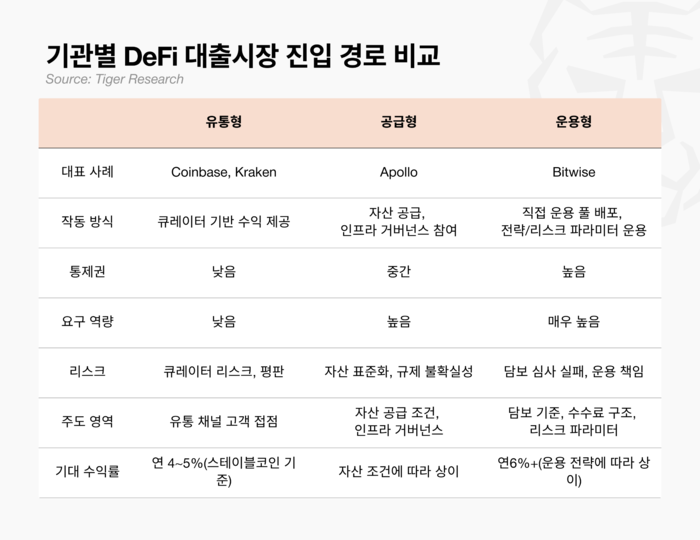
![Comparison table of entry routes into the DeFi loan market by institution, such as distribution type, supply type, and operation type. [Source = Tiger Research]](https://wimg.mk.co.kr/news/cms/202605/20/news-p.v1.20260520.400abcf940e740f99eaf14b2c3ff91de_P1.png)
While the DeFi infrastructure is divided into money distribution, strategic design, and asset trust, and the division of labor of the traditional financial industry is similar, the market entry strategies of large institutions are also being embodied in three branches.
First of all, it is a “distribution type” in which exchanges with wide customer contact points but lack of operational capabilities use curators as outsourcing. Coinbase or Kraken are representative.
Next, like Apollo, is a “supply type” that leads market standards by participating in protocol governance while supplying its own real assets directly to the market.
Finally, like Bitwise, it is an “operational type” in which an asset manager directly curates and takes the lead in rolling the on-chain bolt in the form of “ETF 2.0”.
Tiger Research claimed that now is the golden time to preoccupy the on-chain lending market before the inflow of huge Wall Street institutional capital in earnest.










Leave a comment