

The rocky start to 2025 was not what investors in commercial property had hoped for, especially after the market had seemed poised to reach escape velocity at the end of 2024 after a two-year slump. There was a marked rebound in dealmaking in the fourth quarter, with more active buyers than for any quarter since 2022. In addition, capital values had either stabilized or turned positive for the majority of properties in the MSCI Global Quarterly Property Index.
Even prior to the major tariff announcements on April 2, the new U.S. administration’s actions — tariffs on Canada and Mexico and on certain raw goods and materials; an apparent reset of the post-Cold War security settlement with Europe; and the potential withdrawal of U.S. support for Ukraine — had created a fresh wave of uncertainty for global property markets.
A lackluster quarter
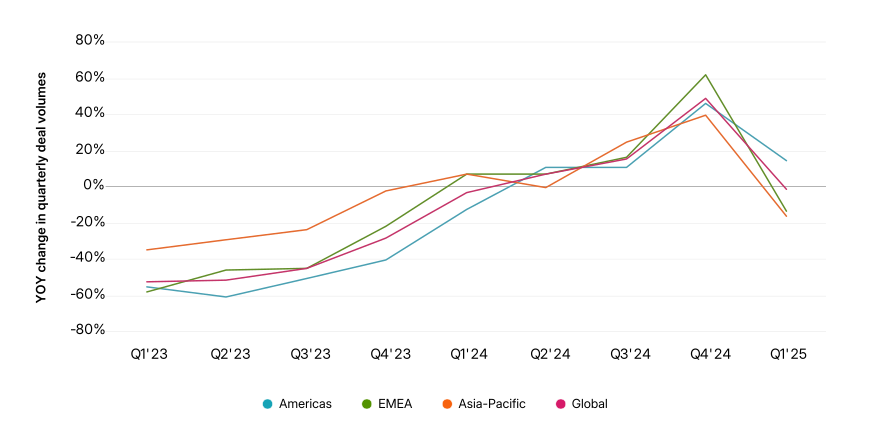
Property is a slow-moving, illiquid asset class, and it can take months or even years for macroeconomic or geopolitical events to filter through into direct real estate. Nevertheless, global real-estate investment volume was flat in the first quarter of 2025 in comparison with the same period a year earlier. This loss of momentum, after volume had increased by close to 50% year over year in the final quarter of 2024, suggests that the spike in uncertainty did start to impact investor decision-making. Lower dealmaking is usually the first reaction to a shift in the macro environment or drop-off in sentiment, just as we saw during the COVID-19 pandemic or in late 2022 and early 2023 after inflation had spiked.
Deal activity retreated most in Europe and Asia-Pacific in Q1
The recent announcement of the reprieve of the extreme U.S.-China tariff levels puts in to question how far the Trump administration is willing to push the tariff agenda. Still, even the baseline imposition of a 10% tariff on U.S. imports has the potential to ripple through the real-estate ecosystem.
Most industrial property assets are essentially warehouses, used to facilitate the flow of goods from producer to end-user; therefore, industrial property would likely be first impacted by any drop-off in global trade. Meanwhile, office and retail property’s fortunes are tied to broader economic confidence and could be negatively affected by a drop-off in GDP growth. In contrast, property types that benefit from structural tailwinds, like apartments or data centers, may prove to be more resilient in this new era of uncertainty.
Differences across regions
Global property markets differed in their reaction to the heightened uncertainty. In the U.S., first-quarter property-transaction volume was above that of the first quarter of 2024, and property prices were either growing or falling at more moderate levels than they were 12 months ago. The immediate effects of tariff policies are still filtering through, however, and the outlook is clouded by rising risk premiums, potential capital flight and renewed fears of recession.
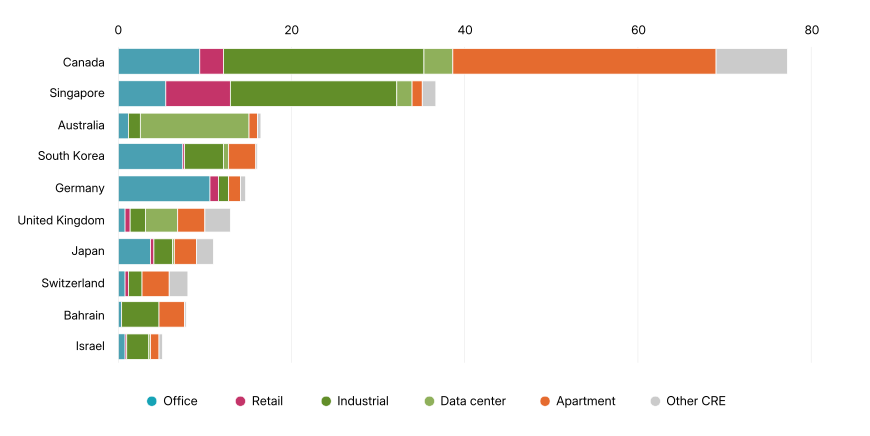
One risk for the U.S. is that cross-border investors, a key source of liquidity, may become more selective in their acquisitions or shift focus altogether. Sentiment among Canadian investors, for example, has become increasingly negative, and anecdotal accounts indicate that some deals have been paused.[1] Canadian investors have spent close to USD 200 billion on U.S. real estate since 2015 and nearly USD 80 billion since 2020, and they are the biggest source of overseas capital in the U.S. market. An absence of overseas capital would negatively impact market liquidity and pricing at the top of the market, as demonstrated by the withdrawal of Chinese investment in Manhattan from 2017 onward.
Canadian investors have been the most dominant in US deals
What is the picture in Europe and Asia?
In Europe, transaction activity for the market overall and for industrial properties was down slightly in the first quarter of 2025. This may be a sign that worries over trade have started to restrain industrial-property investment, though shifts in bond rates through the quarter also likely impacted dealmaking by increasing the cost of capital and making lower-yielding assets look relatively expensive.
European occupier markets have shown a degree of resiliency during the downturn, with many recording above-inflation market-value rental growth, but the geopolitical shock has introduced new downside risks to business investment and leasing decisions.
In Asia, first-quarter deal volume fell by nearly 20% year over year, and the pipeline of pending deals also dropped in comparison with the end of 2024. Optimism around a gradual recovery in China has been tempered by the potential drag on exports and manufacturing investment by the proposed introduction of steep tariffs on Chinese exports to the U.S. By contrast, Japan — Asia’s largest commercial-property market — could benefit from shifting capital flows if lower bond yields and diminished rate-hike expectations persist.
Could global volatility increase real estate’s allure?
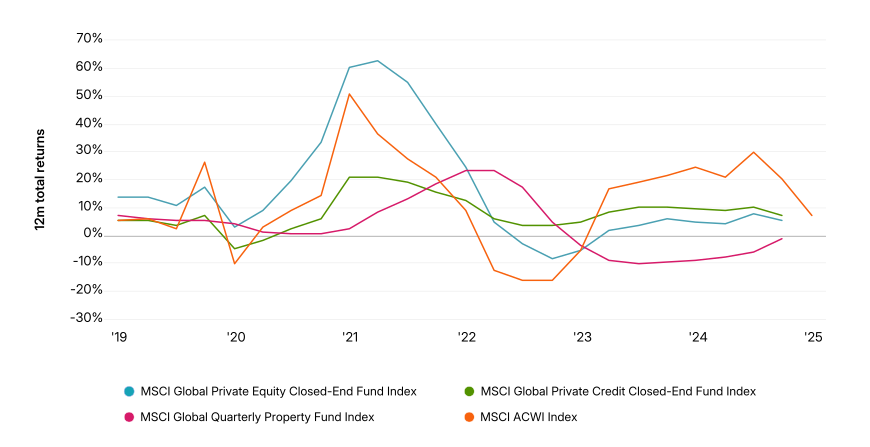
Even though real estate is not immune to a shift in the global order, the longer investment time frames also allow for a more considered and less reactive approach to strategy. Indeed, volatility in other asset classes may make real estate look like a relatively attractive proposition, especially in the context of its underperformance versus other major private and public asset classes in the last 24 months, which has led to a slump in fundraising.
Returns for commercial property have lagged other asset classes
Real estate’s appeal may be amplified if central banks choose to lower interest rates even further to combat the potential deadening impact of tariffs on economic growth. This is by no means a given, but even in the context of a slower economy, lower rates would support real-estate pricing and help make the case for the asset on a relative basis.
Weathering the storm
Without the tariff intervention we could have reasonably expected that the recovery in real estate, which appeared to commence in late 2024, would extend into 2025. While the recovery may have encountered unforeseen challenges, the structural advantages core property provides — relative stability, income generation and some protection against inflation — may help it weather this storm.













Leave a comment