
Key Takeaways
- Regular asset value assessment prevents overstating a company’s worth and misleading investors.
- Impaired assets experience sudden value drops due to factors like market downturns or technology changes.
- GAAP and IFRS have different procedures for assessing asset impairment.
- Impairment requires immediate recording in financial statements, unlike the gradual process of depreciation.
Get personalized, AI-powered answers built on 27+ years of trusted expertise.
What Is an Impaired Asset?
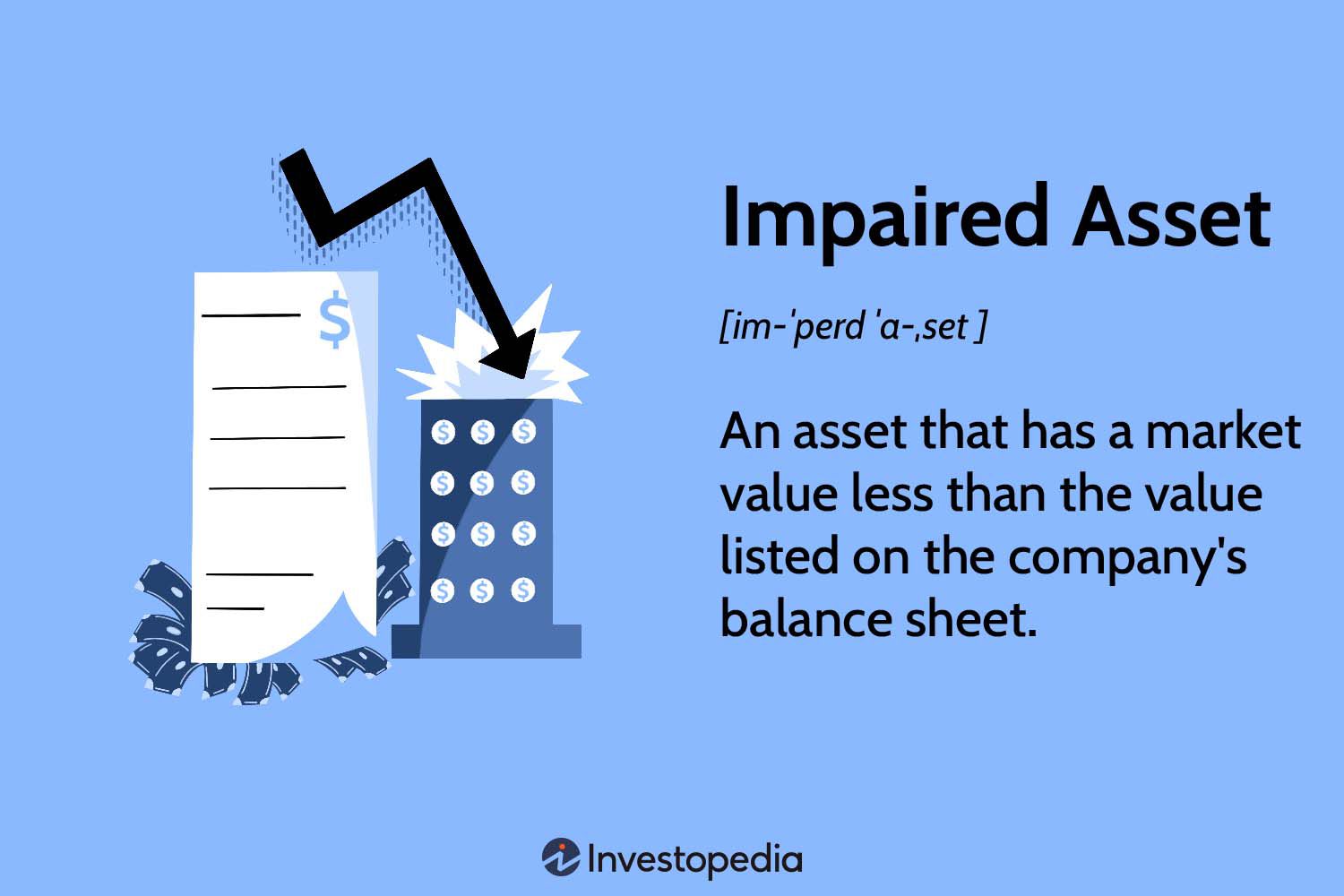
An impaired asset is machinery, equipment, real estate, patents, or any other company asset that has lost value.
Assets must be reviewed regularly to determine their current value to ensure a company’s financials accurately reflect its worth, and any adjustments must be properly recorded. Asset impairment is important for financial accuracy and decision-making, ensuring companies aren’t reporting outdated figures.
Overstating asset value can falsely represent a company’s financial health, leading to regulatory problems, loss of investor trust, and poor business strategies. Accurately reporting asset value ensures transparency, better planning, and adaptability.
Jake Shi / Investopedia
How Impaired Assets Work
Most assets lose value over time, but not all decreases mean an asset is impaired. Asset impairment is associated with specific events, such as market downturns, advances in technology, or business inefficiencies.
For example, a machine that breaks down and needs repairs hasn’t lost its value forever, it just needs to be fixed. On the other hand, a machine that becomes obsolete due to new technology would be considered impaired.
Asset impairment happens to both tangible assets (buildings/machinery) and intangible assets (patents/goodwill).
To determine if an asset is impaired, a company must compare its carrying value to its recoverable amount. The carrying value is the amount recorded on the financial statements, while the recoverable value is the greater of its market value or the cash flow the asset is expected to generate. If the carrying value is higher, then the asset is impaired, and this needs to be adjusted in the financial records.
Accurate asset valuations are essential for financial health. They’re also important to investors and other stakeholders who make decisions based on the expectation of correct financial data. If a company’s worth is overstated, this could have drastic negative consequences for all parties involved.
Reasons for Asset Impairment
Different external or internal factors generally cause asset impairment. Here are a few of the most common reasons for asset impairment:
- Market decline: Changes in market conditions can cause sharp drops in asset values. For example, if a business owns land and there is a mass exodus of people in the region due to adverse climate change, the land value may drop quickly.
- Technological obsolescence: Throughout history, technology has caused obsolescence. The Walkman was replaced by the Discman, and streaming services replaced the Discman on our phones. Companies may find that the technology they once used is no longer in demand by most of society. A company doesn’t need a fax machine when there is e-mail.
- Physical damage: Many assets are rendered useless after physical damage, such as by a fire or natural disaster.
- Regulatory changes: Changes in regulations or laws can hurt the value of an asset. Given how important climate change is today, changes in environmental law could mean companies in the oil sector may not be able to use certain equipment anymore to prevent environmental damage.
How to Test for Asset Impairment
To ensure correct asset valuation, businesses should test for asset impairment regularly. Assessing underperformance or declines in market value are helpful indicators to determine if an asset is impaired.
If an asset may be impaired, a business will need to determine the asset’s recoverable amount. This could be either its fair value (the price it sells for) or its value in use (the present value of expected future cash flows generated from the asset).
Once the recoverable amount is known, compare it to the carrying value of the asset. If the carrying value of the asset is higher than the recoverable amount, the asset is impaired. If impaired, the value needs to be adjusted.
The new value is adjusted on the balance sheet, and the impairment loss needs to be recorded on the income statement, which reduces net income.
Example of an Impaired Asset
For example, Truck Drivers Inc. is a logistics company that has been in the truck delivery service for 50 years. The company has always had strong demand and provided excellent delivery services for its customers. It currently has a fleet of delivery trucks valued at $500,000.
In the last five years, however, Truck Drivers have seen their revenues significantly fall as they have lost market share to newer delivery companies using tech-orientated delivery services. This has allowed these companies to provide more efficient delivery services at lower costs. Truck Drivers have just not been able to keep up with the new technology.
Due to the new competition, the fleet’s value has decreased to where the recoverable amount is $200,000; much lower than the carrying value of $500,000. As such, the company needs to record an asset impairment loss of $300,000.
The $300,000 impairment loss is recorded on the company’s income statement, reducing net income for the period. Additionally, the $200,000 carrying value of the trucks is recorded on the balance sheet.
By accounting for the trucks’ impairment, the company correctly represents its financial condition by not overstating asset value, which is important for regulators, analysts, and investors.
Accounting Standards: GAAP and IFRS
The two main accounting methods used globally are generally accepted accounting principles (GAAP), used primarily in the U.S., and the International Financial Reporting Standards (IFRS), mainly used in the rest of the world, such as Canada, Australia, the European Union, and South Korea.
The treatment of asset impairment is handled differently depending on which accounting method is used. Asset impairment under GAAP is a slightly more complicated process that uses two stages.
First, impairment needs to be determined by comparing the asset’s carrying value to its expected future cash flows. If the carrying value is higher than the cash flows, the asset is impaired. Next, the impairment loss needs to be calculated, which is the difference between the asset’s carrying value and its fair value.
Under IFRS, a business needs to determine the difference between an asset’s carrying value and its recoverable amount. The recoverable amount can be either its fair value or its value in use. As with GAAP, if the carrying value is higher, the asset is impaired.
Comparing Impairment and Depreciation
Impairment may be confused with depreciation as both represent the decline in an asset’s value; however, there are important distinctions between the two.
Depreciation is much more structured as it is an organized, gradual reduction of an asset’s value over its useful life. This process happens every year to represent the natural wear and tear of an asset. A business is aware of this ahead of time and it is incorporated as part of business accounting.
Impairment, on the other hand, is an unplanned drop in an asset’s value due to unforeseen circumstances, either internal or external. This unexpected loss needs to be accounted for immediately and is not adjusted on an ongoing basis as depreciation is.
The Bottom Line
Recognizing asset impairment is important for financial accuracy and business transparency. Unlike depreciation, which is a planned and gradual decline in value, asset impairment is an unexpected drop in an asset’s value due to unexpected factors. By regularly assessing asset value, companies can avoid overstating their worth, which builds investor trust and complies with regulations.














Leave a comment