
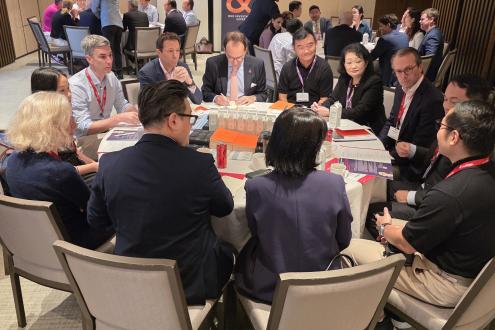
At WealthTHINK Singapore 2026, one of the day’s most practical discussions focused on how private wealth firms are rethinking product access, investment selection and platform differentiation in a market where clients are more sophisticated, product shelves increasingly overlap, and speed of execution matters.
Hosted by Andrew Hendry, CEO Asia and Senior Managing Director, Head of Asia Client Group at Janus Henderson Investors, the discussion brought together participants from private banks, external asset managers, digital wealth platforms and alternative investment specialists. The conversation ranged from open architecture and CIO-led selection to private markets access, securitisation and the still-developing role of tokenisation.
The session suggested that access alone is no longer enough. Clients can obtain many of the same products across multiple platforms. The real differentiator now lies in curation, due diligence, implementation speed, operational flexibility and the ability to package sophisticated exposures in a way that is usable for different client segments.
- Access is no longer the main differentiator: Most major platforms can source broadly similar products, so selection, execution and portfolio fit matter more.
- Open architecture needs discipline: Breadth is useful only when supported by due diligence, monitoring and a clear CIO framework.
- Scale changes the product model: Large banks can support deep research teams, while smaller banks and EAMs often compete through agility and partnership.
- Alternatives require better packaging: Private markets exposure is increasingly important, but minimum tickets, operational friction and due diligence remain barriers.
- Securitisation is solving real access problems: In many cases, securitised structures are more practical than tokenised solutions for democratising private market access.
- Tokenisation has promise but remains uneven: Tokenised money market funds show practical use cases, while illiquid assets still face legal, custody, liquidity and ownership challenges.
Setting the Scene: What is WealthTHINK?
WealthTHINK is an exclusive, invitation-only forum designed for CEOs and senior management at leading private wealth management firms. It offers a platform for industry leaders to engage in peer-to-peer networking and collaborative discussion, free from product pitches and formal presentations. The event focuses on proactive, table-specific debates around key themes shaping the future of wealth management, including digitisation, AI, regulation, business model profitability, family office development, investment access and regional connectivity.
By keeping participation senior and the format deliberately interactive, WealthTHINK is designed to encourage honest, commercially grounded exchanges on the issues firms are grappling with in real time.
Product Access Has Become Table Stakes
The discussion opened with a practical question: how should private wealth firms think about product access when the market has become more open, more competitive and more crowded? Participants described very different operating models, from boutique external asset managers with conservative client bases to larger private banks with centralised investment resources and digital platforms seeking to broaden access to alternatives.
One participant described a boutique model where clients are largely focused on long-term wealth preservation, traditional asset classes and a relatively low-touch relationship. Others pointed to models built around broader open architecture, where clients or intermediaries expect access to a wide range of managers, funds and strategies.
The wider point was clear: access is necessary, but it is no longer sufficient. As one participant observed, “all products are available everywhere”. In that environment, firms cannot rely on the shelf itself as the proposition. They need a process for deciding what goes on the shelf, how it is explained, how it is monitored and whether it genuinely belongs in the client portfolio.
Curation, Governance and Speed
Participants repeatedly returned to the importance of investment governance. Open architecture can give clients choice, but it also creates a burden: firms need to select, monitor and explain what they offer. This is especially important where clients are exposed to long-only funds, alternatives, structured products, private markets or newer digital and tokenised structures.
The discussion contrasted large institutions with deep manager research capabilities and smaller organisations that may rely on a more focused network of managers, partners or trusted counterparties. Large banks can support dedicated research teams, but their processes may be slower. Smaller firms may be more agile, but they need to be realistic about what they can diligence and distribute effectively.
One participant framed speed as a genuine source of differentiation in Asia. If decision-making, due diligence and product approval sit close to the client business, firms can respond more quickly to market opportunities. But that speed only has value if it is embedded in a disciplined investment framework rather than driven by ad hoc product demand.
Local Decision-Making Matters
The table also examined the importance of where investment decisions are made. Participants reflected that some global banks remain heavily tied to head office processes, while others have given Singapore-based teams greater autonomy across research, CIO views, product approval and execution.
That matters because Asia’s private wealth market is fast-moving. Client demand can emerge quickly, particularly around Japanese equities, private markets, alternatives or new structures. If local teams have to wait months for internal approval, time-to-market suffers.
At the same time, local autonomy must be balanced with institutional resources. Participants noted that large groups may have strong onshore capabilities, asset management expertise or balance-sheet relationships that can be valuable if properly connected to the offshore private banking platform. The challenge is not simply whether a firm is global or local. It is whether the global platform can be made useful for clients in Singapore.
Different Models, Different Trade-Offs
The discussion highlighted the different economics of private banks, external asset managers and digital wealth platforms. For a private bank, product selection is tied to suitability, governance, risk appetite, operational capacity and distribution scale. For an EAM, the model can be more flexible. If the client wants a product and the bank can execute it, access may be more direct.
That flexibility is valuable, but it also raises questions around due diligence and scale. A small EAM may not have the resources to maintain a full manager research function. A private bank may provide curated fund lists, model portfolios or approved managers that smaller intermediaries can use as a form of infrastructure. One participant described this as a practical value-add: smaller asset managers may not have the luxury of building their own selection teams, so a bank’s curated list can become part of the support model.
The trade-off is distribution. Large platforms can move volume, which makes them attractive to product providers. Smaller platforms may be more nimble, but product manufacturers still need enough demand to justify the operational work. As one participant noted, enthusiasm from a few advisers does not always translate into sufficient client demand.
Alternatives Are Forcing Better Access Structures
Private markets and alternative investments formed a significant part of the discussion. Participants noted that many clients want access to managers or strategies that historically required large minimum tickets. In practice, that creates a barrier for smaller private bank clients, EAM clients or digital platform users who may want exposure but cannot meet institutional minimums.
One participant described the growing use of securitised vehicles in Europe, particularly for private market funds. These structures can aggregate demand across clients, reduce friction around minimum investment sizes and allow investors to access managers that would otherwise be unavailable to them. The approach may add cost, but it can also create practical access where a direct fund subscription is not viable.
The point was not that securitisation solves every problem. Rather, it is becoming one of the tools wealth managers use to bridge the gap between institutional product supply and private client demand. For EAMs, it can also create a way to build fees into the structure while giving clients exposure to private equity, private credit or other less liquid strategies.
Securitisation Before Tokenisation
The conversation then moved into tokenisation, but the tone was notably pragmatic. Participants were interested in the technology, but they were cautious about the idea that tokenisation automatically solves access, liquidity or suitability issues.
Several participants argued that securitisation remains the more practical step in many cases. A private market fund, for example, can be packaged into a structure that lowers ticket sizes and improves administrative efficiency without needing tokenisation. If the underlying asset is semi-liquid, or if monthly redemption is sufficient, tokenisation may not add meaningful value.
Tokenisation becomes more compelling where it improves settlement, portability or liquidity. One participant cited tokenised money market funds as a practical use case, particularly where investors want fast movement of cash or T+0-style access. In that context, tokenisation is not a marketing label; it addresses a specific operational need.
The Limits of Tokenising Illiquid Assets
The table was more sceptical about tokenising illiquid or highly idiosyncratic assets such as art, property, watches or family jewellery. Technically, participants acknowledged, almost anything can be tokenised. The harder questions are legal ownership, custody, liquidity, investor eligibility, leverage, valuation and secondary market depth.
Property was one example. Tokenising a building may create a digital representation of ownership, but it does not remove local legal restrictions, tax issues, foreign ownership rules or the practical need for a venue where tokens can actually trade. The same applies to collectibles. A token may represent a claim, but custody, enforceability and lender rights still need to be resolved.
One participant described tokenisation as a strong talking point for clients, but not yet a universal solution. The technology may be ready in some areas, but the surrounding infrastructure is still uneven. Without clear custody, governance and liquidity, tokenisation can add complexity rather than reduce it.
Digital Platforms and the Democratisation of Alternatives
Digital wealth platforms added another perspective. Their proposition is often built around lowering barriers to entry and making institutional-style products more accessible to a broader client base. In the alternatives space, this can mean aggregating many smaller investors into a meaningful institutional ticket.
However, even here, the discussion suggested that democratisation is more operational than rhetorical. Lower minimums require appropriate structures, efficient onboarding, clear suitability controls, reporting capability and enough scale to make the economics work. Whether the wrapper is securitised, tokenised or fund-based, the same basic question remains: does it help clients access the exposure in a cleaner, safer and more transparent way?
This is where the investment proposition becomes more than product sourcing. Firms need to match client demand, product structure, operational capability and regulatory requirements. The best structure is not necessarily the newest one. It is the one that delivers the intended exposure with the least unnecessary friction.
Strategic Summary: From Shelf Space to Usable Access
The discussion made clear that private wealth firms in Singapore are no longer competing only on what they can access. They are competing on how intelligently they select, package, explain and execute that access.
For banks, EAMs and digital platforms, the challenge is to combine open architecture with discipline. Clients want more choice, but they also need curation, governance and a clear view of how each exposure fits into the broader portfolio.
Securitisation and tokenisation will both play a role, but not every asset needs to be tokenised and not every structure creates real value. The strongest firms will be those that distinguish between genuine operational improvement and fashionable packaging.
At WealthTHINK Singapore 2026, the table’s message was practical: the future investment proposition will not be defined by product breadth alone. It will be defined by whether firms can turn access into usable, scalable and well-governed client outcomes.













Leave a comment