
Key Takeaways
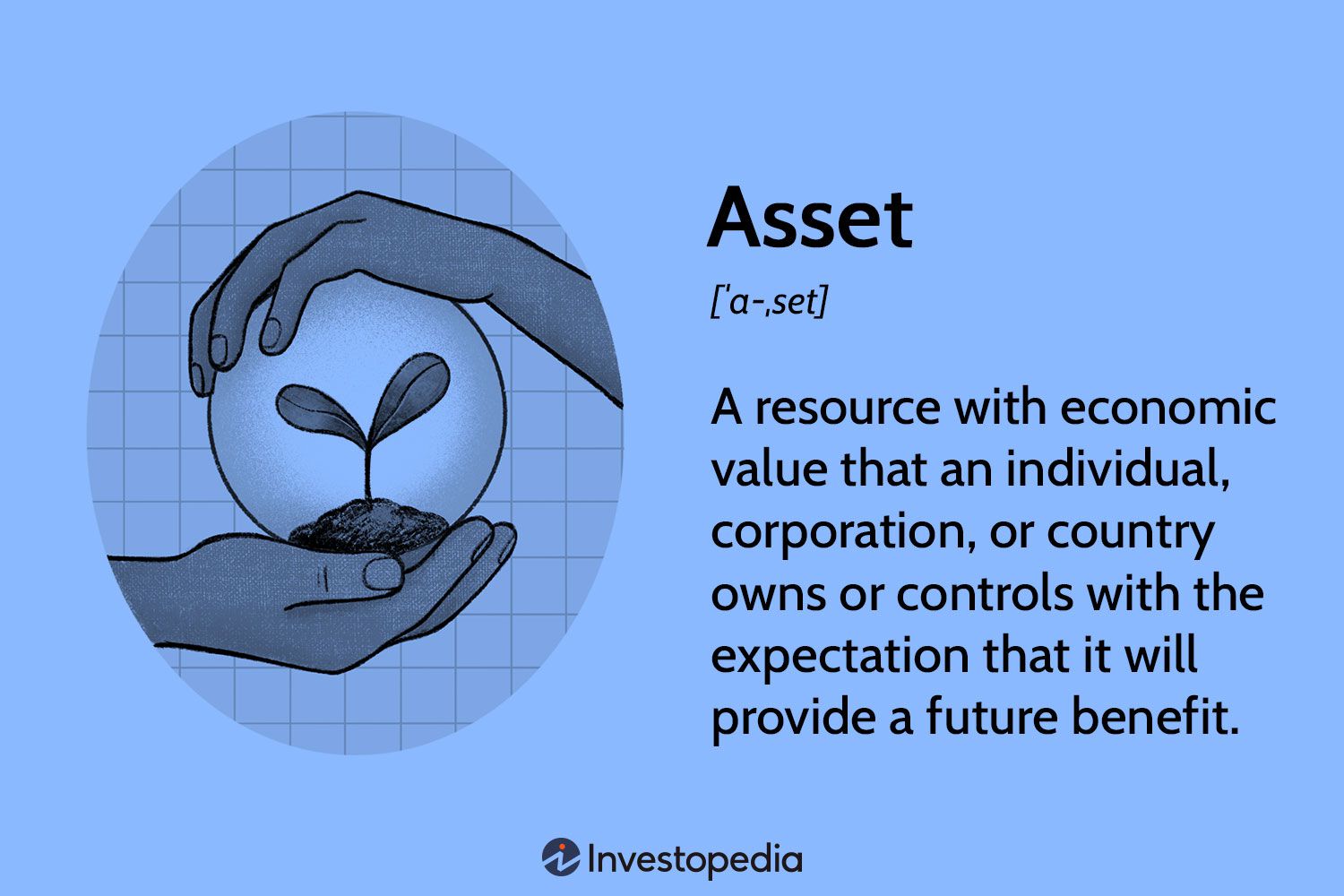
- Assets are things that have value.
- An asset may produce income, now or in the future.
- An asset may appreciate in value over time.
- In business, an asset may generate cash flow, reduce expenses, or improve sales.
Get personalized, AI-powered answers built on 27+ years of trusted expertise.
Investopedia / Nez Riaz
What Is an Asset?
An asset is something you own that adds financial value or helps you generate it. Assets can be physical, like a car or a factory, or intangible, like a patent or brand reputation. For individuals, assets include homes, savings, and investments. For businesses, assets range from cash and inventory to property and intellectual property. An asset is anything that supports earning potential or long-term growth for individuals and companies alike.
How Assets Work
Individuals usually think of assets as items of value that can be converted into cash at some future point, and that might also be income-producing or appreciating in value until that time. They can be financial assets like stocks, bonds, and mutual funds or physical assets like a home or an art collection.
An asset may be something that has the potential to generate cash flow in the case of businesses. It might reduce expenses or improve sales regardless of whether it’s a tangible asset like manufacturing equipment, a fleet of trucks or an intangible asset like a patent or a trademark.
A company must possess the right to the asset as of the date of its financial statements for it to be counted as one of its assets.
Types of Assets
Assets are reported on a company’s balance sheet and can be broadly categorized into current or short-term assets, fixed assets, financial assets, or intangible assets.
Current Assets
Current assets are short-term economic resources that are expected to be converted into cash or consumed within one year. Current assets can include cash and cash equivalents, accounts receivable, physical inventory, and various prepaid expenses.
Cash is easy to value, but accountants must periodically reassess the recoverability of inventory and accounts receivable. A receivable will be classified as impaired if there’s evidence that it might be uncollectible. Companies might have to write off those assets if inventory becomes obsolete.
Important
Some assets are recorded on companies’ balance sheets using the concept of historical cost. It represents the original cost of the asset when it was purchased by the company, and it can also include expenses such as delivery and setup incurred to incorporate an asset into the company’s operations.
Fixed Assets
Fixed assets are resources with an expected life of more than a year, such as plants, equipment, and buildings. An accounting adjustment known as depreciation is made for fixed assets as they age. It allocates the cost of the asset over time. Depreciation may or may not reflect the fixed asset’s loss of earning power.
Generally accepted accounting principles (GAAP) allow depreciation under several methods. The straight-line method assumes that a fixed asset loses its value in proportion to its useful life. The accelerated method assumes that the asset loses its value faster in its first years of use.
What’s considered useful life varies according to the type of asset. The Internal Revenue Service (IRS) assigns office furniture and fixtures a useful life of seven years under the general depreciation system (GDS). Cars and trucks have a useful life of five years.
Financial Assets
Financial assets can include stocks, corporate and government bonds, and other types of securities. They tend to be liquid, unlike fixed assets, and they’re valued according to their current price on the relevant market.
Intangible Assets
Intangible assets are economic resources that have no physical presence. They include patents, trademarks, copyrights, and goodwill. Intangible assets can be amortized over their useful life for accounting and tax purposes, similar to the depreciation process for fixed assets.
Emerging and Alternative Assets
As emerging and alternative asset classes get more media attention and traction, investors are increasingly looking to these types of assets for investment opportunities over more traditional categories like stocks, bonds, and real estate. Emerging and alternative asset classes, such as private equity, hedge funds, venture capital, commodities, cryptocurrency, and collectibles, can offer the potential for higher returns. Still, they often carry greater risk, less liquidity, and less regulation than conventional assets.
Assets vs. Liabilities
An asset is something of economic value that’s owned or controlled by a person, a company, or a government. A liability is the opposite. It’s something that’s owed to another person, company, or government. Examples of liabilities include loans, tax obligations, and accounts payable.
Assets and Personal Finance
Assets form the foundation of personal finance. They can be built in many ways, such as by paying down a mortgage, contributing regularly to retirement accounts, maintaining an emergency fund, or investing in a start-up. Regardless of the approach, successful asset management means balancing growth with risk while considering liquidity and diversification.
Explain Like I’m 5
An asset is something of value that you own, or that’s owed to you. The loan would be an asset if you lent money to someone because they’re obligated to repay you that amount. The loan would be a liability for the person who owes you the money.
What Are Examples of Assets?
Personal assets can include a home, land, financial securities, jewelry, artwork, gold and silver, or your checking account. Business assets can include motor vehicles, buildings, machinery, equipment, cash, and accounts receivable, as well as intangibles like patents and copyrights.
What Are Non-Physical Assets?
Non-physical or intangible assets provide an economic benefit even though you can’t physically touch them. They’re an important class of assets that include intellectual property such as patents or trademarks, contractual obligations, royalties, and goodwill. Brand equity and reputation are also examples of non-physical or intangible assets that can be quite valuable.
Is Labor an Asset?
No. Labor is work carried out by human beings for which they’re paid in wages or a salary. Labor is distinct from assets, which are considered to be capital.
How Are Current Assets Different From Fixed or Noncurrent Assets?
Assets are categorized in accounting by their time horizon of use. Current assets are expected to be sold or used within one year. Fixed assets, also known as noncurrent assets, are expected to remain in use for longer than one year. Fixed assets aren’t easily liquidated, so they can depreciate over time, unlike current assets.
The Bottom Line
Assets are anything of value that an individual, a business enterprise, or another entity owns. Different types of assets are treated differently for tax and accounting purposes. Assets are generally a good thing to have and liabilities less so.













Leave a comment