

Hamak’s core assets include two principal gold exploration projects:
The gold projects are Hamak’s operational focus, while its dual physical gold and Bitcoin treasury strategy is its balance sheet differentiator.
#Akoko Gold Project, Ghana
The Akoko Gold Project sits within Ghana’s prolific Ashanti Greenstone Belt, roughly 25 km south of Tarkwa, one of West Africa’s most gold-rich mining regions. The license covers approximately 89 km² in a well-established mining jurisdiction with existing infrastructure and a long history of gold production.
Hamak completed due diligence on the project in March 2026 and is now advancing the work program that will inform its decision on whether to exercise its exclusive option to acquire Akoko.
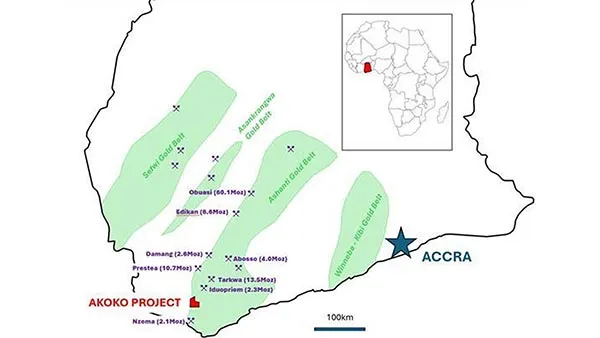
Historical exploration has already identified a meaningful gold system. Around 16,000 meters of drilling has outlined over 250,000 ounces of gold mineralization across the license area (non-JORC) at an average grade of 0.58 g/t gold. A previous operator, CAA Mining, reported a non-JORC inferred resource of 277,000 ounces at 1.7 g/t gold3.
The difference between these estimates largely reflects different geological modelling assumptions. Hamak’s interpretation applies more conservative parameters, which management believes provide a more realistic baseline ahead of modern resource verification.
Importantly, the identified mineralization sits primarily within near-surface oxide material extending to roughly 50 meters depth. Oxide gold deposits are often simpler and cheaper to process than deeper sulfide mineralization.
Chief Executive Officer, Karl Smithson, commented:
In an environment of record high gold prices, Hamak has secured a compelling low-cost option to acquire a near surface oxide gold project which has the potential to be advanced into a low-cost mine in one of the most established mining jurisdictions in Africa.
“Having completed the necessary due diligence, we will now embark on a drilling campaign to establish a new JORC compliant resource, as well as conduct various assays and test work to facilitate the work of independent qualified groups to assess the economic viability for mining at Akoko, with the publication of a PEA report.
The next step is to convert the historical work into a modern, independently verified resource. Hamak plans to begin with a 4,250 meter reverse circulation (RC) drilling program to further define the mineralization and support preparation of a JORC-compliant resource estimate. (Reverse circulation drilling is a drilling method used in mineral exploration to collect rock samples from below the surface quickly and relatively cheaply.) Bulk samples will also be collected for metallurgical testing to determine expected gold recoveries.
Following this work, an independent Preliminary Economic Assessment (PEA) will evaluate the potential economic viability of the project.
Hamak secured the Akoko project at an acquisition cost of approximately US$10 per ounce of historical gold resource, payable through a mix of cash and shares, which management has highlighted as a low acquisition cost relative to the historical resource base4.
If the planned drilling confirms the scale and grade of the mineralization identified in earlier work, Akoko could move the project from historical exploration data toward a modern resource standard and clearer development assessment.
The next phase is intended to validate and modernize the historical dataset, but the current resource remains non-JORC until that work is complete.
#Nimba Gold Project, Liberia
The Company’s Liberia project is an early-stage gold discovery in Nimba County, close to Endeavour Mining’s 5-million-ounce Ity Gold Mine in neighbouring Côte d’Ivoire.
Hamak’s Nimba mineral exploration license, granted in January 2025 for an initial three-year term, covers 831 square kilometers located approximately 40 km southwest of the Ity mine, within the same prospective greenstone belt geology.
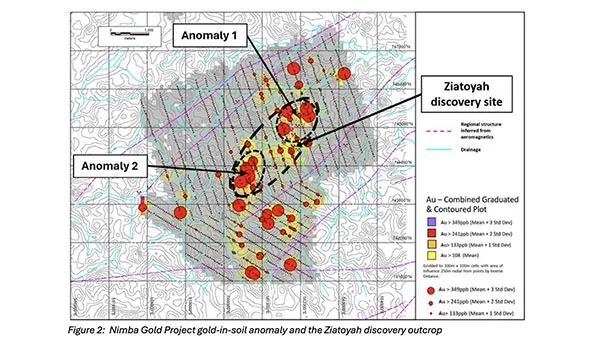
Initial drilling has already returned high-grade results, including 20 meters at 7 g/t gold near surface, which includes a higher-grade zone of 5 meters at 22 g/t gold, at a site called Ziatoyah.
Follow-up work has identified a gold-in-soil anomaly covering a northeast-trending area approximately 5.7 km by 1 km, suggesting potential for a sizeable system. In addition, artisanal gold mining activity within the anomaly is consistent with the presence of an underlying hard-rock gold system. The scale of the anomaly suggests the mineralized system may extend well beyond the initial discovery area.
Hamak recently reclaimed 100% ownership of the Nimba license following the withdrawal of joint venture (JV) partner First Au Limited (ASX: FAU), which refocused its strategy on Western Australia. The recapture was at zero cost to Hamak, and the Company has benefited from more than A$600,000 of exploration expenditure by FAU during the JV period, as well as A$750,000 in cash proceeds from the sale of its FAU shares. As part of the agreement, First Au retains a 2% Net Smelter Royalty (NSR) over the project, which Hamak has the option to repurchase at the production stage for US$1 million per 1% royalty5.
Advanced discussions with a new JV partner are ongoing.
Although the project is at an earlier stage than the Akoko project in Ghana, management sees significant exploration upside. While the early intercepts are encouraging, the project remains at an earlier exploration stage and further drilling will determine the extent and continuity of the mineralized system.
Hamak is also negotiating to add a second exploration project in Liberia with historical drilling and high-grade results, reflecting its view that the country remains underexplored but capable of hosting large gold discoveries.
Liberia has attracted increasing exploration interest in recent years as international mining firms reassess the country’s greenstone belt geology. Its geology is similar to neighbouring gold-producing countries including Côte d’Ivoire, Guinea, and Ghana.
Management has emphasized Liberia’s relative political stability in recent years, along with a regulatory framework designed to support mining investment.
#Development Roadmap
Planned milestones* in 2026 include:
-
Commencement of 4,250m RC drilling program at Akoko
-
Publication of Akoko drilling results
-
Resource upgrade at Akoko
-
Preliminary Economic Assessment (PEA) at Akoko
-
Appointment of a new JV partner for Nimba
-
Further exploration drilling at Nimba
-
Potential maiden resource statement at Nimba
*Milestones are indicative and subject to operational and market conditions.
#Company Treasury
Hamak holds Bitcoin on its balance sheet as part of a broader treasury strategy alongside physical gold. Management is exploring ways to enhance the value of that treasury alongside its gold exploration assets, while accumulating Bitcoin opportunistically to lower its average acquisition cost.
In February 2026, the Company purchased three Bitcoin at an average price of £50,000, bringing total holdings to 26, and established a 3.05% equity position in Vaultz Capital. The Company may pursue additional selective equity investments in listed Bitcoin treasury companies, alongside limited treasury management strategies to improve capital efficiency while maintaining a conservative risk profile. These activities are expected to be applied to only a portion of holdings, avoiding excessive leverage or high counterparty risk.
The broader objective is to grow its Bitcoin position in a disciplined way while protecting shareholder value, with potential future cash flow from gold operations providing an additional route to strengthen the treasury over time.














Leave a comment