
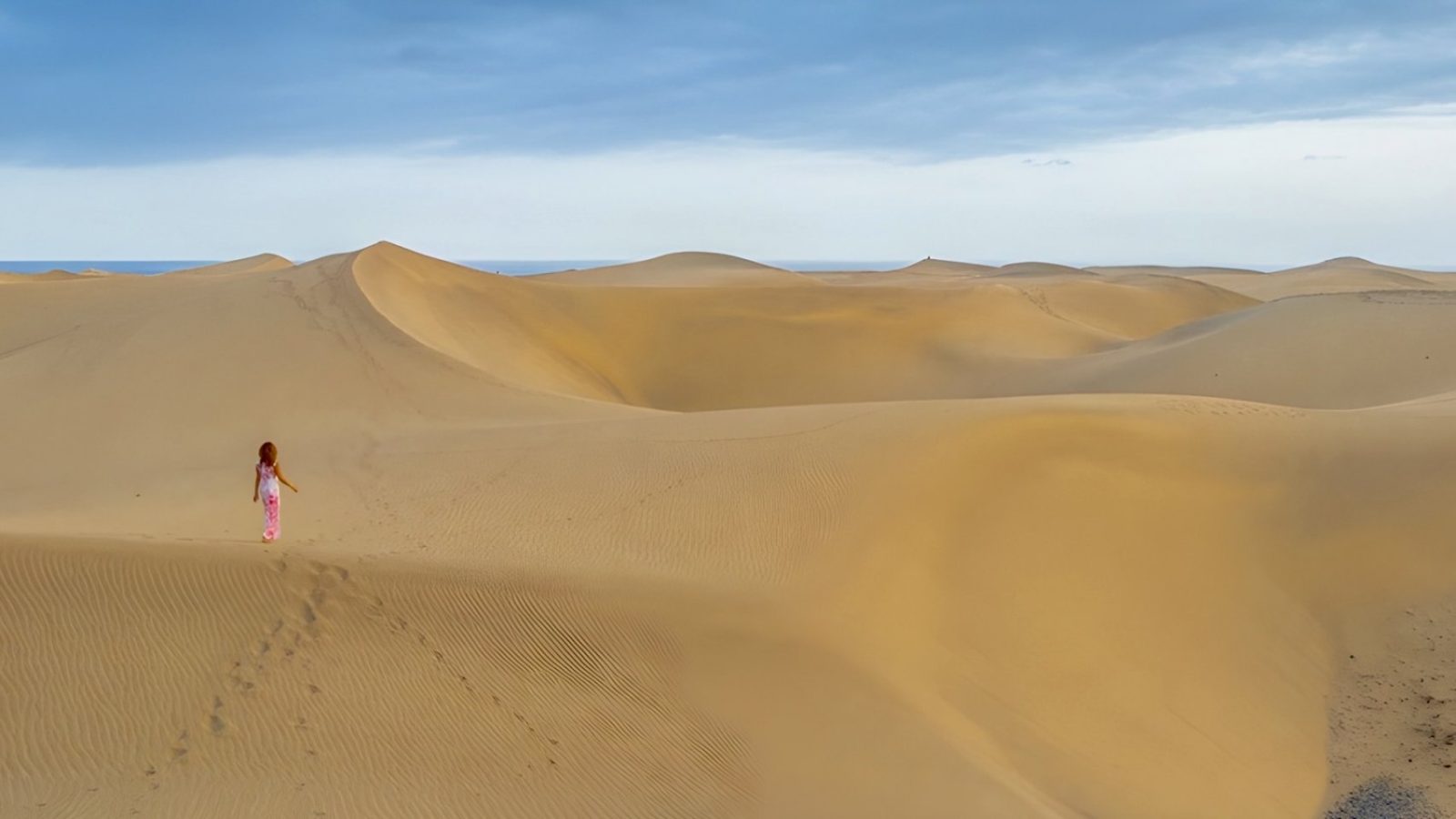
But if the Maspalomas Dunes don’t move like life itself, how can the Administration possibly own something like that there? Trick: They’ve listed it as having no street number. Reality is always stranger than fiction. In the inventory of real estate assets of the Autonomous Community, the feeling of being in a graveyard of unfulfilled intentions becomes unbearable. We’re not just dealing with buildings; we’re looking at the accounting of the absurd.
The Autonomous Community of Gran Canaria owns a space in southern Gran Canaria, under the protection of the Canary Islands Agency for the Protection of the Natural Environment (APMU), with the following address: “Public Road: Las Dunas; Number: SN.” The absurdity lies in classifying a dune as land in an inventory of fixed assets. A fixed asset is, by definition, something permanent. The dune is the antithesis of permanence. It is the State attempting to exercise a property right over the wind and silicon, a paper sovereignty over an ecosystem that rejects any attempt at land registration.
The document obtained by Maspalomas24H begins with a metaphysical slap in the face: the ‘Plot on the Maspalomas Dunes’. In a display of anthropological optimism, the Natural Environment Protection Agency has decided that a mobile sand dune, an entity that by definition disregards property ownership, has a fixed asset ID: 1100000. It’s bureaucracy trying to put a collar on a storm, registering the desert like someone noting down an office on Franchy Roca Street in Las Palmas.
In Santa Lucía de Tirajana, at Avenida de Canarias 338, the Tax Collection Service (active 1100012) functions as an emotional tollbooth before reaching the leisure areas. It’s the place where rent is transformed into statistics. And the Maspalomas Dunes are the most poetic example: a piece of land without a number, without fences, and which laughs in the face of the Canary Islands Agency for the Protection of the Natural Environment every time the wind changes direction.
The Canary Islands Agency for the Protection of the Natural Environment (APMU) is the great collector of the unspeakable. In the transition zones towards the summit, records appear that are simply defined as “plot” or “land parcel” with the fateful “SN”. In municipalities like Valsequillo or San Mateo, the State maintains ownership of sections of woodland under a fixed asset numbering system whose boundaries no one quite understands. These are assets that don’t generate income, that don’t house offices, but that serve to make the Autonomous Community’s balance sheet appear less empty than its reforestation promises.
In the interior of Tirajana, in southern Gran Canaria, there are plots of land associated with the Canary Islands Government’s Department of Education that never became schools. These are fixed assets with outdated identification numbers that reflect a population boom that never materialized in the countryside. These “SN” plots are now makeshift parking lots or overgrown with prickly pear cacti, but the Directorate General of Heritage continues to highlight them as “urban land” ready for investment that no one will ever make due to the declining population.
Even the Canary Islands Health Service (SCS) owns small properties in the midlands of southern Gran Canaria, registered as “local clinics” on streets barely recognized by the land registry. These are the assets of the resistance: an aluminum door, a plaque from the Canary Islands Government dating back to the 80s.









Leave a comment