
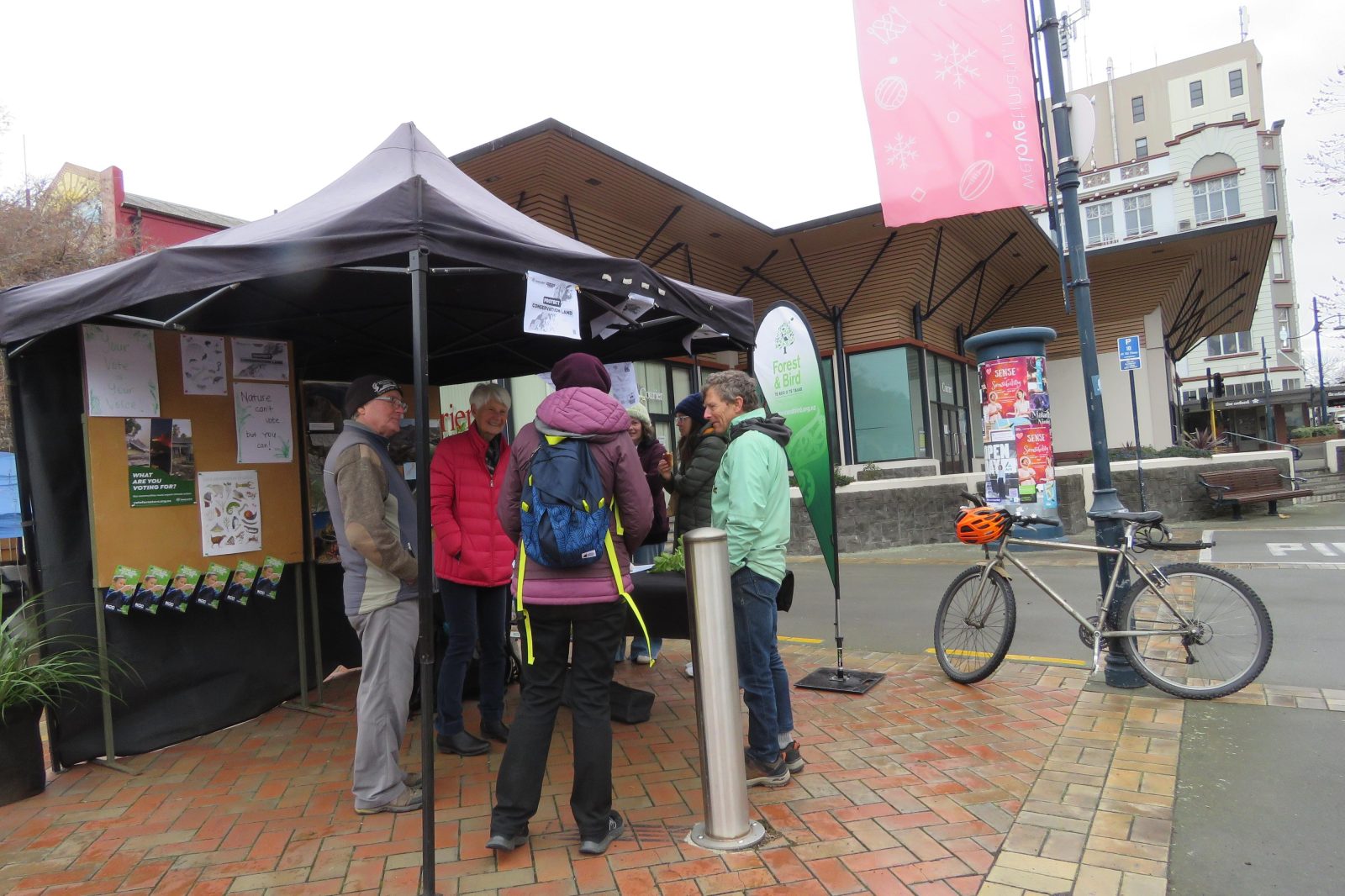
Last Saturday many folks turned up for community events in 37 different locations in New Zealand as part of the National Day of Action, protesting against the Conservation Act Amendment Bill.
The bill proposes to change the purpose of the Act from protecting nature to enabling commercial tourism zones, more mining, and large scale farming and grazing. While some aspects of the act may benefit from being reviewed, the purpose of the current act, protecting nature, needs to be retained. Any changes need to be well considered and consultation is essential.
Thanks to everyone that was braving the elements supporting these events. This country has a long history of standing up to protect nature! Future generations have a right to enjoy the benefits of our and manawhenua’s public protected lands.
This will not be the end though, National has recently announced, if re-elected it would introduce a new Mining General Policy Statement using the fast-track regime.
Currently, the Resource Management Act governs how people can use and develop natural resources while managing impacts on the environment. This plays a key role in protecting ecosystems, freshwater, biodiversity and natural landscapes. These laws are being dismantled right now. The current reform is just one of many legislative changes that pose further threats to our natural environment and its inhabitants.
The fast-track regime has already seen industrial-sized development go ahead. Mega-data centres have been announced for various areas in New Zealand, including Geraldine.
Many countries, including Australia, have put a moratorium on such development because of environmental effects. Air pollution, water usage, contaminated water discharge, power usage, loss of valuable food production soils, are of concern, and the fact that such buildings — industrial in size and appearance — are alien in our rural landscapes.
A “Sierra Club” report mentions that in the state of Virginia, energy prices have skyrocketed by up to 267% in the last five years as a result of the data centre boom. According to Inside Climate News power bills in Pennsylvania have risen by 14% in one year.
Erin Brockovich, an American paralegal, consumer advocate, and environmental activist squeezed a $333 million settlement from a Californian energy company in a scandal over contaminated water in 1993. She is acting again three decades later. She questions the transparency: “If data centres are so great, why are they being built in secret?”
She is asking for a case-by-case moratorium on approving data centres and is currently collating these cases through her open-source mapping site.
Experts warn that during heatwaves the power supply might not be able to keep up with the demand drawn by data centres. Recent heatwaves in Europe may require a rethink of such development, not just in terms of electricity consumption, but also water usage. Switzerland for example, a country with relatively large water resources, faces extreme drought conditions at present. Riverbeds and streams are completely dry, a situation that has never occurred in our lifetime. Around 120 data centres are already operational and another 20 are under construction. A rethink may be required. Can the country afford to provide such vast amounts of water for cooling down the chips that do the work.
Reading in various sources about effects from such an industry, it appears nowadays forever chemicals PFAS (per- and polyfluoroalkyl) are used for cooling down the chips that do the work. These chemicals will never break down in the environment and have been shown to harm human health and living things in the environment. The treatment and disposal of contaminated cooling fluid is a major concern, very little information is visible on how this is being dealt with.
According to the World Health Organisation, some PFAS chemicals are classified as carcinogenic.
There has been no transparency about data centres in New Zealand. Cumulative effects of all data centres needs to be considered, not just one centre at a time. Such centres surely need to provide their own firmed electricity generation and water supply and deal with contaminations. Rate and taxpayers should not have to carry the can.
■ Ines Stager is a landscape architect based in Geraldine, and a committee member of the local branch of the Royal Forest & Bird Protection Society.












Leave a comment