
As field verification in Bassa, Cape Mount and Lofa shows equipment coded and stored after audit; legal experts say findings point to PFM violations, not criminal diversion
Assets valued at more than US$104,900 that the General Auditing Commission (GAC) flagged as un-coded or unverified in its audit of the Smallholder Agriculture Transformation and Agribusiness Revitalization Project (STAR-P) have been physically verified intact at beneficiary sites in three counties, an independent field verification has established.
The verification does not nullify the GAC Management Letter for the period ended October 31, 2025. That letter remains a legally valid record of what auditors observed at the time of their visit. What it does is change the legal and public character of the breach.
Under Liberian law, the facts now point not to criminal diversion, but to a documented failure of asset management and audit readiness.
STAR-P is a US$55 million World Bank IDA-financed project implemented by the Ministry of Agriculture through its Project Implementation Unit (PIU). Its Component 3, which is at the center of the audit, finances private agribusinesses and farmer cooperatives through the Liberia Agriculture Commercialization Fund (LACF) on a matching-grant basis.
A team of journalists conducted follow-up visits to sites cited in the audit in Grand Bassa, Grand Cape Mount and Lofa Counties between August 13-15.
What GAC Reported vs. What Was Found
1. Grand Bassa: US$68,000 at Cheenah Group of Companies
In District #4B, Grand Bassa County, the GAC reported that fixed assets worth US$68,000 procured for oil-palm processing for the Cheenah Group of Companies (CGC) were not coded in accordance with the Government of Liberia Fixed Assets Management Policy.
The listed assets were: one 5.2-ton Isuzu mini-truck valued at US$29,500, two motorized tricycles at US$10,600, one TVS motorbike at US$2,000, and oil-palm processing equipment at US$25,900.
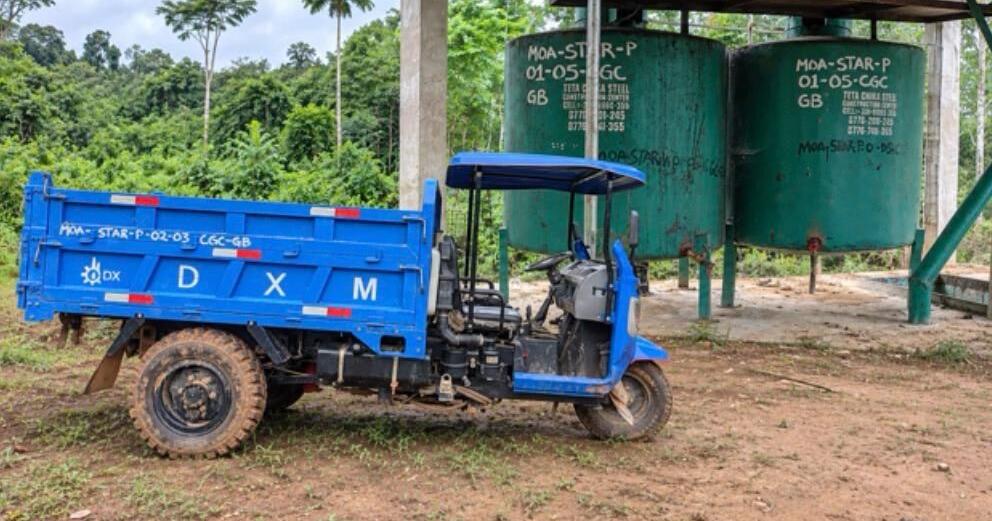
A follow-up visit to the CGC site on Thursday, August 13, found all items physically on site and now coded. This reporter observed and photographed the assets, all of which have now been assigned official Government of Liberia asset codes.
An Isuzu dump truck, one of the major assets at the facility, now bears the identification code MOA-STAR-P-02-01-CGG-GB. The two motorized tricycles have been coded MOA-STAR-P-02-02-CGG-GB and MOA-STAR-P-02-03-CGG-GB respectively.
In addition to the vehicles, other processing equipment was also sighted and documented. These include industrial boilers, a palm-fruit thresher and crusher, and a butter clarification tank – all in good condition at the time of the visit.
“All the equipment and supplies provided to us are accounted for; they are available, and nothing — not one single thing — is missing,” said James Whawhen Jr., Chief Executive Officer of Cheenah Group of Companies.
The coding exercise, carried out under the Ministry of Agriculture’s STAR-P Project, is part of efforts to ensure transparency and accountability in the management of project assets.
2. Grand Cape Mount: US$33,500 at TOTAG Farm
In Pokundu, Tewor District, Grand Cape Mount County, the GAC stated it could not verify US$33,500 worth of assets at TOTAG Farm, including a 10×20 ft cold-storage unit valued at US$11,000, a 10-kW solar grid at US$10,000, and an 8×20 ft shade-net greenhouse.
A field verification tour conducted on Friday, August 14, established that all three items cited in the audit are physically present at the farm site. Some of the equipment was observed still in its original cartons and yet to be installed.
The farm is owned and operated by Madam Tonieh Alpha Gwoah.
Speaking to journalists during the verification, Madam Gwoah said she was away attending to a family emergency at the time auditors visited the farm, which prevented her from presenting the assets for physical inspection.
She confirmed that the farm is currently active and cultivating assorted vegetables using an irrigation system drawing water from the Mano River.
According to Madam Gwoah, the farm is a beneficiary of a matching grant valued at about US$137,000 awarded in 2024 to support agricultural production and irrigation infrastructure. She said the uninstalled items are part of the grant-supported equipment and will be installed as the next phase of cultivation expands.
The verification finding contradicts the initial audit observation that the assets could not be accounted for, suggesting the issue was one of presentation during the audit period rather than absence or diversion.
3. Lofa County: US$3,400 at Kaming Cooperative Society
The three motorbikes belonging to the Kaming Cooperative Society Limited in Lofa County, which were reported as unavailable for verification by the GAC, have also been accounted for and confirmed functional.
In its report, the GAC stated that two TVS motorbikes valued at US$2,100 and one TVS JIVE 100cc motorbike valued at US$1,300 could not be presented for physical verification.
However, a subsequent verification established that all three motorbikes are present, functional, and remain active mobile assets of the Cooperative.
According to the leadership of the Cooperative, the motorbikes were not at headquarters at the time of the GAC’s visit because they had been deployed in the field, in use by extension officers providing support to member farmers in outlying communities.
The three motorbikes were inspected and seen to be in working condition during the verification tour.
In total, assets worth US$104,900 cited by the GAC across the three counties have now been accounted for following independent field verification, bringing to rest questions about their existence and use.
The Legal Lens: Non-Compliance, Not Corruption — Yet
Legal experts consulted say the distinction is decisive under Liberian law.
Under the General Auditing Commission Act of 2014, the GAC is empowered to report compliance as observed. A Management Letter is an interim compliance record, not a criminal indictment. It creates a rebuttable presumption of non-compliance, not a finding of theft.
The breach triggers the Public Financial Management Act of 2009 and the 2023 Revised Fixed Asset Management Regulations. The regulations require that all donor-funded assets be coded, entered into the Fixed Asset Register, insured, assigned custodially, and made available on demand to auditors.
Failure to code or to present an asset on demand constitutes an administrative and regulatory breach. The remedy is an audit qualification, a Management Action Plan, and rectification within a stipulated period.
The threshold for criminal liability is higher. Under Chapter 15 of the Penal Law of Liberia [Theft and Related Offenses] and Section 14 of the Liberia Anti-Corruption Commission Act, criminal diversion requires proof of intent to permanently deprive the Government, and failure to account for the asset after due diligence.
On that test, the three sites have moved from suspected loss to documented compliance failure. The assets exist. The failure was in tagging, storage, and audit readiness.
Legally, the Ministry of Agriculture, as fiduciary holder for STAR-P, remains liable to the World Bank under the Financing Agreement for weak oversight. It is now required to produce a reconciled, geotagged Fixed Asset Register with photographs, codes, GPS coordinates, and signed custodial agreements.
Beneficiaries, for their part, are bound by Clause 7 of the LACF Matching Grant Agreement which provides that all project assets remain the property of the Government of Liberia under custodial care of the grantee until project closure and must be presented at any time to the GoL, GAC, or World Bank Implementation Support Missions.
A Governance Test for the ARREST Agenda
The audit lands at a politically sensitive moment. The Boakai administration has staked its ARREST Agenda for Inclusive Development on commercial agriculture and has pledged to restore donor confidence after years of qualified audits in agriculture sector projects.
For the Executive and development partners, the subsequent field verification provides counter-evidence that equipment was not looted, but it exposes a more systemic governance weakness: a Monrovia-based Project Implementation Unit disbursing high-value assets to rural enterprises without a robust real-time system for monitoring, tagging, insurance, and enforcement.
Governance analysts warn of two risks. First, the World Bank may flag the internal control weaknesses as a moderate fiduciary risk in its next Implementation Support Mission, which could delay disbursements under Component 3. Second, public trust may erode if every “not seen” or “not coded” finding is sensationalized as “missing” or “stolen” on social media before verification.
What is required now is not a selective response. The Ministry of Agriculture and STAR-P must conduct a full county-by-county sweep and reconciliation of all other sites cited by the GAC, publish a complete asset register, and institute mandatory pre-audit presentation protocols for all beneficiaries.













Leave a comment