
In Nepal, gold is an investment and a cultural capital that is deeply embedded in the tradition. The country’s obsession with gold especially during major festivals and wedding seasons has increased the demand drastically, inflating prices to around Rs. 3,00,000 per tola making it an expensive asset class to enter in recent years.
Especially in our country, physical gold jewellery has turned more into a liability than an asset. When buying physical gold, the making charges are about 10 per cent to 15 per cent. There always is a fear of theft, so people tend to keep it safe in the bank lockers, which adds annual locker fees as well. In spite of all these expenses incurred, liquidating a tiny fraction of the jewellery when in need of immediate cash is difficult. Right now, when a person buys gold, that money gets locked up in cupboards and lockers.
From an economic perspective, money invested in physical gold often becomes what economists describe it as “dead capital”. Once purchased, gold is typically stored in homes or bank lockers and does not contribute directly to productive economic activities. To solve all these problems, the concept of a Gold ETF (Exchange-Traded Fund) has been introduced.
A gold ETF serves as a bridge between the stock market and physical gold, allowing investors to invest in gold without having to buy it, store it or make jewelry out of it. Instead of holding physical gold, it is held in digital units in your broker account that are valued at the real-time gold prices. Here one unit would be equal to one gram of gold (or a fraction of a tola) of 99.5 per cent of pure gold that is stored securely in the bank vaults.
Gold ETFs can be bought directly through one’s trading account during market hours, just like buying shares from a regular company stock. Then the fund manager takes the pooled money from all the investors and purchases standard 99.5 per cent pure physical gold bullion from authorised banks. The purchased gold is never held at the fund manager’s office but is directly transported to a highly secure vault managed by an independent major bank. As the prices of gold fluctuate in the physical market, prices in the digital market also fluctuate in the same way and in the same pattern.
Under such a system, investors would no longer need to visit a jeweller or bullion dealer to buy and sell gold. Instead, transactions can simply be done through digital platforms such as MeroShare and broker trading systems. Since Nepal Stock Exchange (NEPSE) is currently equity heavy market, adding gold ETFs to it would give the capital market more diversification moving it away from a heavy reliance on hydropower and banking stock.
Nepal’s gold ETFs need
Nepal’s economy heavily depends on imports. Gold imports consume huge amounts of foreign currency. Every festival season spikes the gold demand. Younger generation investors are becoming more interested in stocks, mutual funds and digital investing. Since online broker systems are already widely spread across the country, introducing Gold ETFs would be easier today than it would have been 10 years ago. Investors currently have no simple financial product that tracks gold prices.
Gold ETFs gained massive global popularity in the early 2000s and transformed the way investors access gold. By converting traditional illiquid physical commodity into a liquid financial asset, Gold ETFs did much more than just giving an easier trading tool for everyday traders and investors but it changed how gold behaves as an economic asset. Turning a physical commodity to a liquid and digital, lower income or young investors can buy a fractional gold with the money that they can invest instead of having to save up a large sum of money for a tola. It helps investors in portfolio diversification. When the stock market is bearish, gold prices traditionally rise.
The transaction costs are also drastically lowered, as there is no making charges, storage cost or insurance. It just requires broking and fund management fees.
Despite their potential benefits, introducing Gold ETFs in Nepal would present several challenges.
As of now there is no legal framework for ETFs in Nepal so the Securities Board of Nepal (SEBON) will have to prepare a complete new legal guidelines and regulatory framework for ETFs. Such regulators must ensure enough reserves and transparency. As mentioned earlier, a gold ETF requires a highly trusted independent banking system capable of holding high-priority gold bullion bars in a secure vault. Nepal’s existing vault infrastructure may require significant upgrades to meet the international standards. Maintaining investors’ confidence would require independent third-party audits to verify the quantity and purity of gold held by ETF providers. Regular disclosure and transparency mechanisms would be essential to ensure safety and protection of investors.
Lesson from another countries
In the US, the first Gold ETF was launched in the early 2000s, which made investing in gold much easier for institutional and retail investors. Investors use gold ETFs primarily for portfolio diversification and as a hedge against economic uncertainty. Today, gold ETFs are among the most actively traded commodity investment products there.
In Australia, gold ETFs are backed by securely stored physical bullion with strict auditing and custody standards helping to maintain investor confidence. Transparency is also very closely monitored.
Singapore is known for having one of the strongest financial systems. Gold ETFs have complimented Singapore’s role as a financial hub. A well-developed financial infrastructure helps the growth of commodity-based investment products.
India’s journey to launch a gold ETF started in 2007. The Securities and Exchange Board of India (SEBI) also had to face multiple challenges to make the ETF come into action.
Initially, the Indian market faced lots of hurdles including skepticism form traditional gold buyers, concerns regarding the physical gold purity verification of underlying bullion and limited public understanding of ETF products.
Over time, regulation improvements, education for investors and increased market participation helped Gold ETFs gain acceptance. It took a long time for the Indian investors to shift towards Gold Saving Funds and Sovereign Gold Bonds. Nepal can learn valuable lessons from the challenges faced by India and make them work effectively in Nepal as well.
Ultimately, introducing Gold ETFs will not stop people from buying traditional jewellery for weddings and cultural rituals. However, it can completely revolutionise the nation’s approach to wealth creation.
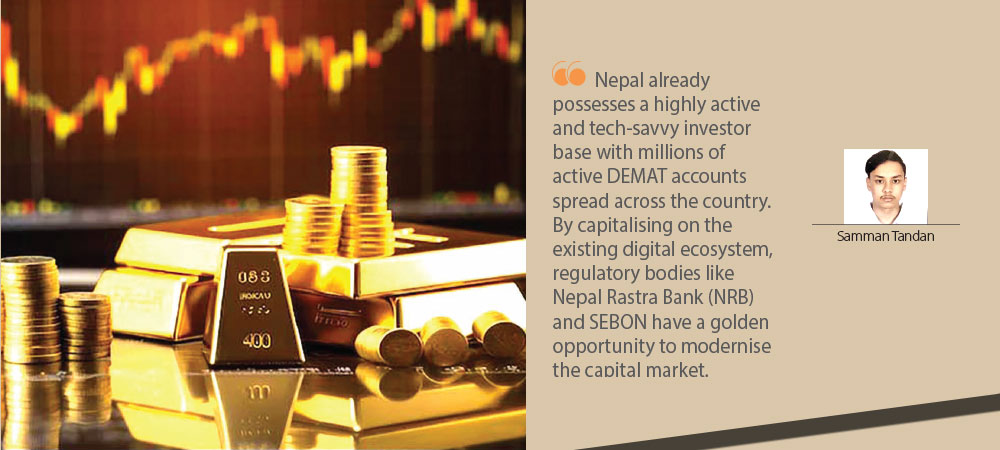
Nepal already possesses a highly active and tech-savvy investor base with millions of active DEMAT accounts spread across the country. By capitalising on the existing digital ecosystem, regulatory bodies like Nepal Rastra Bank (NRB) and SEBON have a golden opportunity to modernise the capital market. If SEBON wants to replicate India’s success, they can bypass it in an early stage.
If SEBON, Nepal Rastra Bank and NEPSE collaborate to launch Gold ETFs, they will not need to educate millions of public however they will need to gain public trust to make them work. While digital gold will never completely replace traditional jewellery for weddings and other festivals, it’s time for Nepal to separate emotional consumer behavior from pure wealth creation.
(Tandan is currently pursuing Chartered Accountant.)













Leave a comment