
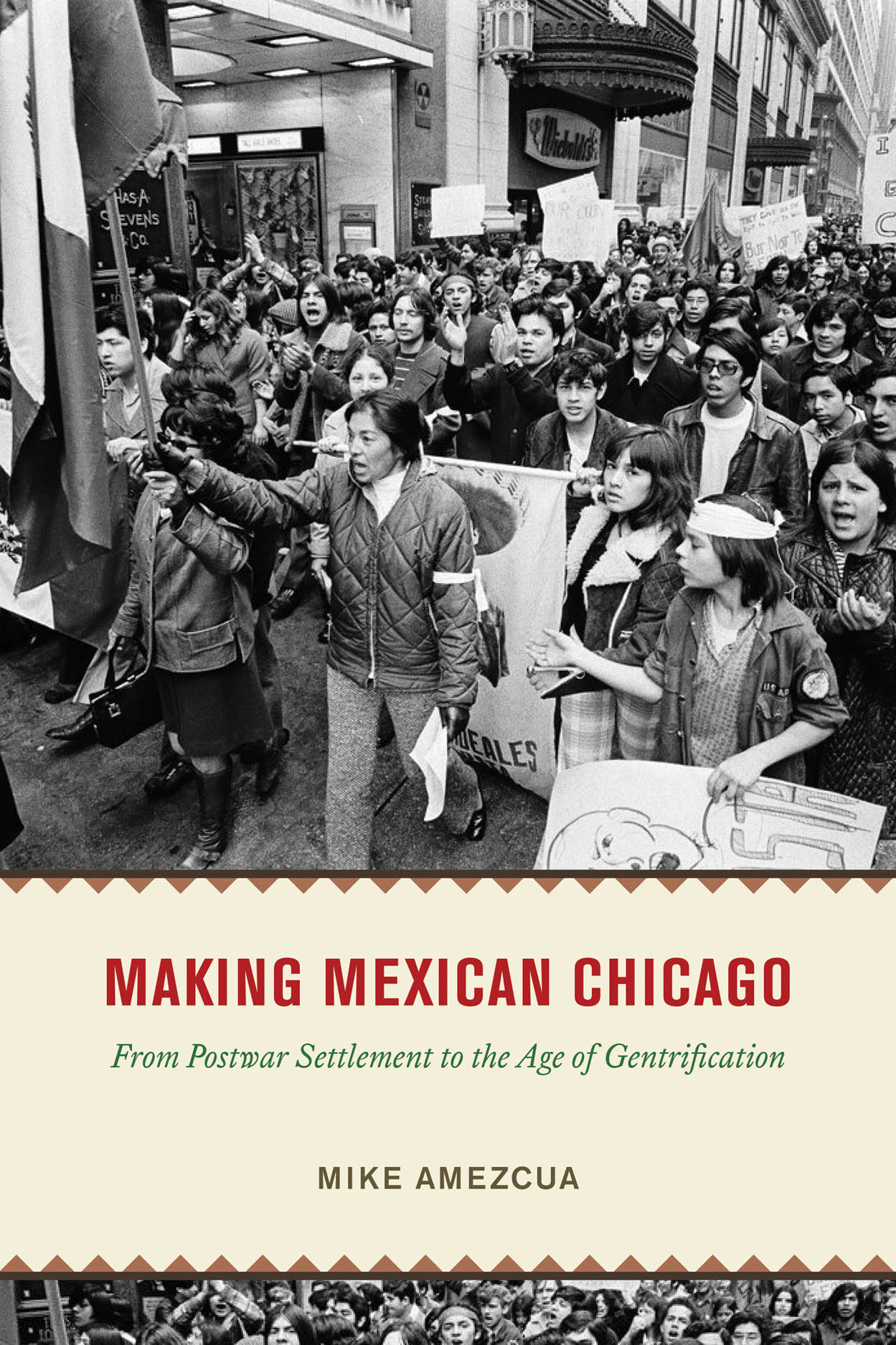
Before Pilsen welcomed gallery spaces and Little Village became La Villita, the city’s Mexican population fought to make their voices heard and for places to live. Georgetown University historian Mike Amezcua chronicles this decades-long struggle in his compelling Making Mexican Chicago: From Postwar Settlement to the Age of Gentrification, published in February by University of Chicago Press. As he describes it, building these communities meant continually changing tactics, alliances, and opponents.
Mexican citizens living in Chicago (as well as American citizens of Mexican descent) faced a considerable foe when the federal government’s Operation Wetback initiated mass deportations during the 1950s. Amezcua details the resulting civil liberties violations and lasting collective trauma. A few years later, local segregationists decried Mexicans moving into such southwest-side neighborhoods as Gage Park and Back of the Yards. But Amezcua also shows the complexities in those reactions as Brown families received substantially less violent hostility than their Black counterparts.
At the same time, he writes about how different Mexican activists used their growing numbers to enter Democratic machine politics. Coinciding with John F. Kennedy’s election, a new organization arose here, “Amigos for Daley.” City Hall, in turn, offered them some patronage jobs and a few concessions in fighting discrimination, but not enough to usurp existing power structures.
Mike Amezcua in conversation with James Akerman
Thu 4/28, 6 PM, Newberry Library, 60 W. Walton, 312-943-9090, newberry.org
Mexicans in the city answered such slights in different ways. Amezcua describes the “sweat equity” that came with increasing home buying and building economic strength. Others became radicalized in the later 1960s and embraced Chicano Power and the Brown Berets (who were modeled after the Black Panthers). Pilsen’s Casa Aztlán cultural center and its original exterior murals emerged from this movement. Some rejected the Democratic Party entirely and started an organization named after Illinois’s Republican governor Richard Ogilvie, “Adelante con Ogilvie.” [Go ahead with Ogilvie.] Eventually, white developers saw certain Mexican areas as desirable for urban renewal, or for an arts colony, and Amezcua draws from Garry Freshman’s 1978 Reader article headlined, “The Colonization of Pilsen.”
These controversies continue while some of the politicians who ascended decades ago have remained. Amezcua mentions that a big advocate for Little Village’s La Villita arch in the 1980s was Mayor Harold Washington’s young aldermanic ally, Jesus “Chuy” Garcia.

Throughout this history, Amezcua highlights myriad personalities and their transformations. Garcia’s political rival, realtor Anita Villarreal, was arrested for resisting immigration laws in the 1950s, then aggressively obtained properties for Mexican homebuyers before supporting Richard J. Daley and Ronald Reagan.
Others were unheralded but their experiences spoke volumes, even when their statements were brief. Cicero resident Xochitl Casas responded as to why she and her husband were welcome in that notoriously antagonistic suburb: “We spend.”
Making Mexican Chicago: From Postwar Settlement to the Age of Gentrification by Mike Amezcua ($45, University of Chicago Press, press.uchicago.edu)
Reader Recommends: ARTS & CULTURE
What’s now and what’s next in visual arts, architecture, literature, and more.

The Hull-House Museum celebrates the vitality of urban agriculture in “Perennial City.”

“The Lawn Open” puts the revolutionary spirit back into mini golf.

The Driehaus tackles the copyright question, as it existed 250 years ago.

Alberto Aguilar brings his inviting approach to artmaking to the People’s Palace.

At Document, works by Kazuhito Tanaka are an exercise in looking.

The artworks in “Longer Than the Sky” present a down-to-earth alternative to those at the Obama Presidential Center.












Leave a comment