
Key Takeaways
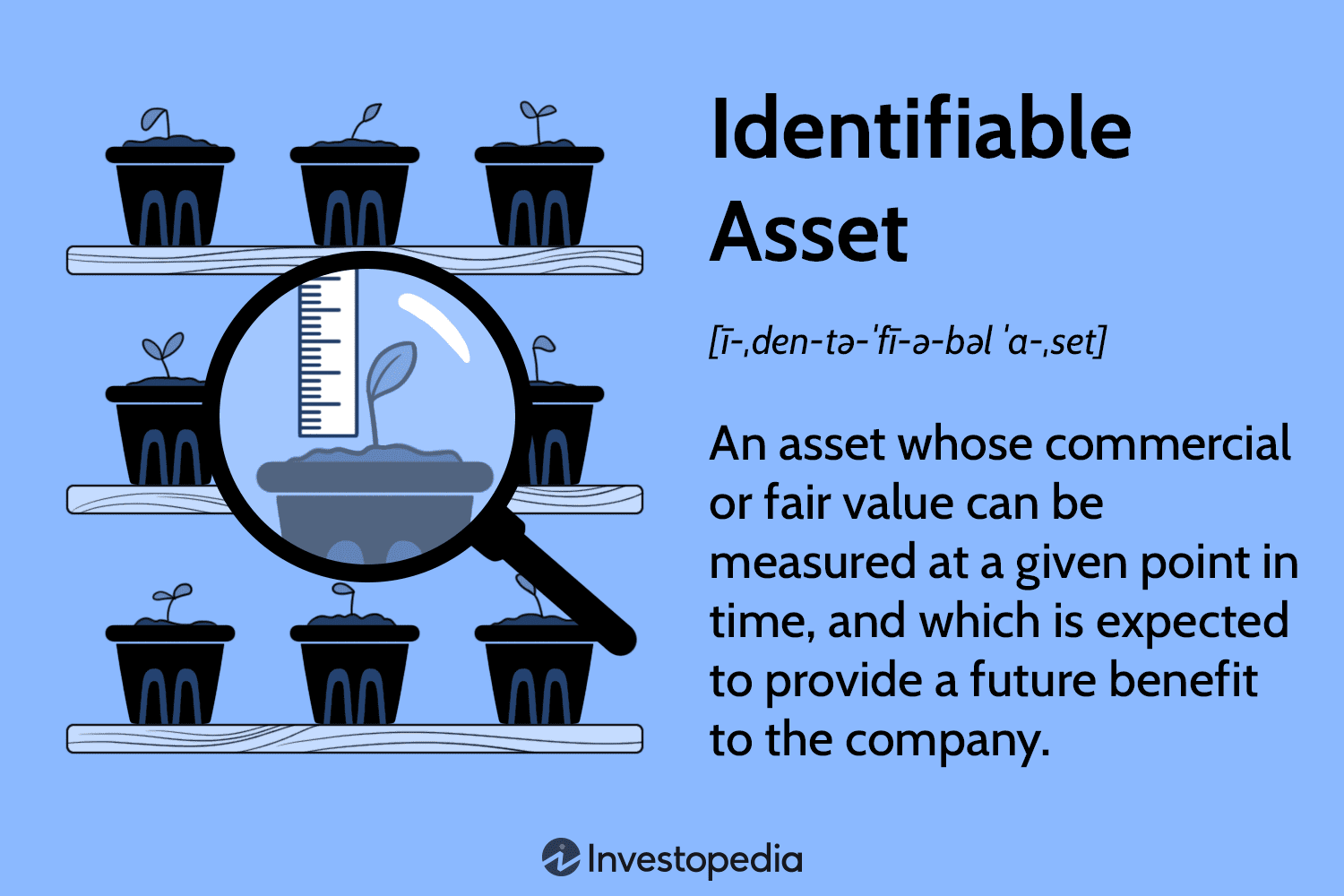
- Identifiable assets are measured by fair value and provide future benefits to a company.
- Examples include cash, property, equipment, and inventories that can be quickly valued.
- These assets play a crucial role in mergers and acquisitions for assessing company value.
- Tangible and intangible assets are identifiable, unlike goodwill, which can’t be separately valued.
- Goodwill arises when the purchase price exceeds the fair value of identifiable assets and liabilities.
Get personalized, AI-powered answers built on 27+ years of trusted expertise.
What Is an Identifiable Asset?
An identifiable asset is a tangible or intangible asset with a fair value that can be measured at a point in time, with future benefits expected for the company. It matters in mergers and acquisitions because accurate valuation affects how a deal is priced and allocated on the balance sheet. Identifiable assets differ from goodwill, which cannot be separately measured as a specific asset.
How Identifiable Assets Impact Business Valuation
When one company seeks to take over another, the acquiring company can assign a fair value to the identifiable assets that can be reasonably expected to provide a benefit to the purchasing company in the future. Identifiable assets can be both tangible and intangible assets. Identifiable assets are quite important in valuing a business accurately.
If an asset is deemed to be identifiable, the purchasing company records it as part of its assets on its balance sheet. Identifiable assets consist of anything that can be separated from the business and disposed of such as machinery, vehicles, buildings, or other equipment. If an asset is not deemed to be an identifiable asset, then its value is considered part of the goodwill amount arising from the acquisition transaction.
Practical Applications of Identifiable Assets
For example, suppose a conglomerate company purchases both a smaller manufacturing firm and a smaller start-up internet marketing company. The manufacturing company would likely have most of its value tied up in property, equipment, inventory, and other physical assets, so virtually all of its assets would be identifiable.
The Internet marketing company, on the other hand, would likely have very few identifiable assets, and its value as a company would be based on its future earnings potential. As such, the purchase of the marketing company would generate a lot more goodwill on the company’s books, as it’s total value cannot be readily measured even though there might be a few tangible assets.
Comparing Identifiable Assets and Goodwill With Real Examples
If the fair value of Company ABC’s identifiable assets are $22 million, and its liabilities are $10 million, it has an identifiable value:
- Assets – liabilities = $12 billion
Company XYZ agrees to purchase Company ABC for $15 billion, the premium value following the acquisition is $3 billion. This $3 billion will be included on the acquirer’s balance sheet as goodwill since it exceeds the identifiable assets.
As a real-life example, consider the T-Mobile and Sprint merger announced in early 2018. The deal was valued at $35.85 billion as of March 31, 2018, per an S-4 filing. The fair value of the assets was $78.34 billion and the fair value of the liabilities was $45.56 billion. The difference between the assets and liabilities is $32.78 billion. Thus, goodwill for the deal would be recognized as $3.07 billion ($35.85 – $32.78), the amount over the difference between the fair value of the identifiable assets and liabilities.
The Bottom Line
In a takeover, identifiable assets are items with measurable fair value that get recorded separately on the balance sheet, which drives purchase-price allocation and overall valuation.
Goodwill sits apart as the remaining premium, as seen in the T-Mobile-Sprint deal where spectrum licenses plus network infrastructure counted as identifiable assets while goodwill reflected expected benefits beyond those measured items.














Leave a comment