
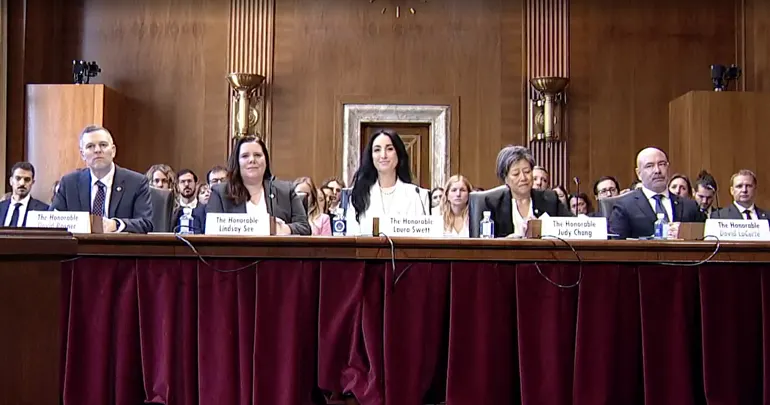
The Federal Energy Regulatory Commission has created a task force on “grid-enhancing technologies” to see how the agency can support them, possibly with incentives, FERC Chairman Laura Swett said Wednesday.
Utilities have proactively started using GETs — which include dynamic line ratings, advanced power flow controllers and high-performance conductors — and their cost-saving data is now available, Swett told the U.S. Senate’s Energy and Natural Resources Committee during an oversight hearing.
The Federal Power Act bars FERC from requiring utilities to use GETs, but the agency can direct transmission owners to analyze them, which can show what the most economic option is when considering new transmission infrastructure, according to Swett.
In addition, FERC could incorporate GETs into its processes for doling out incentives to transmission owners and developers, FERC Commissioner Judy Chang said. When they seek incentives, FERC could ask them to explain what technologies they’re implementing, what else they have considered and why they are not using the best technologies available, she said.
While FERC cannot mandate a technology, it is required to approve “just and reasonable” rates, Sen. Angus King, I-Maine, noted.
“If the transmission folks are taking actions that don’t make economic sense and will penalize their ratepayers, that does give you a hook to look more carefully at how they actually do it,” King said.
Currently, transmission owners have an incentive to invest as much as possible in their infrastructure — potentially to “gold plate” it — so they can earn as much return as possible, King said. That’s a disincentive for investing in less expensive GETs, he said.
“One of the things we need to look at is how do we provide shared savings, for example, or some kind of incentive to the companies to make these kinds of investments because the cost of the grid enhancement is going up in a huge way over the next several years … and this cost is going to be overwhelming in the next five or 10 years if we don’t do it in a smart way,” King said.
PJM governance reform
The PJM Interconnection is the largest and oldest electricity market in the United States, and it is “probably performing the worst,” Swett told the committee the day before FERC was set to hold a technical conference on possible reforms to the grid operator’s governance.
“We are optimistic that people will be able to coalesce around identifying what should change in the market by the end of tomorrow and the comments filed after, so that we can give clearer direction,” Swett said.
“Success to me looks like a PJM in the near future that is able to propose solutions quickly, with some type of member support that is clear, and to make those filings and excellent filings at FERC, so that we can move expediently to have this market serve the country efficiently,” Swett said.
Currently, PJM saves consumers billions a year by efficiently operating the grid and planning the transmission system, FERC Commissioner David Rosner said.
“But … none of that works if you don’t have buy-in from states,” he said. “We set the market rules, and that results in price signals to invest, but none of that goes anywhere if the states don’t believe in the way that that price was derived.”
Transmission competition
Fifteen years after FERC issued its Order 1000 injecting competition into the transmission process, the push “has not yet fully materialized,” Sen. Mike Lee, R-Utah and committee chair, said.
“What else do you think the Commission can do to bring more competitive pressure into the electricity sector in a way that’s likely to improve conditions, including prices and reliability for consumers?” Lee asked FERC commissioners.
Some regions have been implementing competitive transmission processes, but they are only just beginning to bring efficiencies and cost savings to consumers, according to Chang.
“We should find additional efficiencies through competition where it’s possible,” she said. “The backbone transmission system is extremely important in integrating the large loads that we’re seeing and the large generation that we’re adding to the system, and to bring down the cost to all consumers requires competition.”
Data center show cause orders
“Utilities and markets do not want to change, with the exception of a few of them, and it requires aggressive instruction for them to innovate,” Swett said in response to a question about FERC’s “show cause” orders to major grid operators on how they integrate data centers and other large loads to the grid. “These June orders were the perfect vehicle for us to employ the market experts, the markets themselves, in order to push the grid into the future.”
Key elements of the orders include FERC’s requirement for fast action on modernizing transmission services and interconnection study processes, according to Swett.
“This will save our consumers a lot of money, and with our instructions, they are now … forced to consider advanced transmission technologies in their study processes, and also to study load that may appear near generation, which will reduce the amount of transmission build that is necessary to get the load online,” Swett said.
Also, FERC is forcing more accountability in getting generation built, according to Swett.
“FERC has no jurisdiction over generation, but because we have directed each market to come back to us with reporting on what they intend to do, how to handle this generation cliff that we are standing on as a nation, that is forcing thought and hopefully action,” Swett said.











Leave a comment