

(Edited and refined by Candice Chan, with the assistance of AI translation.)
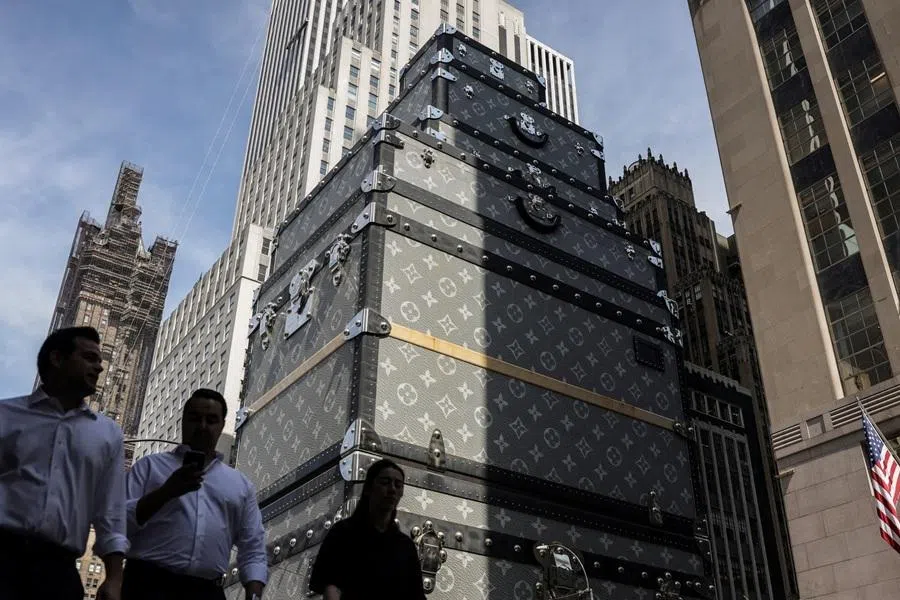
On 29 June, the Suzhou Intermediate People’s Court in Jiangsu province ruled in favour of Louis Vuitton (LV) in its trademark infringement lawsuit against Chinese milk tea chain Molly Tea. The court found that Shenzhen Molly Tea Catering Management Co. and a franchise store in Suzhou’s Wuzhong Economic Development Zone had infringed seven of LV’s registered four-petal floral trademarks. It ordered Molly Tea’s operator to pay 10 million RMB (US$1.48 million) in damages and 300,000 RMB in legal costs, for a total of 10.3 million RMB.
The ruling has left many Chinese people feeling unhappy and even humiliated. Critics have pointed to the baoxiang floral motifs found on Tang dynasty pipa instruments and the decorative window designs of Suzhou’s classical gardens, arguing that the four-petal flower motif has existed in China for more than 1,000 years, whereas LV’s monogram has a history of only about 130 years. How has a pattern with such ancient Chinese origins become LV’s “exclusive” design?
To understand the ruling, one must begin with the legal reasoning behind it.
The court held that the black geometric four-petal floral design later adopted by Molly Tea closely resembled LV’s classic floral monogram in its overall four-petal symmetrical structure, the curvature of the petals and the size of the blank space at the centre. Although tea beverages and luxury leather goods belong to entirely different industries, LV has used its four-petal floral design across its full range of products for many years, giving it exceptionally high brand recognition. Under China’s Trademark Law, well-known trademarks enjoy cross-category legal protection to prevent consumer confusion or the dilution of brand identity.

Clearly, the case was decided on the basis of modern trademark law.
LV cannot, of course, monopolise flowers found in nature, nor can it claim exclusive ownership of traditional Chinese motifs such as the baoxiang pattern or the begonia motif. These belong to the public domain and remain available for anyone to use. What trademark law protects is not the underlying motif itself, but its specific expression and its function as an identifier of commercial origin. LV’s four-petal flower consists of a distinctive combination of design elements, including the curvature of its lines, the proportions of the intersecting petals and the central dot. Molly Tea’s design was found to be highly similar to this registered trademark.
More precisely, trademark law does not protect ideas or source material; it protects specific designs and their distinctiveness. The legal principle underlying the judgement is therefore that anyone is free to draw inspiration from traditional Chinese culture, but the final design cannot resemble, in geometric proportions or overall visual appearance, a famous trademark that has already been registered and used in China for four decades. A comparable example occurred in the late 1980s, when the American magazine Reader’s Digest sued the Chinese publication of the same name over trademark similarity and infringement. The Chinese magazine ultimately changed its name to Readers (《读者》) in 1993.
One of the fundamental principles of modern trademark law is that earlier registrations enjoy legal protection. On 15 January 1986, LV obtained approval from China’s National Intellectual Property Administration (CNIPA) to register its combined four-petal floral trademark under registration number 241012. Owing to its high degree of public recognition, the monogram also enjoys cross-category legal protection as a well-known trademark.

After LV had lawfully secured its registration, Molly Tea also attempted to register a similar trademark. Beginning in 2024, Molly Tea repeatedly applied to the CNIPA to register various four-petal floral designs, but each application was rejected and declared invalid because the designs were considered too similar to LV’s earlier trademark. The authorities concluded that the proposed designs were “suspected of imitating a luxury brand and therefore could not be registered”. Nevertheless, Molly Tea continued to use the similar logo extensively across more than 2,000 physical outlets, on takeaway cups and bags, and on its mini-programme.
Such conduct was evidently viewed as deliberate infringement, or an attempt to “free ride” on another brand’s reputation. Legally, this constituted wilful bad-faith infringement, leading the court to award substantial damages in favour of LV.
Although LV prevailed in its lawsuit against Molly Tea, the case has also forced many Chinese to confront a troubling phenomenon: cultural latecomers using modern legal systems to fence off ancient Chinese public cultural resources, such as the four-petal floral motif. This reflects one of the pathologies of globalisation and international exchange, where cultural appropriation can generate advantages under modern legal rules.

Your fortnightly dose of Chinese history, culture, and cartoons. Sign up now.

Historically, luxury brands in developed countries have frequently drawn inspiration from Eastern cultures, including decorative patterns from China’s Sui and Tang dynasties and Japanese family crests, to create a wide range of cultural products, including trademarks. They have then taken advantage of the modern intellectual property system established in the West by registering these designs globally — or in China itself — effectively staking legal claims over them.
It is therefore understandable why many Chinese feel aggrieved. Countless cultural symbols with histories spanning several millennia belonged to the public domain in ancient China, where no modern commercial laws or trademark registration systems existed. As a result, these symbols now receive no legal protection and can instead be defeated in court by commercial trademarks that are only around 130 years old.
LV’s classic monogram was created in 1896 to combat counterfeiting. Celebrating the monogram’s 130th anniversary, LV describes it as a “universal symbol of creativity”, saying it drew inspiration from Neo-Gothic ornamentation and the influence of Japonism. The design was registered as a trademark in China in 1986. Whatever its artistic inspirations, its legal protection has made it considerably more difficult for Chinese companies to draw on their own millennia-old cultural heritage when designing trademarks without risking infringement and costly legal consequences.
China’s cultural resources embody both natural and cultural attributes, reflecting the Chinese understanding of the world and of nature. The four-petal floral motif originated from the Chinese observation of plants. After a persimmon fruit is picked, its calyx remains attached. Commonly known as the persimmon calyx, it is in fact the persistent sepals left behind after flowering, naturally forming four pointed lobes arranged in a symmetrical cross. Over time, this persimmon calyx motif evolved into the four-petal floral pattern.
The persimmon calyx motif first appeared during the Shang and Zhou dynasties, flourished during the Spring and Autumn and Warring States periods, and by the Han dynasty had been widely used on bronze mirrors, lacquerware, silk textiles, jade objects and even coffin decorations in tombs.
To the ancient Chinese, this small four-petal motif represented far more than a flower. It embodied the Buddhist notion that “one flower contains an entire world, one leaf contains enlightenment” — a miniature model of the cosmos itself. It encapsulated ancient Chinese philosophy and concepts of space and time. Its cross-shaped design guided people’s understanding of the four cardinal directions — east, south, west and north — while also symbolising the sun’s path across the heavens, representing the beginning of time and cosmic order.
The Chinese did not merely derive inspiration from the persimmon calyx motif when creating decorative designs. More broadly, they looked to nature as a source of artistic inspiration. During the Tang dynasty, the baoxiang motif emerged as a composite ornamental pattern that combined characteristics of lotus flowers, peonies, chrysanthemums and other natural blossoms, with artistic embellishment and geometric reconfiguration. Such designs became widely used on Tang bronze mirrors, silk brocades, Dunhuang murals and the richly decorated caisson ceilings of imperial architecture.

During the Song and Yuan dynasties, the begonia motif also became highly popular. Based on the shape of the begonia blossom — particularly the weeping begonia — it symbolised prosperity, abundance, gentleness and elegance. Begonia motifs developed into both naturalistic and geometric forms. The naturalistic style depicted the graceful drooping branches and unopened buds of the flower, while the geometric style — such as the “begonia line” and “begonia lattice” — abstracted the curved petals into continuous four- or eight-lobed patterns with smooth, rounded lines. These motifs were widely used in the backrests of traditional Chinese furniture, lattice windows and partitions, decorative borders on porcelain, and woven patterns in ancient clothing.
For Chinese companies, the lesson is twofold. First, they should continue to draw inspiration from the vast wealth of Chinese culture when designing trademarks. Second, they must ensure compliance before proceeding with trademark use. If the National Intellectual Property Administration rejects a proposed trademark or logo, companies should not gamble on using it regardless. Instead, they should return to Chinese culture — or indeed Western culture and even modern scientific achievements — for fresh inspiration, redesigning and creating genuinely original trademarks.
Perhaps that is the greatest lesson to emerge from LV’s trademark infringement lawsuit against Molly Tea.














Leave a comment