
Stakeholders at the 5th African Natural Resources and Energy Investment Summit (AFNIS 2026) have called for the swift implementation of agreements reached during the event, urging governments, investors and industry players to translate discussions into tangible projects capable of driving Africa’s economic transformation.
The two-day summit, which ended in Abuja on Thursday, featured the signing of several strategic partnerships and investment agreements focused on mining, critical minerals development and sustainable resource management across the continent.
Speaking at the closing ceremony, Nigeria’s Minister of Solid Minerals Development, Dr Dele Alake, commended delegates from across Africa for their commitment to leveraging the continent’s natural resources for industrialisation and economic growth.
“Everywhere I go in Africa for these mining events, the enthusiasm has been real, the zeal has been ideal, and the results have been showing,” Alake said.
He noted that the agreements signed at the summit demonstrated that AFNIS had moved beyond dialogue to become a platform for practical outcomes.
“The signing ceremonies that we had here are eloquent testimonies to our stated objectives and the achievement of our goals. These AFNIS events have not just been talking shops; they have become platforms for delivering results,” he said.
However, the minister stressed that the true measure of the summit’s success would be the implementation of commitments made by stakeholders.
“We don’t want everything to end here—not just in speeches, addresses, remarks and photographs. We need actual results,” he said.
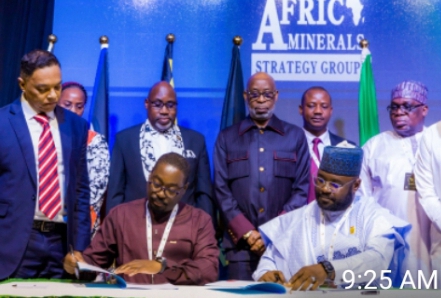
A major highlight of the summit was the signing of a Memorandum of Understanding (MoU) between the Africans for Africa (AFA) Initiative and Steron International Resources Limited to support the development of lithium and rare earth mineral projects in Nigeria.
Under the partnership, Steron is expected to receive technical support and access to investment opportunities to advance the project while complying with international environmental, social and governance (ESG) standards.
A key component of the agreement is the adoption of AFA’s 51 per cent Total African Benefit (TAB) model, which seeks to ensure that a significant share of the economic value generated from mineral projects is retained within Africa through local processing, domestic supply chains and investments in host communities.
Speaking at the signing ceremony, Managing Director and Chief Executive Officer of Steron International Resources Limited, Sadiq Abubakar Omar, said the partnership demonstrates that mining projects in Nigeria can meet global standards while delivering economic benefits locally.
“This MoU is a testament to our shared belief that Nigerian mining projects can and must meet global ESG standards while delivering transformative economic outcomes for our local communities,” Omar said.
“Our objective is to demonstrate that responsible mining and economic development can go hand in hand. Investors increasingly demand sustainability, and communities increasingly demand inclusion. We believe both objectives can be achieved simultaneously.”
Omar said the company is focusing on rare earth elements because of their growing importance in modern technology and the global energy transition.
“We are prioritising rare earth elements because these minerals are increasingly becoming the backbone of modern technology,” he said.
“They are found in inverter systems, electronics, electrical appliances, renewable energy technologies, electric vehicles and virtually every technology that will define the future economy.”
He disclosed that the company had identified three major rare earth element deposits in Nigeria’s Middle Belt and plans to invest heavily in their development.
According to him, the long-term goal is not merely to extract and export minerals but to develop the expertise and industrial capacity required to process them into finished products within Nigeria and across Africa.
“Our intention is not simply to mine these resources and ship them overseas. We want to develop the intellectual property, technical knowledge and skills required to convert them into finished products here in Nigeria and across Africa,” he said.
“If we are the source of these minerals and also the consumers of the finished products, then the logical thing to do is to develop the capacity to manufacture these products ourselves. That is where the real value lies.”
Omar also identified access and credibility challenges faced by young African entrepreneurs but said such obstacles should not discourage efforts to build indigenous businesses.
“The first challenge is simply being young. Being young and managing a business in Africa is already a challenge,” he said.
“But these challenges are ours to solve. We cannot continue to wait for others to fix them for us.”
He also commended ongoing reforms in Nigeria’s solid minerals sector, saying they align with emerging opportunities created by the global shift towards cleaner energy technologies.
“It could not have come at a better time. The leadership of the ministry coincided with a period when the world is rapidly transitioning towards cleaner energy systems,” he said.
“We understand that global demand for critical minerals will continue to grow as countries seek to achieve their energy transition goals by 2030 and beyond. This is Africa’s opportunity to industrialise.”
Also speaking, Co-founder of the Africans for Africa Initiative, Suleiman Zakari, described the agreement as a practical step towards ensuring that Africa derives greater value from its natural resources.
“Two years ago, we launched the AFA Initiative on this very stage with a vision to institutionalise African mineral wealth,” Zakari said.
“Today, with the AFA Mining Fund institutionalised and approaching its first close, this partnership with Steron demonstrates that our strategy is moving from vision to tangible, high-impact reality.”
He noted that Africa has historically exported raw materials while importing finished products at higher cost, a model he said has limited the continent’s economic gains.
“For decades, Africa has exported raw minerals and imported finished products at significantly higher cost. That model has not delivered the level of prosperity our people deserve,” he said.
“What we are trying to achieve is a system where African resources create African industries, African jobs and African prosperity.”
Zakari added that the project aligns with efforts to promote local value addition, technology transfer, skills development and community participation in the mining sector.
Industry stakeholders said the partnership reflects growing interest in leveraging Nigeria’s substantial deposits of lithium, rare earth elements and other critical minerals as countries seek secure supplies of resources needed for the global energy transition.
Nigeria is believed to possess significant reserves of lithium, rare earth elements, cobalt and graphite, minerals that are increasingly important to the production of batteries, renewable energy technologies, advanced electronics and defence systems.
Also speaking, Nasarawa State Governor Abdullahi Sule highlighted his administration’s commitment to responsible mining and infrastructure-driven development.
He said the state had established a legally backed Infrastructure Fund financed through five per cent of its internally generated revenue (IGR) to support key sectors such as mining and agriculture.
“Responsible mining ensures fair returns for investors, protects government revenues and safeguards the interests of host communities,” Sule said.
He explained that the fund is being used to provide infrastructure such as roads, electricity and security to create an enabling environment for investment.
Governor Sule described AFNIS as an important platform for building partnerships and advancing sustainable resource development across Africa, urging investors and development partners to explore opportunities in Nasarawa State.
The summit, with the theme, ‘One Africa, One Resource Vision,’ brought together policymakers, investors, mining executives and development partners from 15 African countries to discuss strategies for value addition, critical minerals development and industrial transformation.
Participants expressed optimism that the agreements reached at AFNIS 2026 would accelerate Africa’s shift from exporting raw materials to becoming a more competitive player in the global resource value chain.
We’ve got the edge. Get real-time reports, breaking scoops, and exclusive angles delivered straight to your phone. Don’t settle for stale news. Join LEADERSHIP NEWS on WhatsApp for 24/7 updates →












Leave a comment