
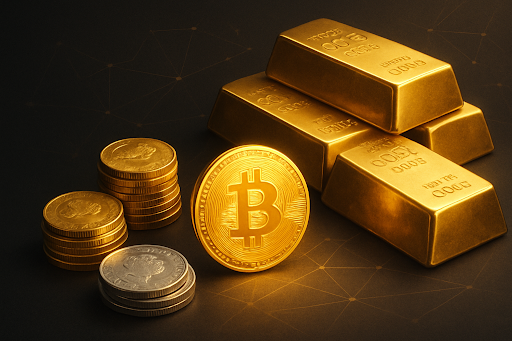
Cryptocurrency and precious metals make a natural pair: one is digital and fast-moving, the other is physical and time-tested. Converting some of your Bitcoin, Ethereum or stablecoins into gold and silver lets you lock in a hard, tangible store of value — without a bank in the middle, and often in minutes. This guide explains how buying precious metals with crypto actually works, what it costs, how private it is, and how to do it safely, with real dealer examples along the way.
Key takeaways
- You can buy physical gold and silver directly with Bitcoin, Ethereum and stablecoins from a growing number of dealers.
- Crypto-native shops settle on-chain from your own wallet — faster and more private than card or wire, often with no ID below a set limit.
- Prices are spot plus a premium, locked for roughly 10–20 minutes while your transaction confirms.
- Investment-grade gold is VAT-exempt in the UK and EU; spending crypto can still trigger capital-gains tax in some countries.
- Vet the dealer first: confirm LBMA sourcing, a real company behind it, insured shipping and a fair buyback.
Can you buy gold and silver with cryptocurrency?
Yes — you can buy physical gold and silver with cryptocurrency today. A widening list of bullion dealers accept Bitcoin (BTC), Ethereum (ETH) and US-dollar stablecoins such as USDT and USDC for coins and bars. You shop as normal, select crypto at checkout, and pay from your own wallet. Large mainstream dealers like APMEX, JM Bullion and BullionStar route crypto through a payment gateway that converts it to cash, while crypto-native specialists accept payment directly on the blockchain — keeping the process faster and more private.
Why buy gold and silver with crypto right now
The timing is striking. Gold had its strongest year in decades in 2025, climbing roughly 65% and setting more than 50 record highs — its best annual run since 1979 — while silver surged even harder. Central banks added another 863 tonnes of gold in 2025, and total gold demand passed 5,000 tonnes for the first time on record. Meanwhile, the number of people holding crypto has grown past 740 million worldwide. For anyone sitting on crypto gains, rotating a portion into hard metal is a classic diversification move: it hedges crypto’s volatility into an asset that has held value for thousands of years.
How to buy gold or silver with Bitcoin: step by step
- Choose a reputable dealer that accepts crypto. Confirm a verifiable company behind the site, LBMA Good Delivery sourcing, and insured, tracked shipping. Read independent reviews before a first order.
- Set up and fund a crypto wallet. A self-custodial wallet (hardware or software) gives you the most control and privacy. Make sure it holds the coin the dealer accepts.
- Check which cryptocurrencies are accepted. Bitcoin is universal; many dealers also take ETH, LTC, XMR and stablecoins. Stablecoins remove price-swing risk at checkout.
- Add metal to your cart and select crypto at checkout. Pick coins or bars, enter shipping details, and choose your coin. The price shows as spot plus a transparent premium.
- Send payment within the price-lock window. You get a fresh receive address and exact amount (often a QR code) locked for 10–20 minutes. Send the exact amount from your wallet.
- Confirm and receive your metal. Once the transaction confirms on-chain, your order is allocated and ships — usually within one to a few business days — in discreet, insured packaging.
Which cryptocurrencies can you use?
Bitcoin is accepted almost everywhere, but crypto-native dealers cast a far wider net — between them taking Bitcoin (including the Lightning Network), Ethereum, the major stablecoins and a long tail of altcoins:
| Cryptocurrency | Commonly accepted? | Best for |
| Bitcoin (BTC) | Universally | The default; widest support, incl. Lightning at some shops |
| Ethereum (ETH) | Very widely | Fast settlement, large holder base |
| USDT / USDC (stablecoins) | Widely | Removing price volatility during checkout |
| Litecoin (LTC) | Often | Low fees, quick confirmations |
| Monero (XMR) | Crypto-native shops | Maximum payment privacy |
| SOL, XRP, BNB, DOGE, ADA, TRX | Selected dealers | Spending existing altcoin holdings |
Why stablecoins are popular: because USDT and USDC are pegged to the dollar, the value you send won’t drift while you complete checkout — handy given the short price-lock window.
Physical metal vs tokenized gold (PAXG & Tether Gold)
Physical bullion means real coins and bars you take delivery of or store in an insured vault — a tangible asset with no counterparty. Tokenized gold is a blockchain token where one unit equals one fine troy ounce of vaulted gold. PAX Gold (PAXG), from the New York-regulated Paxos Trust, is backed by allocated London Good Delivery bars held with Brink’s; Tether Gold (XAUT) is backed by gold in Swiss vaults. Tokens settle instantly and trade in fractions, but you depend on the issuer and usually need a large balance to redeem the actual metal. The tokenized-gold sector passed $6 billion in 2026 — but if your goal is to own and hold metal, physical bullion is the focus below.
Crypto-friendly bullion dealers compared
Among shops built specifically for paying with crypto, three are worth knowing in 2026. Each suits a slightly different priority — widest coin support, maximum privacy, or the most established business behind it.
BitGolder — longest-running, widest coins
BitGolder has been operating as a crypto-native bullion shop since 2023, making it the most established of these three crypto-first brands, and it advertises the largest customer-review base of the group. It accepts the widest coin list — BTC plus the Lightning Network settled through its own BTCPay server, ETH, SOL, XMR and major stablecoins, with 30+ further coins via a processor. It sells LBMA-sourced gold and silver from 1g to 1kg, with simplified due diligence (no ID) on orders up to $20,000, insured discreet worldwide delivery that’s free over $500, a short price-lock at checkout and a 7-day buyback at live spot.
Anonymity: High — no ID up to $20k, plus Monero & Lightning support.
Pros
- Longest-running of the three (since 2023)
- Largest advertised review base
- Widest coin support incl. Lightning & Monero
- Free shipping over $500; 7-day buyback
Cons
- No-ID ceiling lower ($20k) than BTC Goldshop
- Long-tail coins go via a third-party processor
- Crypto-only — payments are irreversible
Best for buyers who want the longest track record among crypto-native shops and the broadest list of accepted coins.
BTC Goldshop — highest no-KYC limit, non-custodial
BTC Goldshop (operated by Victoria Gold & Silver) is the privacy-maximiser of the group: it’s fully non-custodial, so you pay directly from your wallet and the store never holds your funds, and it offers the highest no-ID threshold here — guest checkout with no KYC up to $50,000. It advertises 50+ accepted assets, LBMA-certified gold and silver from refiners and mints such as PAMP Suisse, Perth Mint, Heraeus, Metalor, Umicore and Valcambi, shipping to 150+ countries, and a 20-minute rate lock with automatic on-chain confirmation. It’s the newest brand of the three (launched 2025).
Anonymity: Very High — non-custodial payment, no KYC up to $50k.
Pros
- Highest no-KYC threshold ($50k)
- Fully non-custodial — never holds your funds
- 50+ coins; ships to 150+ countries
- Clear 20-minute rate lock
Cons
- Newest brand — shortest track record
- Smaller catalogue than the others
- Crypto-only — no chargebacks
Best for privacy-first buyers who want self-custodial payment and the highest no-ID limit.
BTC Mints — most established business, free shipping
BTC Mints is the crypto checkout of KDG Gold, a precious-metals dealer that has run a physical office and in-house authentication lab in Paphos, Cyprus since 2013 — the strongest real-world pedigree of the three. It’s also the only one offering platinum and a collectibles range. Its detailed authenticity page documents LBMA Good Delivery sourcing, allocated stock with full chain-of-custody back to the mint, serial-numbered assay cards and a money-back authenticity guarantee. Payment is processed directly on-chain (BTC, ETH, USDT, USDC, XMR and more), standard orders need no KYC, and shipping is insured with free delivery over $1,000 (a flat $25 below that), plus a 7-day buyback at live spot.
Anonymity: High — no KYC on standard orders; pays on-chain.
Pros
- Backed by an established dealer (KDG Gold, since 2013) with a real office
- Documented chain-of-custody & authenticity guarantee
- Only one offering platinum & collectibles
- Free insured shipping over $1,000; 7-day buyback
Cons
- Crypto storefront itself is newer
- $25 shipping on smaller orders
- Crypto-only — payments are irreversible
Best for buyers who value an established, verifiable business, documented authenticity, and platinum alongside gold and silver.
Comparison at a glance
| Feature | BitGolder | BTC Goldshop | BTC Mints |
| In business since | 2023 (crypto-native) | 2025 | 2013 (via KDG Gold) |
| No-KYC limit | Up to $20,000 | Up to $50,000 | Standard orders |
| Anonymity rating | High | Very High | High |
| Pays on-chain (native) | Yes (+ Lightning) | Yes (non-custodial) | Yes |
| Coins accepted | BTC, ETH, SOL, XMR, stablecoins +30 via processor | 50+ assets | BTC, ETH, USDT, USDC, XMR +more |
| Metals | Gold, silver | Gold, silver | Gold, silver, platinum, collectibles |
| Shipping | Free over $500, insured worldwide | 150+ countries, insured | Free over $1,000 (else $25) |
| Buyback | 7-day at spot | Buyback offered | 7-day at spot |
| Stands out for | Track record & coin range | Highest no-KYC limit | Established business behind it |
Details reflect each company’s published terms in June 2026. Always confirm the latest pricing, limits and shipping on the dealer’s own site before ordering.
Overall pros and cons of buying metals with crypto
Advantages
- No bank or intermediary needed
- Fast, borderless settlement
- Lower fees than cards; some dealers give ~3% off
- More privacy via self-custodial payment
- Diversifies volatile crypto into a hard asset
Disadvantages
- Crypto can move during the payment window
- Blockchain network fees apply
- Payments are irreversible — no chargebacks
- Premium over spot, plus shipping/insurance
- Newer crypto-only shops carry more counterparty risk
Timing tip: because both metal and crypto prices move, pay with a stablecoin to neutralise crypto volatility at the moment of purchase, and use a wallet that broadcasts quickly so you comfortably beat the price-lock clock.
Privacy, KYC and anonymity
Paying with crypto is generally more private than a card or wire, but rarely fully anonymous — a delivery address is always required. The key variable is each shop’s no-ID threshold: BitGolder applies simplified due diligence (no documents) up to $20,000, BTC Goldshop goes up to $50,000 with no account at all, and BTC Mints takes standard orders without KYC. Above those limits, expect identity checks in line with anti-money-laundering rules (EU reporting obligations commonly begin around €10,000). Privacy coins like Monero and a self-custodial wallet add further confidentiality, but they don’t erase the shipping trail.
Vet every dealer before a big order: confirm a real registered company and address, look for LBMA Good Delivery sourcing and a certificate of authenticity, check independent reviews, confirm insured and tracked shipping, and place a small first order to test the process. Because crypto payments can’t be reversed, this up-front check is your main protection.
Tax and VAT when you buy metals with crypto
This is general information, not tax advice — rules vary by country and change often. Two points matter most:
VAT: investment-grade gold is VAT-exempt across the UK and EU, no matter how you pay. Silver is treated differently and usually carries VAT (20% in the UK), so silver has to rise further just to break even — a key reason gold is the more tax-efficient metal.
Capital gains: in many countries, spending cryptocurrency is itself a disposal that can trigger capital-gains tax on any gain since you acquired the coins — separate from any tax on the metal later. In the US, physical gold and silver are taxed as collectibles (long-term gains up to 28%). In the UK, certain legal-tender coins such as Britannias and Sovereigns can be exempt from capital-gains tax. Keep records of what you paid in crypto and check the rules where you live.
Ready to turn crypto into real metal? Compare live prices and start with a small test order at BitGolder, BTC Goldshop or BTC Mints — then scale up once you’ve confirmed delivery.
Frequently asked questions
Can you buy gold and silver with cryptocurrency?
Yes. Many dealers accept Bitcoin, Ethereum and stablecoins for physical gold and silver. Crypto-native shops like BitGolder, BTC Goldshop and BTC Mints accept payment directly on-chain from your own wallet.
Can you buy gold with Bitcoin anonymously?
More privately than with a card, but not fully anonymously — a shipping address is required. No-ID limits vary: ~$20k at BitGolder, up to $50k at BTC Goldshop, and standard orders at BTC Mints.
Is it cheaper to buy gold with crypto?
It can be. Crypto fees are lower than cards, and some dealers offer around 3% off. You still pay a premium over spot and a network fee, so compare the all-in price.
What’s the difference between physical metal and tokenized gold (PAXG/XAUT)?
Physical metal is something you hold or vault. Tokenized gold is a blockchain token representing one ounce of vaulted gold — instant and fractional to trade, but reliant on the issuer and harder to redeem physically.
How long do I have to send the crypto payment?
Usually a 10–20 minute price-lock window. Miss it and the order re-prices. Use a fast wallet, or pay with a stablecoin to avoid volatility.
Is investment gold VAT-free when bought with crypto?
Yes — investment-grade gold is VAT-exempt in the UK and EU regardless of payment method. Silver generally is not.
Is buying metal with crypto safe?
It can be, with a reputable dealer that has a verifiable business behind it, LBMA sourcing and insured shipping. Because crypto payments are irreversible, vet the seller and start with a small order.













Leave a comment