
After talking about the genesis of the CNAV strategy previously, I am going to disclose the method of analysis and calculation process in this article.
How to calculate CNAV
Before we dive deep into the calculation, you would need to understand the structure of the Annual Report and the 3 financial statements.
It will be easier to use Hongkong Land as an example to go through the calculation. The first page of the annual report we usually go to is the Balance Sheet. I am using the Dec 2013 report which you can download from SGX website.
As part of the CNAV Strategy, we’ll need to identify the value of the ‘Conservative Assets’ and the ‘Total Liabilities.
Let’s dive into the calculations:
These are items we would count as Assets: and let us be conservative and only consider properties and cash, and exclude other assets which are less valuable and stable:
- Leasehold land: $7.4m
- Investment properties: $23,583m (main bulk of their assets)
- Bank Balances: $1,406.3m (cash)
- Ignore Tangible fixed assets. Also known as Property, Plant & Equipment. Usually companies would give a break down but not in this report, so we do not know what constitute properties or furniture)
- Exclude properties for sale (these are development units for sale. We exclude it first and assume these are not sold)
- Sum all these assets after discount, Conservative Assets = $24,996.7m
These are items we count as Total Liabilities (most reports would state the Total Liabilities as a line item but Hongkong Land did not. We have to add the non-current liabilities together too.)
- Current liabilities: $2,192.3m
- Non-current liabilities: $3,719.4m + $83.1m + $102m = $3,904.5m
- Total Liabilities = Current Liabilities + Non-current Liabilities = $6,096.8m
Sum Conservative Assets and minus Total Liabilities to get CNAV = $18,899.9m
Look to note 21 to get the number of shares = 2,352.8m
Divide CNAV by the number of shares, we will have CNAV per share = $8.03
At the time of writing, Hongkong Land is trading at $6.80 (both report and share price are in USD so no conversion is required), or a 15% discount to CNAV.
Note:
- We usually exclude S-Chips (Chinese companies listed in Singapore) as we do not trust the numbers reported by them.
- The above valuation is known as CNAV1 which is used for property counters. We use CNAV2 for stocks in other industries.
POF Score
Although there is a discount, we have a step two test which we termed it as POF score (I will describe the general principle and please do not ask what the exact criteria are)
Profitability
While we emphasised on asset-based valuation, we look into earnings as well. The company should be making profits with its assets. If we realised by now, if we pay a fraction for its valueable assets, future earnings all come free to us. We do not pay a single cent for the potential profits.
Operating Efficiency
We have to look at the cashflow to ensure the profits declared are received in cash. A positive operating cashflow will ensure the company is not bleeding cash while running its business. If it does, the CNAV will decline as the company has to raise cash by selling assets and / or borrowing money.
Financial Position
Lastly, we will look at the gearing of the company. We do not want the company to have to repay a mountain of debts going forward, especially if interest rate rises, it may dip into their operating cashflow, or worse, depleting their assets.
And believe it or not, the above analysis can be done within 15 minutes!
We do make other qualitative assessment to enhance the probability of win. But in general, we trust the quantitative approach substantially.
When to Take Profit
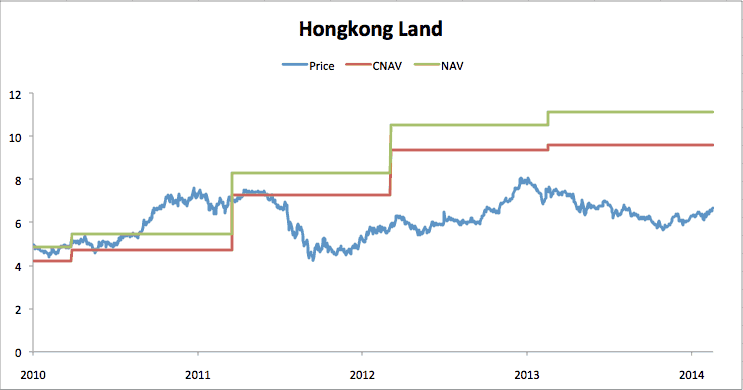
A systematic way to take profit is to wait till the Stock Price to hit Net Asset Value (NAV). Hongkong Land current NAV is $11.43. You would reap a 64% gain if you buy at $6.95 and sell at $11.43. In fact, it is possible to sell even higher because the NAV is expected to go up annually, since part of the earnings which are not paid out in dividends are retained by the company.
In the chart below, you can see how the asset value rises year-on-year:

DISCLOSURE: I am a shareholder of Hongkong Land.
DISCLAIMER: This is an example to illustrate the CNAV strategy and not an investment advice for the reader.
Concerns and Doubts
I know you have a few concerns and doubts going in your head. Let me anticipate them:
- The property value is based on current market valuation, which is considered ‘high’, what if the property market comes down?
- Hongkong Land is quoted in USD and there is currency exchange risk investing in it. What if USD weakens against SGD? The gains would be neutralised.
- What about the dividends? If dividends are not high, I won’t want to invest in it. So what if the asset value is high and I cannot unlock the value?
- This stock doesn’t seem to be going anywhere. What if I am stuck in the investment?
- Are there enough stocks to buy using such a conservative method? Will it be all property stocks?
- Will CNAV give me small cap stocks? They are so low in liquidity. What if I cannot get out?
- Any other examples how CNAV worked in the past?
- How long do I have to wait?
- What is an investment return to be expected?
I will address these concerns in future articles. Are there other pros and cons of the strategy that you can think of?









Leave a comment