
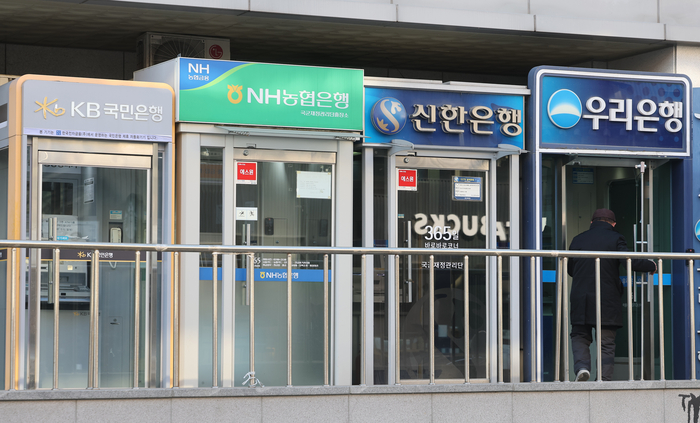

South Korean lenders are accelerating the sale of real estate holdings as they shutter physical branches to boost asset efficiency.
According to data from the Financial Supervisory Service on Tuesday, the average fixed asset-to-equity ratio for the nation’s four major banks—KB Kookmin, Shinhan, Woori, and Hana—hit a record low of 8.83 percent as of the third quarter of last year. The figure marks a significant decline from approximately 15 percent a decade ago. After falling into single digits in 2024, the ratio has maintained a steady downward trajectory.
Operating fixed assets mainly include bank-owned branch properties and land. Because these tangible assets are difficult to liquidate quickly, a lower fixed asset-to-equity ratio suggests a bank is successfully streamlining its balance sheet and strengthening liquidity.
Total fixed assets for the top four banks fell to 13.23 trillion won ($9.12 billion) as of the third quarter of last year from 13.79 trillion won in 2020. KB Kookmin Bank led the decline with a reduction of 611.1 billion won over five years. Analysts note that since real estate prices rose sharply during this window, the drop in book value confirms a substantial disposal of physical property.
The decline is driven by an aggressive restructuring of branch networks. As digital transformation and artificial intelligence bankers render physical locations high-cost burdens, banks are closing offices at a rapid pace.
The total number of branches and sub-branches for the four major lenders fell from 3,406 in 2020 to 2,689 last year. This represents a loss of 717 locations (21.1 percent), in just five years. Shinhan Bank saw the sharpest contraction, with its network shrinking by over 25 percent from 870 to 651 locations.
While banks typically aim to own about 30 percent of their branch real estate, many are now offloading these titles rather than simply ending leases. One major lender reduced its owned-property count by 30 over four years, while another liquidated nine owned locations in 2024 alone.
These sales allow banks to bolster capital quickly, as gains are immediately reflected in retained earnings. Industry experts expect this trend to continue as banks seek to secure liquidity for productive and inclusive finance initiatives in line with government policy.
Heightened financial sector uncertainty has also pushed lenders to shed illiquid land and buildings in favor of cash reserves to improve crisis-response capabilities. To maintain a physical presence, many banks are replacing full-service branches with smaller sub-branches, which operate at roughly one-third the cost and manpower.
By Yon Q-uk and Chang Iou-chung
[ⓒ Pulse by Maeil Business News Korea & mk.co.kr, All rights reserved]














Leave a comment