
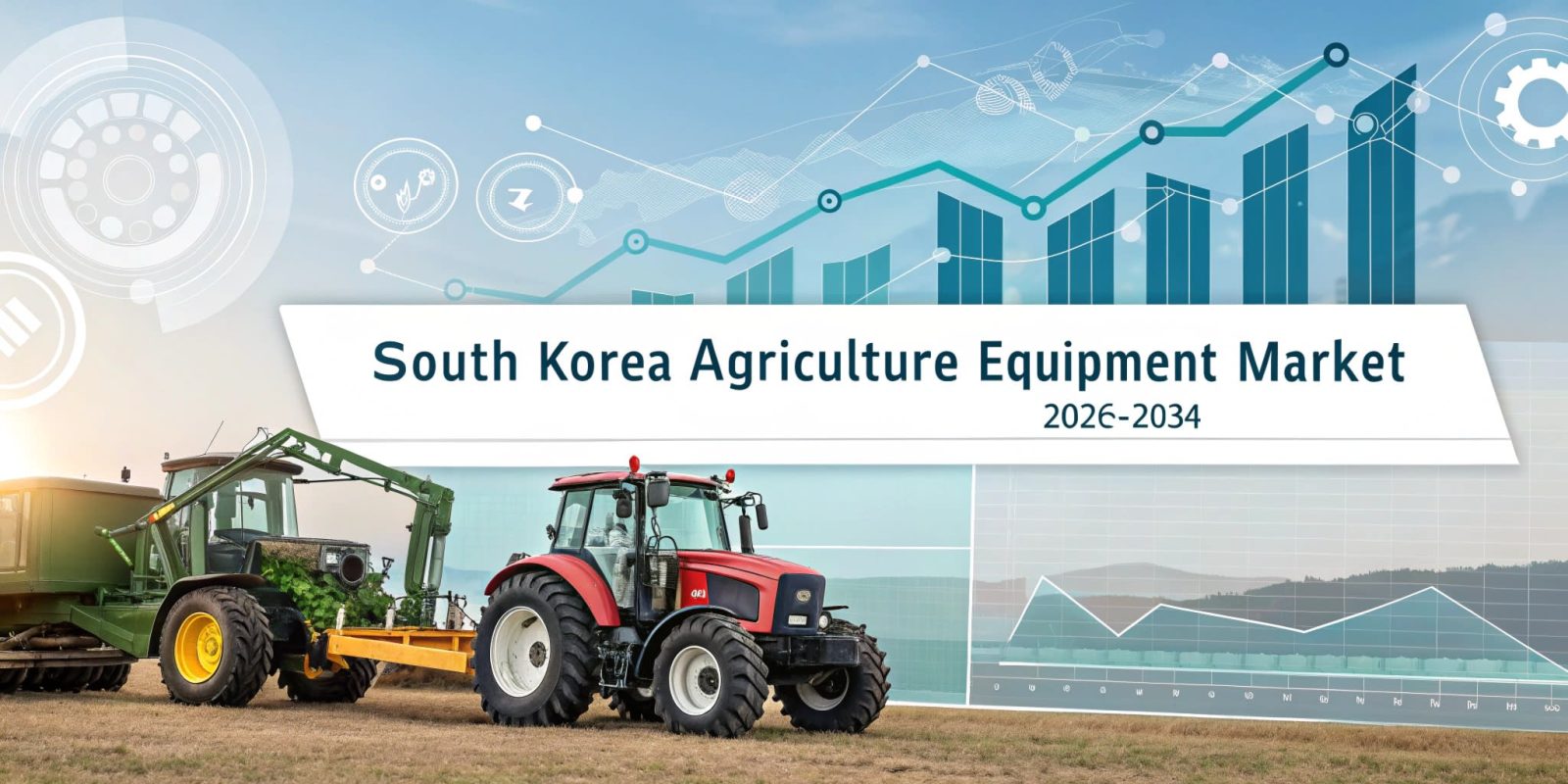
The South Korea agriculture equipment market is experiencing steady growth due to increasing farm mechanization, rising adoption of precision farming technologies, and supportive government initiatives aimed at improving agricultural productivity. According to IMARC Group’s latest data, South Korea agriculture equipment market size reached USD 3,588.4 Million in 2025. Looking forward, IMARC Group expects the market to reach USD 4,913.3 Million by 2034, exhibiting a growth rate (CAGR) of 3.45% during 2026-2034.The market includes a wide range of machinery categories such as agriculture tractors, harvesting equipment, irrigation systems, crop processing equipment, spraying machinery, handling equipment, and soil cultivation tools.
Agricultural equipment plays a critical role in improving farming efficiency by reducing dependence on manual labor and enhancing operational productivity. These machines support activities including seeding, tillage, harvesting, spraying, irrigation, and livestock management. In addition to increasing efficiency, modern agricultural machinery helps reduce crop losses, improve soil management, and optimize the use of agricultural resources. The growing need to modernize farming practices in South Korea is contributing to the wider adoption of advanced agricultural equipment across both small-scale and commercial farming operations.
The market is also being influenced by changing demographic patterns in rural areas, particularly the aging farming population and labor shortages. These factors are encouraging farmers to adopt mechanized solutions that improve productivity while minimizing physical labor requirements. Furthermore, the integration of digital technologies into farming equipment is supporting the transition toward precision agriculture and smart farming systems.
South Korea Agriculture Equipment Market Growth Drivers
Rising Demand for Farm Mechanization
One of the major factors driving the South Korea agriculture equipment market is the growing need for mechanization in farming activities. A significant portion of the farming population in South Korea is aged 65 years and above, leading to reduced availability of agricultural labor. As a result, farmers are increasingly adopting machinery such as compact tractors, rice transplanters, automated harvesters, and crop sprayers to maintain productivity.
Mechanized farming equipment helps reduce labor dependency, improve operational efficiency, and minimize production time. Government-backed subsidy programs are also supporting equipment purchases by reducing the financial burden on farmers. These initiatives are encouraging small and medium-sized farms to transition from traditional farming practices to more efficient mechanized systems.
Government Support for Smart Farming
Government policies and modernization programs are contributing significantly to market growth. The Ministry of Agriculture, Food and Rural Affairs (MAFRA) has introduced several support schemes aimed at improving farm productivity through mechanization and digital agriculture.
Programs focused on smart farming infrastructure encourage the use of IoT-enabled devices, automated irrigation systems, greenhouse monitoring technologies, and AI-based crop management solutions. Financial support and subsidies for machinery purchases are helping increase accessibility to modern farming equipment. These initiatives are improving awareness and adoption of advanced agricultural technologies across rural regions.
Specialized Equipment Demand Due to Terrain Conditions
South Korea’s geographical landscape includes hilly terrain and relatively limited flat agricultural land, creating demand for specialized agricultural machinery designed for smaller and irregular farming areas. Compact tractors, slope-compatible harvesting equipment, and precision spraying systems are increasingly being used to improve farming operations in such environments.
This demand for terrain-specific machinery supports consistent equipment adoption across different agricultural regions. Areas such as Yeongnam and Honam, known for diverse crop cultivation and challenging terrain, continue to show strong demand for specialized farming equipment.
South Korea Agriculture Equipment Market Trends
Increasing Adoption of Precision Agriculture
Precision farming technologies are becoming more common across South Korea’s agricultural sector. Farmers are increasingly using GPS-enabled machinery, remote monitoring systems, and IoT-connected agricultural devices to improve efficiency and crop management.
Modern agricultural equipment integrated with digital systems allows farmers to monitor soil conditions, optimize fertilizer usage, track moisture levels, and improve irrigation efficiency. Mobile-based farm management applications and real-time analytics tools are also contributing to more data-driven farming practices.
The integration of automation and digital technologies is helping improve productivity while reducing operational costs. These developments are expected to continue shaping the future of the South Korea agriculture equipment market.
Expansion of Agricultural Drone Usage
Agricultural drones are gaining popularity in South Korea for crop monitoring and spraying applications. Drone-based spraying systems allow more precise pesticide and fertilizer application while reducing chemical waste and labor requirements.
Supportive government policies and subsidy programs are helping farmers adopt drone technology more rapidly. Drone equipment is particularly useful in hilly and hard-to-access farming areas where traditional machinery may be less effective. The growing use of drones reflects the broader transition toward smart and technology-driven agriculture in the country.
Shift Toward Electric and Autonomous Machinery
Demand for electric and autonomous agricultural equipment is gradually increasing in South Korea. Manufacturers are developing electric tractors and automated farming machines that help reduce fuel consumption and operational costs while supporting environmentally sustainable farming practices.
Autonomous features such as auto-steering systems, obstacle detection sensors, and remote-control functionality are improving operational efficiency and reducing operator fatigue. These technologies are becoming increasingly relevant for farms facing labor shortages and productivity challenges.
Research institutions and equipment manufacturers are continuing to invest in the development and testing of next-generation farming machinery, supporting long-term technological advancement within the sector.
Regional Insights
Different regions across South Korea contribute to the demand for agricultural equipment based on crop cultivation patterns and terrain conditions. The Yeongnam region remains a major market for advanced machinery due to its extensive agricultural activity and diverse crop production. Honam also represents an important agricultural region with significant demand for cultivation and harvesting equipment.
Urban-adjacent agricultural zones are increasingly adopting smart farming systems and automated technologies to improve efficiency and optimize resource utilization.
Recent Developments
April 2026: Hyundai Agri introduced a prototype autonomous weeding robot designed for row-crop farming applications.
March 2025: LS Mtron expanded its electric tractor lineup targeting small and medium-sized farms.
January 2025: TYM Group partnered with a precision agriculture software provider to integrate advanced field mapping technologies into tractor systems.
November 2024: Daedong (KIOTI) introduced autonomous-compatible tractors designed for South Korea’s hilly farming conditions.
August 2024: MAFRA expanded subsidy support for agricultural drones to encourage wider adoption in crop protection activities.
Note
Additional insights, regional analysis, or industry-specific information can be incorporated based on specific business or research requirements.











Leave a comment