
Key Takeaways
- Fixed-income securities provide predictable income and return of principal at maturity.
- Common types include government bonds, corporate bonds, municipal bonds, and CDs.
- Government-backed securities are generally lower risk but offer lower returns.
- Fixed income can stabilize portfolios and reduce volatility.
- Key risks include inflation, interest rate changes, and credit risk.
Get personalized, AI-powered answers built on 27+ years of trusted expertise.
What Is a Fixed-Income Security?
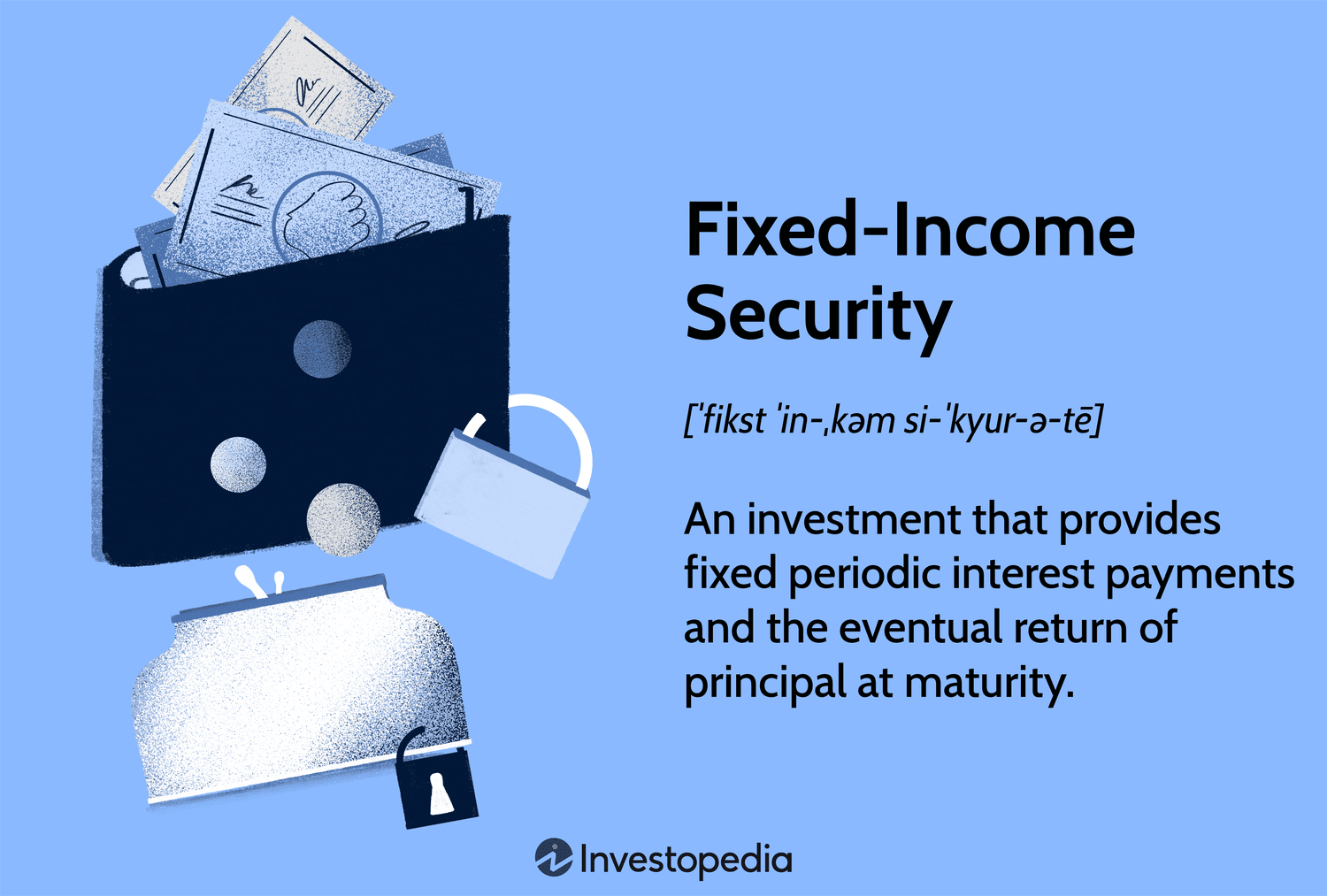
A fixed-income security is an investment that provides fixed, periodic interest payments and returns the principal amount at maturity. Corporations, municipalities, or the government typically issue fixed-income securities to raise capital for a project or budget item.
The main appeal of fixed-income securities is their ability to offer predictable income over time. However, the trade-off is usually lower returns compared to more volatile investments like stocks.
How Fixed Income Securities Works
Fixed-income securities operate on a simple principle: you lend money to an issuer for a set period.
In exchange, the issuer agrees to:
Because of their predictability and relatively low volatility, fixed-income securities often appeal to conservative investors. They can also help balance a diversified portfolio by offsetting the volatility of higher-risk assets.
Why Investors Choose Fixed Income Investments
Fixed-income investments are often used to generate steady income, preserve capital, and reduce overall portfolio volatility—especially during market downturns.
Types of Fixed-Income Securities
While all fixed-income securities offer income and principal repayment, they can vary significantly based on issuer, credit quality, tax treatment, and risk.
At A Glance
Government bonds: Low risk, lower returns
Municipal bonds: Tax-advantaged income
Corporate bonds: Higher yields, higher risk
CDs: Bank-issued, low risk, insured
Savings bonds: Long-term government-backed savings
Municipal Bonds
Municipal bonds are a debt obligation issued by a state or local government to fund infrastructure and public projects such as schools, hospitals, bridges, and highways. Municipal bonds, also known as munis, pay interest income exempt from federal taxes and, for some residents, state and local taxes.
Municipal bonds are typically issued in $5,000 increments, making them accessible to many investors. Muni’s tax exemption status makes them particularly appealing to investors in high tax brackets. However, many retirees and investors can benefit from diversification and income provided through bond products.
Tip
Municipal bond interest is generally exempt from federal income tax and may also be exempt from state and local taxes for residents of the issuing state.
Corporate Bonds
Corporate bonds are issued by companies to finance business operations, expansion, or capital investments. Purchasing a corporate bond does not represent ownership or voting rights, but it does entitle investors to regular interest payments, usually every six months.
Corporate bonds are classified by:
- Credit quality: investment-grade or non-investment-grade
- Maturity: short-term, medium-term, or long-term
Treasury Bills
Treasury bills, or T-bills, are short-term debt obligations from the U.S. Government, ranging in maturity from four to 52 weeks.
Because short maturities don’t allow much time for interest to accrue or for periodic payments, the U.S. Treasury issues T-bills at a discount from par value. Investors then receive the full par value at maturity. T-bills are considered very safe because they are backed by the full faith and credit of the U.S. government.
Treasury Notes
Treasury notes (T-notes) are intermediate-term government securities that mature in two to 10 years. They are sold in $100 increments and pay fixed interest semiannually. At maturity, investors receive their full principal repayment.
Treasury Bonds
Treasury bonds (T-bonds) are the longest-maturing U.S. government securities, with maturities of 20 or 30 years. Like T-notes, they are sold in $100 increments and pay semiannual interest.
Interest earned on Treasury bonds is exempt from state and local taxes, which can make them attractive for long-term income and diversification, particularly in retirement portfolios.
Certificates of Deposit
Certificates of deposit (CDs) are issued by banks and credit unions and require investors to lock up funds for a specified period. In exchange, CDs typically offer higher interest rates than savings accounts.
CDs are generally considered low risk and are usually insured:
- By the FDIC for banks
- By the NCUA for credit unions
Standard CDs often have minimums of $500 or $1,000, though some have no minimum. Jumbo and high-yield CDs require larger deposits but may offer higher rates.
U.S. Savings Bonds
U.S. savings bonds are government-issued securities designed for long-term saving. They are typically purchased at a discount and earn interest for up to 30 years.
Minimum purchases start at $25, and interest is exempt from state and local taxes.
Preferred Stock
Preferred stock shares some characteristics with fixed-income securities, such as paying regular dividends. However, dividends are based on a set dollar amount or percentage of the stock’s par value and may be suspended if the issuing company experiences financial difficulty.
Unlike most fixed-income securities, preferred stock generally does not have a maturity date.
Fixed Income Credit Ratings
Independent credit agencies such as Moody’s Investor Service, Standard & Poor’s Global (S&P Global), and Fitch’s Ratings evaluate the creditworthiness of issuers of fixed-income securities. Ratings range from AAA (highest quality) to D (default).
- BBB- or higher (S&P/Fitch)
- Baa3 or higher (Moody’s)
Speculative-grade bonds:
- BB+ or lower (S&P/Fitch)
- Ba1 or lower (Moody’s)
U.S. Treasury securities are typically considered among the lowest-risk fixed-income investments.
Pros and Cons of Fixed Income Security
Advantages
-
Predictable income paid on a schedule
-
Lower volatility and market risk
-
Principal returned at maturity
-
Diversification benefits
-
Some have tax-advantages
Disadvantages
-
Lower returns compared to other securities
-
Interest rate risk as interest rates may drop as prices rise
-
Future dollars may not have as much value
-
Higher returns mean higher default or credit risk
Are Fixed Income Securities Safe?
Fixed-income securities are generally considered safer than stocks, but they’re not risk-free investments. The safety of fixed-income securities depends on the issuer and credit rating. Government-backed fixed-income securities, such as T-bills or munis, are the safest, but the trade-off is lower interest rates.
Should I Include Fixed Income in My Portfolio?
Fixed income securities can be an excellent way to diversify your investment portfolio, especially if you’re looking for stability and predictable income. The right amount to invest depends on your risk tolerance, investment goals, and timeline.
How Do I Decide Between a Bond Fund and Individual Bonds?
Both options provide income and diversification, but they differ:
Individual bonds
- Known maturity date and principal repayment
- Less exposure to ongoing management fees
- Require more capital to diversify
Bond funds
- Instant diversification and liquidity
- No guaranteed principal return
- Subject to management fees and price fluctuations
Do All Fixed Income Securities Have Tax Benefits?
Not all fixed-income securities have tax benefits, but some do. Municipal bonds, for example, are exempt from federal income tax, and qualified investors may also be exempt from state and local tax.
The Bottom Line
Fixed-income securities offer investors predictable income and portfolio diversification. Some fixed-income securities also have significant tax benefits, particularly for investors in high tax brackets.
These investments are generally safe, but investors should consult credit ratings and research before committing- especially because of the illiquidity of fixed income securities. If you’re considering adding fixed-income securities to your portfolio, consider consulting with a financial advisor to determine which fixed-income securities are right for you based on your risk tolerance, timeline, and goals.












Leave a comment