
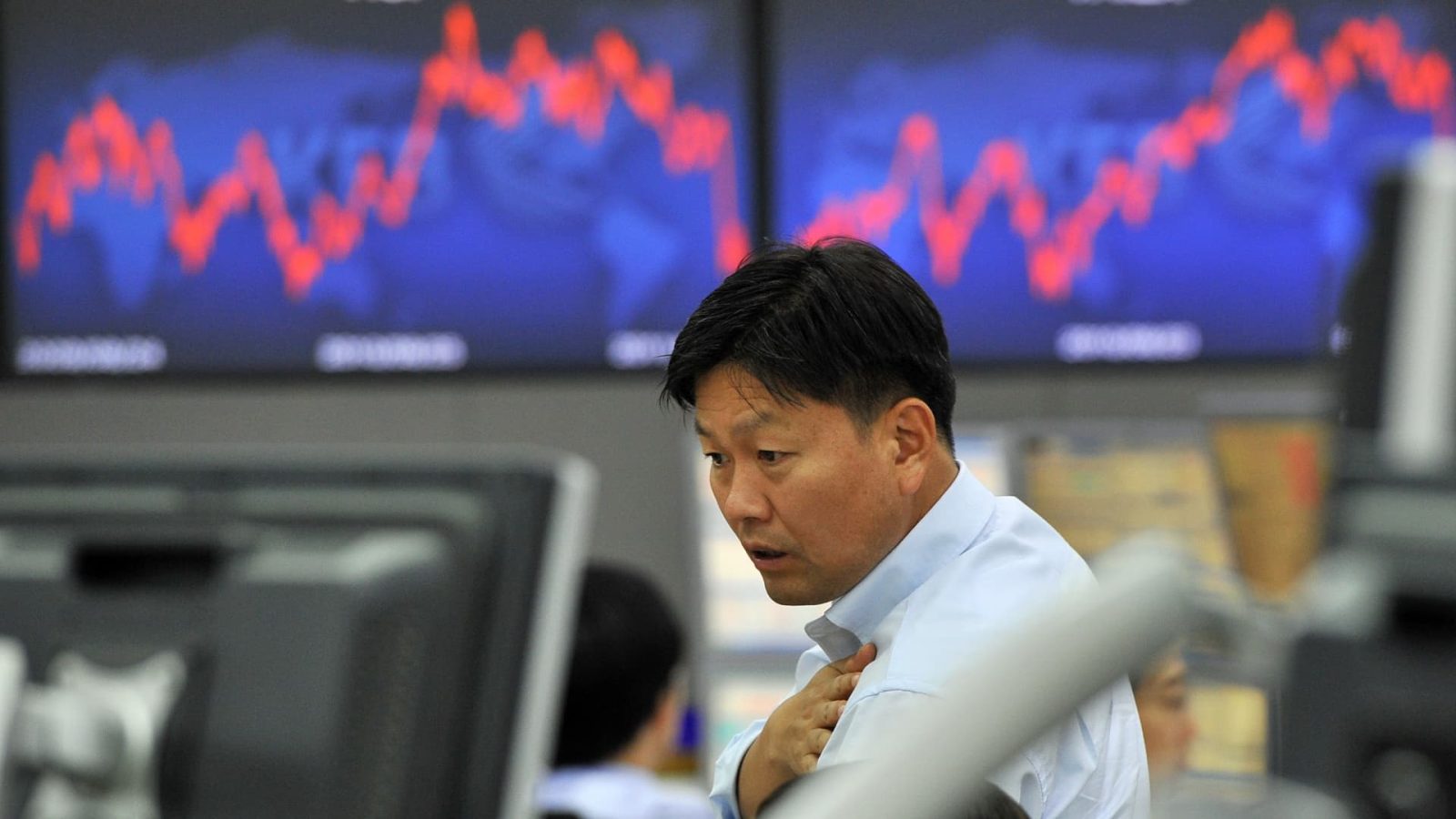
A currency trader monitors exchange rates in a dealing room at the Korea Exchange Bank in Seoul
Jung Yeon-je | Afp | Getty Images
South Korean stocks have been surging to record highs over the past year, but that hasn’t dimmed the allure of U.S. equities for its residents.
In 2025, South Korea was the third largest buyer of U.S. stocks, behind Singapore and Norway, according to CNBC calculations of U.S. Treasury data. Investment hubs like Cayman Islands and Ireland were excluded.
The country made net purchases of $73.6 billion in U.S. stocks in 2025 — nearly five times more than it did in 2024. The rush into U.S. stocks continues even as South Korea’s benchmark Kospi stock index delivered 75% returns last year, and has hit new highs this year.

South Korea’s preference for U.S. equities is also reflected in their outsized share in the country’s foreign portfolio.
A report by the Bank of Korea last week revealed that the share of U.S. investments in the country’s overall external portfolio stood at 63.4%, far outstripping the 25.3% for advanced economies and 36.8% for emerging economies.
‘Seohak ants’
A significant part of these massive outflows are owed to individual investors, according to experts. South Korea has about 15 million retail investors accounting for 60% to 70% of annual trading volume, according to investment platform GAM Investments.
Data from the Korea Securities Depository’s settlement system — widely used as a proxy for retail investor activity — shows that net purchases of U.S. equities exceeded total net overseas purchases, implying investors were selling non-U.S. assets while continuing to buy U.S. stocks.
Retail investors that buy foreign stocks are known as “seohak ants” in South Korea. Seohak translates to “Western learning,” but is now used to refer to Korean retail investors (often referred to as ants) buying foreign stocks.
Daniel Yoo, global strategist and head of global asset allocation at Yuanta Securities Korea, said that retail investors are responsible for this rush for U.S. equities. “Retail investors are much more appreciative of the attractiveness of U.S. market investment.”
Potentially higher returns, and also a positive perception of the U.S. market by the country has been driving retail investors to U.S. stocks.
The Kospi‘s outperformance with respect to the S&P 500 and Nasdaq in 2025 has done little to diminish the appeal of U.S. equities, as the S&P 500 has outperformed the local benchmark in four of the past five years.
Facing a sluggish domestic market prior to 2025, retail investors shifted their attention to the U.S. market, which provided higher returns, said Kang Min Joo, senior economist for South Korea and Japan at ING.
“For the individuals this year, compared to 2020, their investment in foreign assets more than tripled, or almost four times higher than 2020,” she added.
Yoo said U.S. companies are also seen as more shareholder-friendly and transparent, with a track record of rewarding investors through dividends and buybacks, and stronger corporate governance compared to South Korean firms.
Bringing retail investors home
Seoul has implemented measures to try and stem outflows, with the country’s finance ministry announcing tax breaks for individual investors who sell their foreign holdings.
The government announced that it will exempt taxes on capital gains from overseas stocks if the proceeds are invested in domestic stocks for one year, subject to certain conditions.
Analysts, however, remained skeptical that the government’s steps will this stem the exodus of “ant investors.”
Florian Weidinger, CEO at Santa Lucia Asset Management, told CNBC that while recent efforts in South Korea attempt to create a stronger domestic equity culture that encourages wealth creation away from the property market, locals don’t seem convinced.
The South Korean government announced measures in December last year, but in the first two months of 2026 combined the country was still the largest net buyer of U.S. stocks, at almost $10 billion, with the Cayman Islands and Ireland excluded.
Yuanta Securities Yoo said the measures might “partially” work, bearing some fruits in the short term as the performance of the Kospi stays strong, but he added that the tax breaks were not enough to keep investors away from U.S. stocks.













Leave a comment